 Visual Paradigm Desktop |
  Visual Paradigm Online
Beyond the Tables
This tool is more than a data entry form. It’s a strategic framework to help you deeply understand your customers and unlock new growth opportunities.
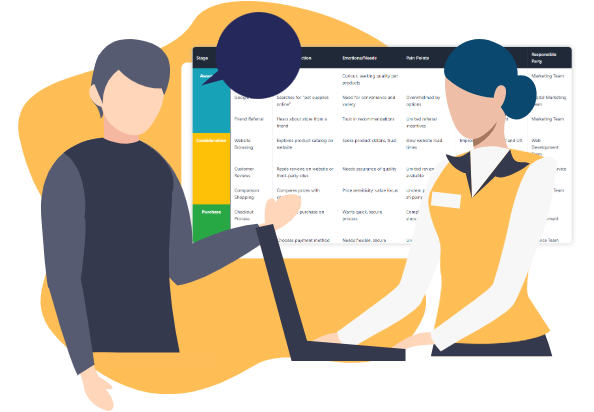
Purpose of Mapping the Customer Journey
Every customer has a story—a unique journey they take when interacting with your business. This journey is filled with a series of moments, from the first time they hear about you to their post-purchase experience. Our free app provides a structured way to capture this narrative.
By documenting each step, thought, and feeling from your customer’s perspective, you can go beyond surface-level insights and identify the critical pain points and strategic opportunities that truly matter.
From Research to a Roadmap
The app’s tables are the destination for your findings, but the real work happens in the real world. The information you’ll enter isn’t invented; it’s discovered through direct interaction with your customers and analysis of their behavior.
Where Does the Information Come From?

Direct Customer Interviews & Surveys
Engage in one-on-one conversations or use online surveys to capture their journey in their own words. This is the most powerful way to understand their emotions and motivations.
Tip: Ask open-ended questions like “Tell me about the last time you tried to solve [problem]” to encourage detailed stories.
Tip: Create a discussion guide but be prepared to deviate from it to follow the customer’s lead.

Employee & Stakeholder Workshops
Your team members from sales, support, and marketing have valuable insights into the customer journey from their perspective. Host workshops to gather their collective knowledge and challenge assumptions.

Behavioral Data & Analytics
Complement qualitative data with quantitative insights. Analyze your website traffic, support ticket logs, social media mentions, and sales funnel data to see how customers are actually behaving.
Tip: Look for patterns. If many customers drop off at a certain stage, this points to a major pain point to investigate.
Tip: Use data to validate what you’ve learned from interviews and workshops.
Breaking Down the Journey
Each column in the Free Customer Journey Map Tool prompts you to think about a critical aspect of the customer experience. Filling them out transforms a simple table into a powerful diagnostic tool. Here’s how each piece connects to your real-world strategy:

Touchpoint
“Where does this interaction happen?”
Example:
‘Social Media Ad’ or ‘Website Product Page’.
Strategic Purpose:
Identifying all touchpoints reveals the full scope of the customer experience. It helps you see where you’re currently engaging with customers and where you might be missing opportunities. It’s the foundational ‘map’ of your journey.

Customer Action
“What is the customer actively doing?”
Example:
‘Sees pet-related ads on Instagram’ or ‘Compares product prices’.
Strategic Purpose:
This focuses on customer behavior, not your business process. Understanding their actions helps you design user flows that are intuitive and efficient, reducing friction and making it easier for them to achieve their goals.

Emotions/Needs
“What are they thinking or feeling?”
Example:
‘Curious, seeking quality products’ or ‘Anxious, wants a simple process’.
Strategic Purpose:
This is the emotional core of the journey. Tapping into customer emotions allows you to build empathy and create experiences that resonate on a deeper level. Addressing their needs directly leads to higher satisfaction and loyalty.

Pain Points
“What’s making this step difficult or annoying?”
Example:
‘Ads may feel generic’ or ‘Confusing checkout process’.
Strategic Purpose:
Pain points are immediate opportunities for improvement. Fixing them directly enhances the customer experience, reduces churn, and can lead to quick wins in customer satisfaction and conversion rates. They are the problems you need to solve now.

Opportunities
“How can we make this step better or more delightful?”
Example:
‘Create targeted, pet-specific ads’ or ‘Simplify checkout flow’.
Strategic Purpose:
Opportunities are about proactive innovation. They go beyond fixing problems to creating moments of delight that differentiate your brand from competitors. This is where you build a long-term competitive advantage.

Responsible Party
“Who actually owns this part of the experience?”
Example:
‘Marketing Team’ or ‘Web Development Team’.
Strategic Purpose:
This creates accountability and turns the journey map from a document into an actionable plan. By assigning ownership, you ensure that identified issues and ideas are addressed, driving real change within the organization.
When you complete all the steps in the app, you will generate a comprehensive, visually compelling report. This isn’t just a summary; it’s a strategic asset that will help your team make smarter decisions.
The final report provides a clear, shared understanding of your customers’ experiences. It gives your team a roadmap to focus on what matters most: improving the customer experience, reducing friction, and ultimately, driving business growth.
No, you don’t. The app is a flexible framework. You can use the tables that are most relevant to your specific project goals. However, the more detail you include, the more comprehensive and valuable your final report will be.
That’s perfectly normal. We recommend starting with the information you have and identifying the gaps. The journey map itself becomes a tool for discovering what you don’t know, guiding your next research steps.
A Pain Point is a current problem, frustration, or friction your customer experiences (e.g., ‘Website loads too slowly’). An Opportunity is a proactive idea for improvement or innovation (e.g., ‘Create a loyalty program to reward repeat customers’). Fixing a pain point is an opportunity, but not all opportunities come from pain points.
A journey map is a living document, not a one-time project. We recommend reviewing and updating it at least annually, or whenever you launch a major new product, feature, or marketing campaign. Keeping it current ensures it remains a valuable strategic tool.
