 Visual Paradigm Desktop |
  Visual Paradigm Online
The Scenario Analysis Tool is not just a digital spreadsheet; it is a structured framework to help you and your team proactively prepare for an uncertain future. Think of it as a guide for strategic foresight. Instead of reacting to change, this tool helps you anticipate and plan for various plausible futures, making your organization more resilient and adaptive.
The true power of this tool lies in its connection to the real world. The data you enter does not come from a vacuum—it comes from the invaluable insights of your team, stakeholders, and external research.

Collaborative Workshops
Use team workshops with diverse perspectives to brainstorm, define goals, and identify variables. The app becomes the canvas for your collective findings.

Stakeholder Interviews
Conduct one-on-one interviews with leaders, experts, and customers to gather detailed or sensitive information for impact analysis and action plans.

External Research & Data
Ground your qualitative insights in quantitative data from industry reports, government statistics, and academic journals to move from assumption to informed analysis.

Strategic Clarity: A clear understanding of your industry’s dynamics, helping you identify opportunities and anticipate threats.
Informed Decision-Making: The final report provides a data-driven foundation for developing a sustainable competitive strategy.
A Shareable Deliverable: The report can be easily shared with your team, stakeholders, and management to align everyone on your company’s strategic direction.
Using this app is more than just filling out a template; it’s an investment in your company’s future. The structured process forces you to look beyond daily operations and think critically about your competitive landscape.
This leads to several key benefits:

Competitive Advantage
By systematically analyzing the five forces, you can identify and exploit market weaknesses, giving you an edge over rivals.

Confident Decision-Making
When your strategy is based on data and thorough analysis, you can make decisions with greater confidence, reducing risk and uncertainty.

Team Alignment
The final report serves as a single source of truth, aligning everyone on the same strategic goals and providing a common language for discussion.

Resource Optimization
Understanding the most significant forces allows you to allocate resources more effectively, focusing on areas that deliver the greatest return.
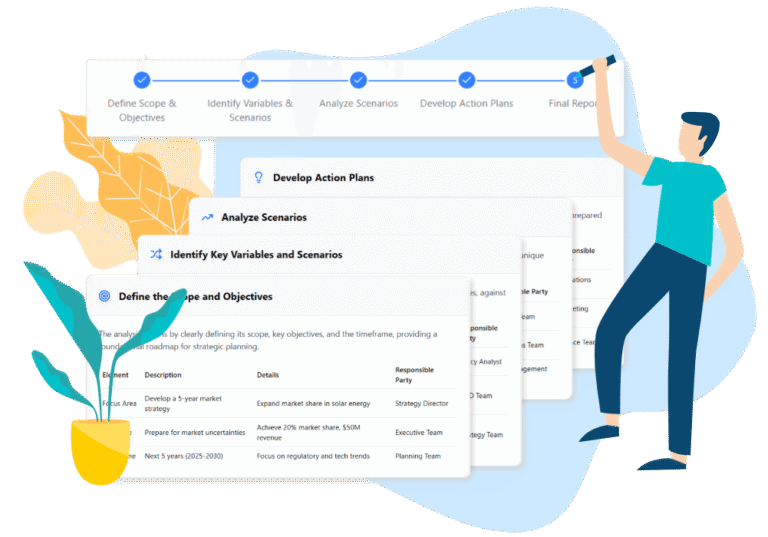
This app guides you through a four-step process. Each step builds on the last, transforming initial ideas into a comprehensive, actionable strategic plan.

STEP 1
Define Your Focus and Goals
Use team workshops with diverse perspectives to brainstorm, define goals, and identify variables. The app becomes the canvas for your collective findings.
Your Role:
Conduct foundational research and hold a kick-off meeting with key stakeholders to collaboratively agree upon your Focus Area, Objectives, and Timeframe.
Your Input:
Document the outcomes of these discussions in the tool. You will enter the Focus Area, Objective, Timeframe, and assign a Responsible Party for each element.

STEP 2
Identify Variables and Scenarios
Move from defining goals to exploring the external forces that could impact them. Create plausible stories about the future based on how those factors might play out.
Your Role:
Run brainstorming workshops or expert interviews to identify critical external variables (e.g., tech shifts, regulations). Develop 2-3 distinct scenarios (e.g., ‘Best Case,’ ‘Base Case,’ ‘Worst Case’).
Your Input:
Document your identified variables and the different scenarios you’ve developed. This turns abstract ideas into a clear framework for the next step.

STEP 3
Analyze the Impact
Move from defining goals to exploring the external forces that could impact them. Create plausible stories about the future based on how those factors might play out.
Your Role:
Run brainstorming workshops or expert interviews to identify critical external variables (e.g., tech shifts, regulations). Develop 2-3 distinct scenarios (e.g., ‘Best Case,’ ‘Base Case,’ ‘Worst Case’).
Your Input:
Document your identified variables and the different scenarios you’ve developed. This turns abstract ideas into a clear framework for the next step.

STEP 4
Develop Action Plans
Turn analysis into concrete action. For each scenario you have explored, you will create a dedicated plan of attack, ensuring your team is ready to respond.
Your Role:
Hold a strategic planning meeting with leadership. Using the analysis from Step 3, develop a ‘what-if’ plan for each scenario (e.g., ‘Aggressive Expansion Plan’ for Best Case).
Your Input:
Detail the Action Plan, Implementation Details (e.g., ‘Invest $10M in new plants’), and Expected Impact for each scenario in the app.
Communicate Clearly
Present your thinking to investors, board members and your team, demonstrating a clear-eyed view of the future.
Make Better Decisions
Justify investment decisions, resource allocation, and project prioritization with a robust analysis of potential outcomes.
Stay Agile
Use the report as a living document to quickly adapt your strategy as new information emerges and the future unfolds.
This tool is a strategic framework designed to help you and your team proactively prepare for an uncertain future. Instead of simply collecting data, it guides you through a structured, collaborative process of foresight and planning.
While it uses tables for data entry, the tool’s true value lies in its embedded methodology. It organizes your thinking and guides you through a proven four-step process—from defining goals to creating actionable plans. A spreadsheet is a blank canvas; this tool provides the structure and a purpose-driven path for strategic analysis.
Upon completion, the app generates a professional, polished Final Scenario Analysis Report. This report is a comprehensive document that summarizes your entire strategic journey, including your analysis, findings, and prepared action plans for each scenario.
The tool is designed to serve as a central hub for your team’s insights. The methodology encourages collaborative activities like workshops and meetings to gather inputs for each step. The final report can be easily shared to ensure alignment and shared understanding across your organization.
