 Visual Paradigm Desktop |
  Visual Paradigm Online
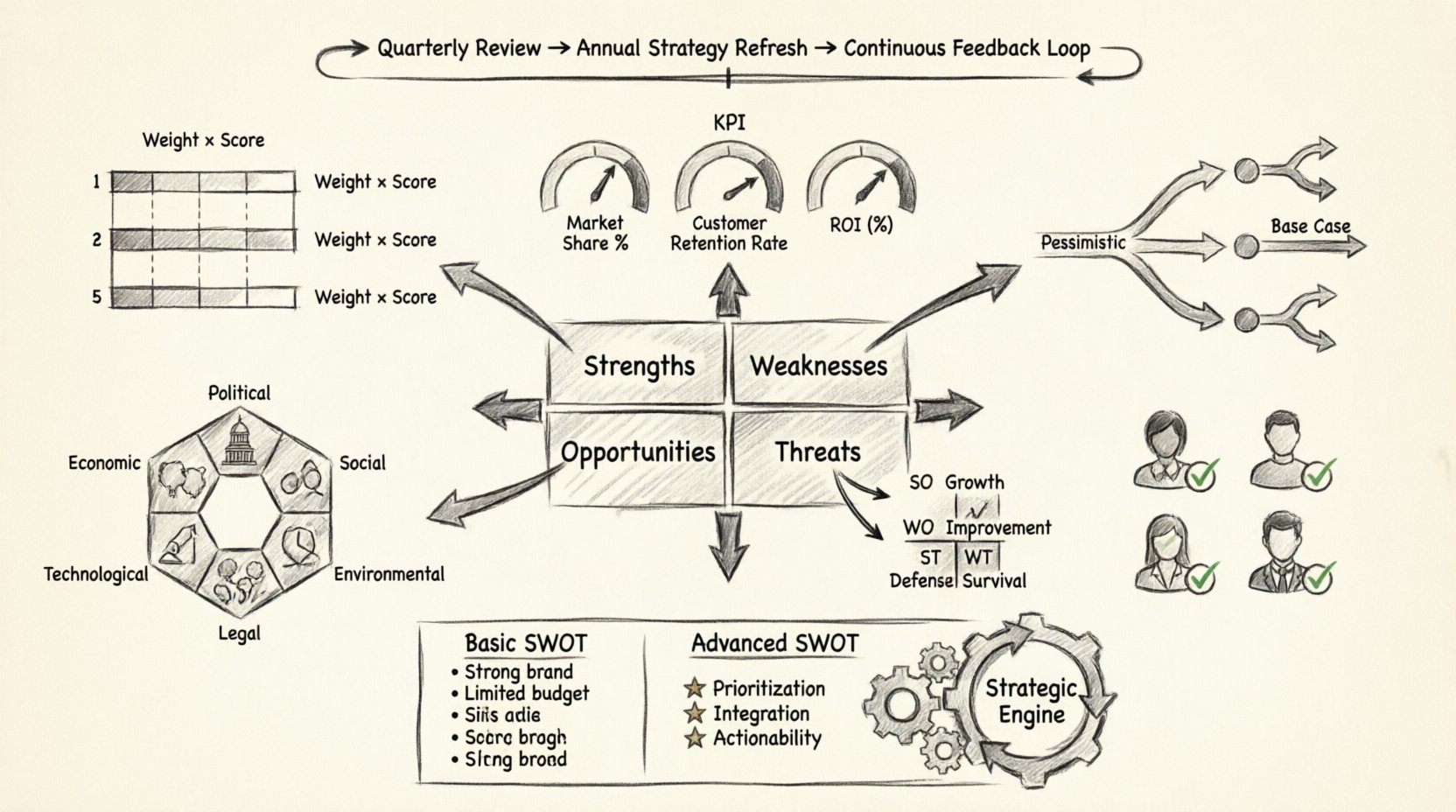
Strategic planning often begins with a simple grid. The SWOT Analysis—Strengths, Weaknesses, Opportunities, and Threats—is a staple in business education and boardrooms worldwide. However, a standard four-quadrant list often fails to capture the nuance of complex market environments. When leaders rely solely on basic categorization, they risk creating static documents that gather dust rather than driving action.
To truly leverage this framework, you must move past the checklist mentality. This guide explores advanced methodologies that transform a simple audit into a dynamic strategic engine. By integrating quantitative scoring, matrix manipulation, and environmental scanning, you can derive actionable intelligence that withstands market volatility.
Before diving into advanced techniques, it is vital to understand the limitations of the traditional approach. Most organizations treat SWOT as a brainstorming session that results in a flat list of items. This linear thinking misses the critical relationships between internal capabilities and external pressures.
Advanced techniques address these gaps by forcing connections between quadrants and introducing objective metrics.
The TOWS Matrix is the most direct evolution of the SWOT framework. While SWOT focuses on identification, TOWS focuses on strategy generation. It requires you to cross-reference internal factors (Strengths and Weaknesses) with external factors (Opportunities and Threats) to create specific strategic options.
This approach eliminates the passivity of standard SWOT by demanding a “So What?” answer for every item identified.
These strategies use internal strengths to maximize external opportunities. They represent the ideal growth path.
These strategies overcome internal weaknesses by taking advantage of external opportunities. They often require investment or partnership.
These strategies use internal strengths to avoid or reduce the impact of external threats. They are defensive but proactive.
These strategies minimize internal weaknesses and avoid external threats. They are often survival tactics or restructuring measures.
| Quadrant | Focus | Strategic Goal |
|---|---|---|
| SO | Strengths + Opportunities | Growth & Expansion |
| WO | Weaknesses + Opportunities | Improvement & Adaptation |
| ST | Strengths + Threats | Defense & Risk Mitigation |
| WT | Weaknesses + Threats | Survival & Stabilization |
Qualitative lists are prone to bias. A strategic leader knows that not all strengths are created equal. Some capabilities are core to survival, while others are merely nice-to-haves. Quantitative scoring adds a layer of rigor to the analysis.
Assign a weight and a score to each item within the SWOT quadrants. This process forces stakeholders to debate the importance of each factor.
For Strengths and Opportunities, a high weighted score indicates a priority asset to leverage. For Weaknesses and Threats, a high weighted score indicates a critical risk area that requires immediate resource allocation.
Once calculated, sort the items. The top 20% of weighted factors should drive 80% of the strategic planning. This Pareto principle application ensures that resources are not diluted across too many initiatives.
A SWOT analysis often fails because it ignores the macro-environment. Strengths and Weaknesses are internal, but Opportunities and Threats are heavily influenced by macro factors. The PESTLE framework (Political, Economic, Social, Technological, Legal, Environmental) provides the necessary context for the O and T quadrants.
Do not run PESTLE and SWOT as separate exercises. Merge them.
By explicitly linking PESTLE factors to the O and T quadrants, you ensure that external analysis is not generic. It becomes specific to the regulatory and societal landscape your organization navigates.
A static SWOT assumes a linear future. Reality is non-linear. Advanced analysis involves testing your SWOT findings against multiple future scenarios. This process is known as Scenario Planning.
Run your SWOT analysis through three distinct lenses:
This exercise reveals the resilience of your strategy. If a specific Strength is only valuable in the Optimistic Scenario, it is a fragile asset. If a Weakness causes failure even in the Base Case, it is a critical vulnerability.
Identify the key variables that cause the biggest swings in your strategy. For example, if your “Opportunity” relies on raw material costs staying low, how does a 10% increase in cost affect your SWOT position? This helps in identifying the “break-even” points for strategic initiatives.
Internal bias is the enemy of accurate analysis. Employees in sales see different strengths than those in engineering. Customers see different threats than executives. To deepen insights, you must validate SWOT findings with diverse stakeholder groups.
Conduct separate SWOT sessions for different departments, then synthesize the results.
When you merge these perspectives, you often find contradictions. The sales team might claim a product is a Strength, while engineering knows it is technically unstable. Resolving these contradictions through data is where the true strategic insight lies.
External validation is crucial. Send surveys or conduct focus groups to ask customers if they perceive your listed Strengths as value drivers. If customers do not care about a “Strength,” it is not a strategic asset, regardless of what internal data says.
The most advanced technique is the recognition that SWOT is not a one-time event. It is a living system. Markets change, competitors adapt, and internal capabilities evolve. A static document is a liability.
Attach KPIs to every item in your SWOT. If an item does not have a metric to track it, it is not actionable.
Establish a formal review cycle. A quarterly review is standard for dynamic industries. Annual reviews are sufficient for stable sectors. During these reviews, update the scores and weights. Old items that no longer apply should be removed to keep the document relevant.
To summarize the shift in approach, consider the following comparison of methodologies.
| Feature | Basic SWOT | Advanced SWOT |
|---|---|---|
| Output | List of items | Strategic Actions & Priorities |
| Data Source | Brainstorming & Opinion | Data, Metrics & Validation |
| Connections | None (Quadrants are separate) | TOWS Matrix Connections |
| Priority | Equal importance | Weighted Scoring System |
| Timeframe | Static (One-time) | Dynamic (Continuous Monitoring) |
| Context | Internal focus | Integrated with PESTLE |
Putting these advanced techniques into practice requires discipline. Follow this structured process to ensure depth and accuracy.
Moving beyond the basic SWOT grid requires effort, but the return on investment is significant. By treating strategic analysis as a rigorous, data-driven process rather than a clerical exercise, organizations gain clarity on where to compete and how to win. The goal is not just to list factors, but to understand the dynamics that drive success and failure.
When you integrate TOWS, weighting, PESTLE, and continuous monitoring, the SWOT Analysis transforms from a static snapshot into a dynamic navigation system. It becomes a tool that guides decision-making in real-time, ensuring that resources are directed toward the highest value opportunities while mitigating the most critical risks.
Start applying these advanced techniques to your next planning cycle. The depth of insight you uncover will fundamentally change the quality of your strategic conversations.
