 Visual Paradigm Desktop |
  Visual Paradigm Online
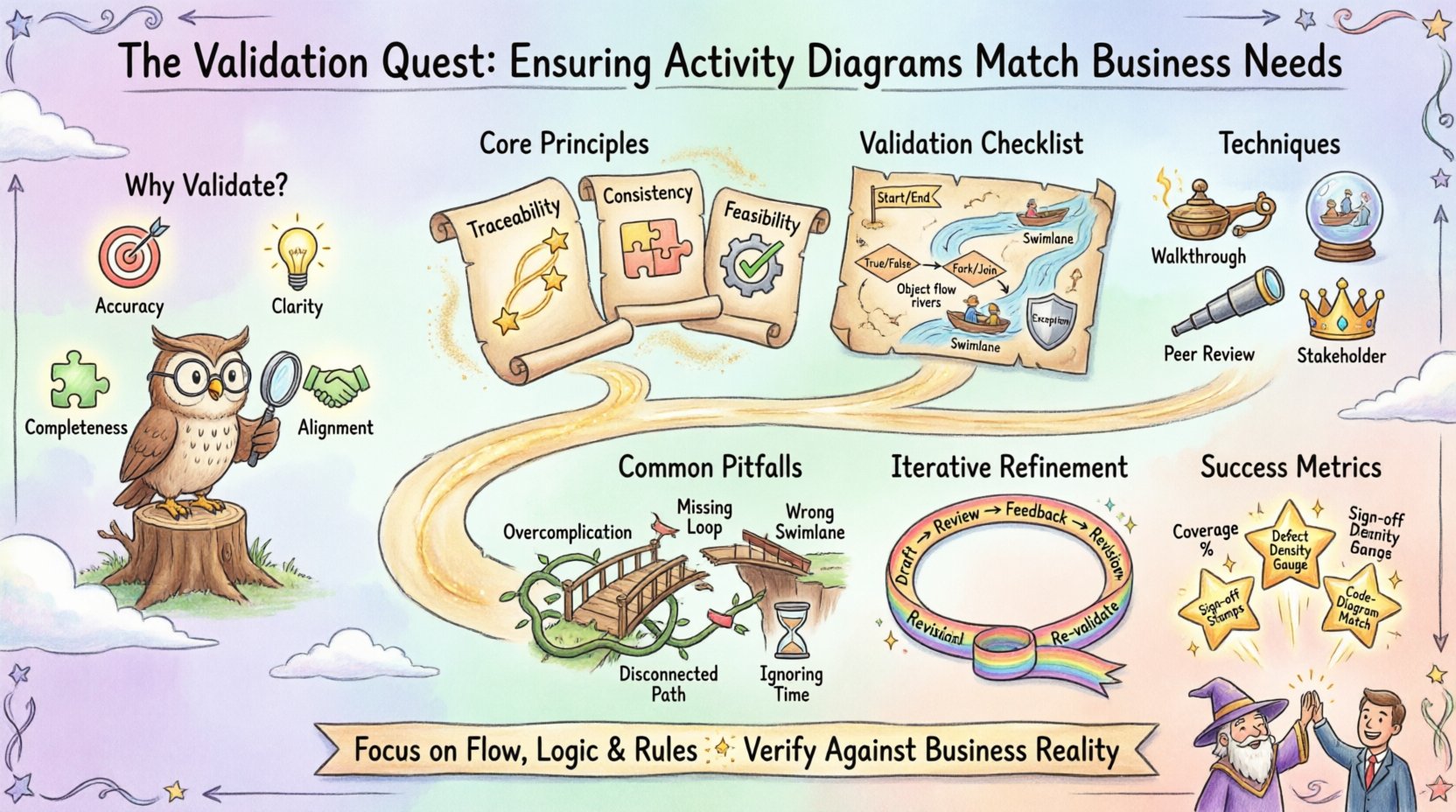
Building accurate process models is a critical component of systems analysis and design. An activity diagram serves as a visual representation of workflows, showing how tasks flow from one action to another. However, a diagram that looks correct structurally does not always reflect reality. Validation ensures that what is drawn matches what happens in the real world. This guide explores the steps, methods, and criteria necessary to verify that your activity diagrams align with actual business requirements.
When teams create models without rigorous checking, discrepancies often emerge later in development or implementation. These gaps can lead to costly rework, misunderstood requirements, and systems that fail to support user needs. Validation acts as a checkpoint. It bridges the gap between abstract modeling and concrete operations.
Effective validation provides several benefits:
Validation is not a single event; it is a continuous process throughout the modeling lifecycle. You must approach it with a mindset focused on truth and verification. The following principles guide this process:
Every activity, decision node, and flow in the diagram should correspond to a specific business requirement. If a step exists in the model but has no origin in the requirements document, it is likely unnecessary. Conversely, if a requirement exists without a corresponding path in the diagram, the model is incomplete.
An activity diagram does not exist in isolation. It must align with state diagrams, sequence diagrams, and use case models. Inconsistencies between these artifacts indicate a breakdown in the design understanding. Validation requires cross-referencing these documents to ensure a unified view of the system.
A model might be logically sound but technically impossible. Validation involves asking if the steps can actually be performed. Are the inputs available? Are the resources sufficient? Can the system handle the load implied by the flow?
To systematically verify your diagrams, use a structured checklist. The table below outlines key areas to examine during the validation phase.
| Area | Question to Ask | Indication of Issue |
|---|---|---|
| Start and End Points | Is there exactly one start node and one end node? | Multiple starts or dead ends suggest logic errors. |
| Decision Nodes | Are all possible outcomes labeled and covered? | Unlabeled branches or missing “else” paths create ambiguity. |
| Parallel Flows | Do fork and join nodes match correctly? | Mismatched forks and joins can cause synchronization issues. |
| Object Flows | Do objects enter and exit actions logically? | Objects appearing without input or disappearing without output break data integrity. |
| Exception Handling | Are error paths defined? | Missing error handling indicates a fragile process design. |
| Human vs System | Are swimlanes correctly assigned? | Confusing which actor performs which task leads to implementation errors. |
There are multiple methods to validate activity diagrams. Relying on a single technique often leads to oversight. Combining several approaches yields the highest confidence in the model.
Organize a meeting where the model is presented step-by-step. This is not a presentation; it is an interrogation of the logic. Walk through a specific transaction from start to finish. Ask participants to trace the flow physically on the screen or printout. This reveals gaps in logic that are invisible when viewing the diagram statically.
Apply specific business scenarios to the diagram. For example, “What happens if the user cancels during step 3?” or “What if the database is down?” Map these scenarios against the diagram. If the diagram cannot handle the scenario, the model needs revision.
Have a colleague who was not involved in the creation of the diagram review it. Fresh eyes often spot inconsistencies or assumptions that the creator missed. This external validation reduces bias.
Engage the business owners who defined the requirements. They are the authority on what the process should look like. Their sign-off confirms that the diagram represents their understanding of the business.
Even experienced modelers make mistakes. Recognizing common errors helps prevent them during the validation phase.
Business rules dictate constraints and policies that govern the process. An activity diagram must enforce these rules. Validation involves checking the model against the rule set.
Consider the following rule types:
During validation, verify that the diagram enforces these rules. For instance, if a rule states “Orders over $500 require manager approval,” the diagram must show a decision node checking the amount and a branch leading to the manager action. If this branch is missing, the model fails validation.
Validation is rarely a one-time event. As understanding deepens, the model evolves. Iterative refinement ensures the diagram remains accurate.
The cycle typically follows these steps:
Repeat this cycle until the diagram stabilizes. Stability does not mean it will never change; it means the current version accurately reflects the agreed-upon process.
How do you know validation was successful? Use specific metrics to measure the quality of the model.
Tracking these metrics helps identify weak spots in the modeling process. If defect density remains high, the validation team may need more training or better tools.
Business processes change. Regulations shift. New features are added. A validated diagram today might be outdated tomorrow. Version control is essential for maintaining integrity.
Best practices include:
This ensures that when a change is requested, you can compare the new version against the baseline to understand the impact.
Validation should not happen in a vacuum. It must integrate with the development lifecycle. When developers start coding, they refer to the diagram. If the diagram is not validated, they may build the wrong thing.
Ensure that:
This integration ensures that the model remains a living document that guides the system construction.
Ensuring that activity diagrams match actual business needs is a disciplined effort. It requires attention to detail, clear communication, and a willingness to challenge assumptions. By following a structured validation process, teams can reduce errors and build systems that truly serve their purpose.
Remember that the goal is not perfection in the first draft. The goal is a reliable foundation that can be refined as understanding grows. Through consistent validation, models become trusted assets rather than just pictures on a page.
Focus on the flow, the logic, and the rules. Verify them against the reality of the business. This approach leads to robust systems and satisfied stakeholders.
