 Visual Paradigm Desktop |
  Visual Paradigm Online
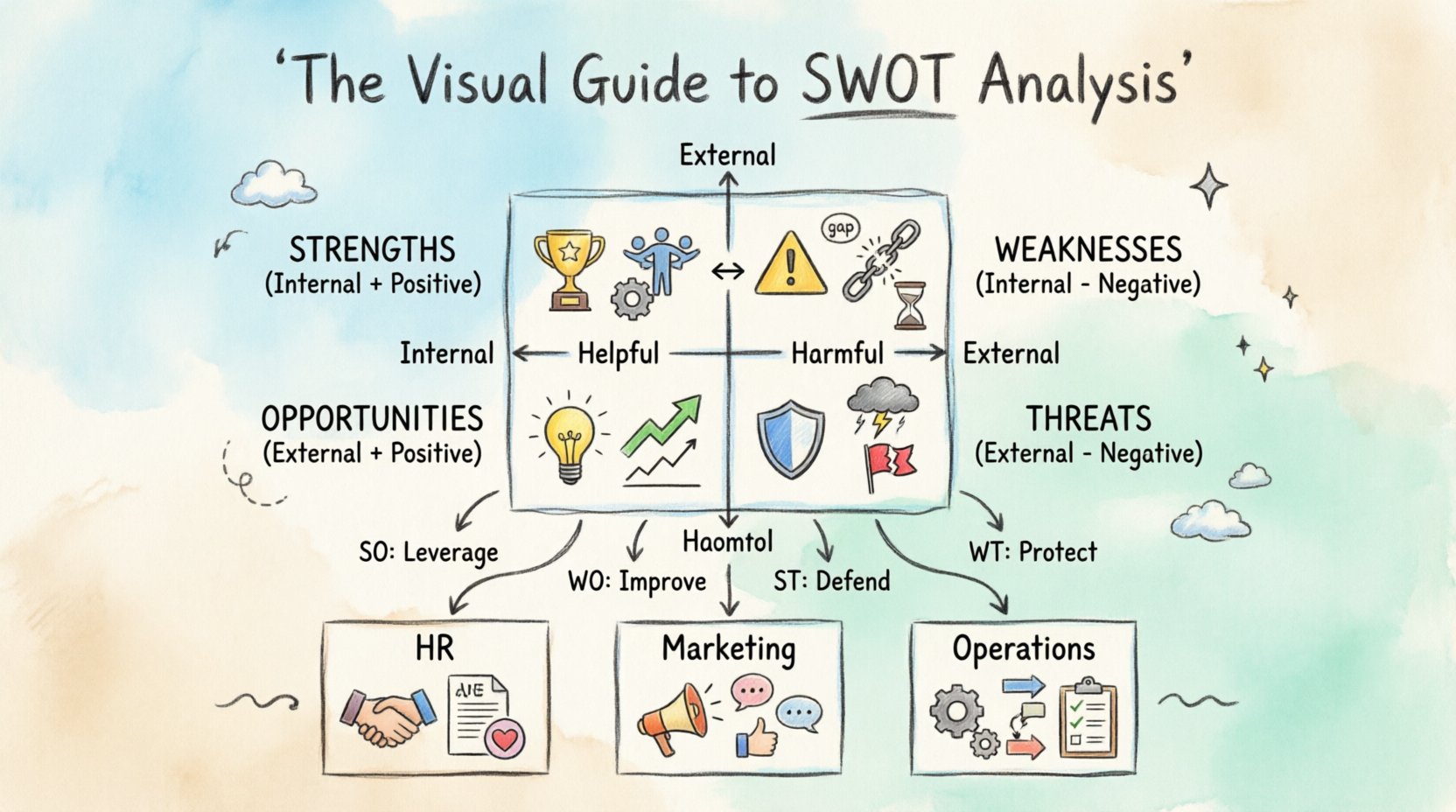
Business planning often feels like a reserved domain for C-suite executives or specialized strategy teams. However, every manager plays a critical role in shaping the direction of their organization. Understanding how to evaluate your position, resources, and environment is not just for the top tier; it is a fundamental skill for anyone leading a team. This guide breaks down the SWOT Analysis into a practical, visual framework designed for non-strategy managers.
Strategic thinking does not require a degree in business administration. It requires a clear view of reality. By mapping out your internal capabilities and external pressures, you can make decisions that align with broader organizational goals without getting lost in jargon. This resource provides a structured approach to identifying Strengths, Weaknesses, Opportunities, and Threats, ensuring your team moves forward with clarity and purpose.
A SWOT Analysis is a strategic planning technique used to evaluate the internal and external factors affecting an organization, project, or business unit. The acronym stands for Strengths, Weaknesses, Opportunities, and Threats. While it sounds simple, the power lies in the specificity of the data gathered and the honest assessment of the current state.
For managers who do not specialize in strategy, this tool serves as a diagnostic instrument. It helps answer critical questions:
Visualizing these elements in a four-quadrant matrix allows for immediate comparison. It transforms abstract concerns into concrete data points that can be discussed, debated, and acted upon. This method is versatile and applies to marketing campaigns, operational improvements, product launches, or departmental restructuring.
To conduct an effective analysis, you must distinguish between factors that are within your control and those that are not. Internal factors belong to the organization itself. External factors exist in the market environment regardless of your actions.
Strengths represent the advantages your team or organization holds over competitors. These are assets you possess. When listing strengths, focus on tangible and intangible resources.
When identifying strengths, avoid vague statements like “we are good.” Be specific. Instead of “good sales team,” use “sales team with 20% higher conversion rate than industry average.” Specificity creates accountability.
Weaknesses are internal limitations that place you at a disadvantage relative to others. Acknowledging these requires honesty. It is easy to gloss over gaps in performance, but doing so hinders improvement.
Identifying weaknesses is not about assigning blame. It is about recognizing areas where investment or training is needed to close the gap.
Opportunities are favorable conditions in the external environment that you can exploit. These are trends or events that could lead to growth if you act correctly.
Opportunities often require action. If you do not seize them, they disappear. This section of the analysis should prompt questions about innovation and expansion.
Threats are external elements that could cause trouble for your business. These are risks you cannot control but must mitigate.
Understanding threats allows you to build contingency plans. It shifts your mindset from reactive to proactive.
Organizing these four categories into a grid provides a clear snapshot of the situation. Below is the standard layout used to visualize the analysis.
| Internal Factors | Helpful (Positive) | Harmful (Negative) |
|---|---|---|
| Controllable | Strengths Assets, Skills, Resources |
Weaknesses Gaps, Limitations, Issues |
| Uncontrollable | Opportunities Trends, Gaps, Shifts |
Threats Risks, Challenges, Obstacles |
This table structure helps you categorize information quickly. When holding a workshop, draw this grid on a whiteboard or create a digital equivalent. Assign team members to fill in specific quadrants based on their expertise.
Executing a SWOT Analysis is a process that requires preparation, collaboration, and follow-through. Follow these steps to ensure the output is actionable.
Before gathering data, clarify what you are analyzing. Is it the entire organization? A specific product line? A marketing campaign? A new department? A clear scope prevents the analysis from becoming too broad and unmanageable.
Do not rely on assumptions. Collect evidence to support your points.
Strategy is not a solo activity. Bring together people from different levels of the organization. Frontline employees often see weaknesses and opportunities that leadership misses.
You will likely generate a long list of items. It is impossible to address everything at once. Use a voting system or impact/effort matrix to rank the items.
Analysis without action is merely observation. For every major Strength and Opportunity, define a strategy to leverage it. For every Weakness and Threat, define a mitigation plan.
The real value of a SWOT Analysis emerges when you connect the dots between the quadrants. This is where strategy mapping happens. You are looking for synergies between what you have and what the market needs.
These strategies use internal Strengths to maximize external Opportunities. This is the ideal growth zone.
These strategies overcome internal Weaknesses by taking advantage of external Opportunities. This is the turnaround zone.
These strategies use Strengths to minimize or avoid external Threats. This is the defensive zone.
These strategies aim to minimize internal Weaknesses and avoid external Threats. This is the survival zone.
To make these concepts concrete, let us look at how different departments might apply this framework.
A HR manager wants to improve employee retention.
Action: Leverage the culture (Strength) to recruit remote specialists (Opportunity) while introducing performance-based bonuses to offset salary gaps (Weakness).
A marketing lead is planning a product launch.
Action: Utilize the email list (Strength) to drive early buzz before the competitor launch (Threat) and create organic content to ride the viral trend (Opportunity) without spending on ads (Weakness).
An operations manager reviews supply chain logistics.
Action: Adopt the AI software (Opportunity) to reduce manual errors (Weakness) and optimize routes to mitigate shipping costs (Threat), utilizing the in-house warehouse (Strength) for faster fulfillment.
Even with a solid framework, teams can stumble. Being aware of these common errors ensures your analysis remains accurate.
Items like “poor communication” or “good service” are too subjective. Replace them with metrics. “Communication delays average 3 days” or “Customer satisfaction score is 4.2/5.”
A common mistake is listing “competitors are cheaper” under Strengths. This is external; it belongs in Threats or Opportunities. Ensure you know what you control.
Spending weeks gathering data without making decisions. The goal is to inform action, not to create a perfect report. Set a deadline for the workshop.
Completing the matrix and filing it away. Every item identified must have an owner and a deadline. If there is no follow-up, the exercise was a waste of time.
Only looking for data that supports what you already believe. Encourage dissenting opinions during the workshop. If everyone agrees on everything, you are not looking deep enough.
How do you know if your strategy mapping worked? You need to track the initiatives derived from the SWOT Analysis.
Strategy is a living document. It requires maintenance. By treating the SWOT Analysis as a foundational tool rather than a one-time event, you build a culture of continuous improvement.
Strategic planning does not have to be intimidating. With a structured approach, any manager can gain clarity on their position and path forward. The SWOT Analysis offers a straightforward method to sort through complexity and focus on what truly matters.
By distinguishing between what you control and what you do not, you reduce uncertainty. By connecting internal assets to external conditions, you create opportunities for growth. By acknowledging risks, you protect your team.
Start small. Apply this framework to a single project or department. Observe the difference in decision-making speed and confidence. Over time, this visual guide will become second nature, embedding strategic thinking into the daily workflow of your organization.
Remember, the best strategy is the one you execute. Use this tool to build that foundation.
