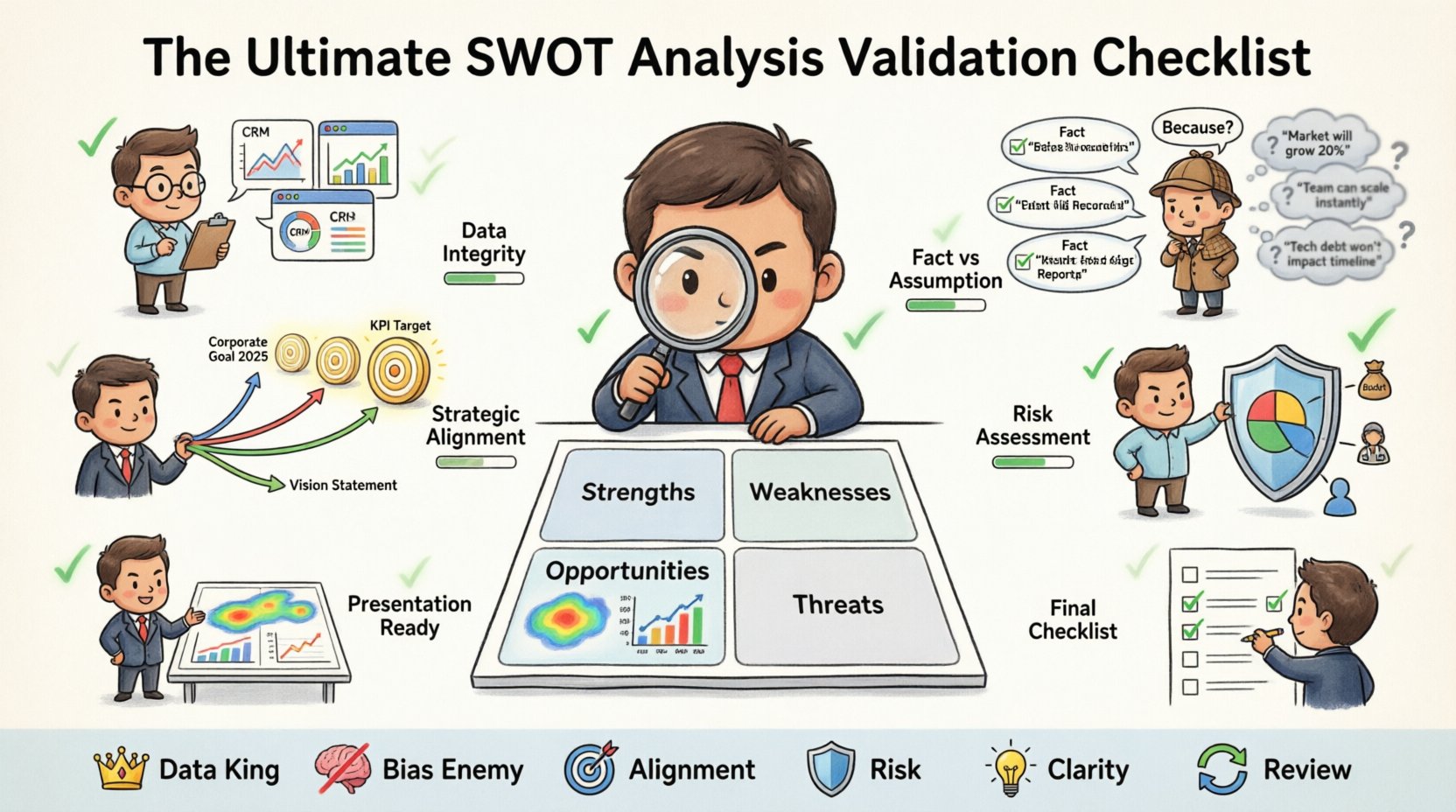
Strategic planning is the backbone of organizational growth. However, the quality of a strategy depends entirely on the quality of the analysis that informs it. A SWOT analysis (Strengths, Weaknesses, Opportunities, Threats) is a common tool used to assess these factors. Yet, many teams rush through this process, leading to superficial insights that fail to persuade executives. Before you walk into a boardroom, you must ensure your data is robust, your logic is sound, and your recommendations are actionable.
This guide outlines a rigorous validation process. It moves beyond basic definitions to focus on the nuances of business intelligence. We will examine data integrity, alignment with corporate goals, and the psychological readiness of the audience. Follow this structure to build confidence in your strategic recommendations.
📊 Phase 1: Data Integrity and Sourcing
Leadership does not trust gut feelings; they trust evidence. The foundation of a valid SWOT analysis is the source of your data. If the information is anecdotal, outdated, or biased, the entire exercise collapses.
1.1 Verifying Internal Data Sources
Strengths and Weaknesses are internal factors. You must verify that your assessment of the organization’s capabilities matches reality.
- Financial Records: Are your revenue and cost figures current? Cross-reference with the latest quarterly reports. Do not rely on last year’s budget for a current market assessment.
- Operational Metrics: Look at throughput, error rates, and employee retention. These hard numbers define operational strengths and weaknesses better than qualitative opinions.
- Employee Feedback: If you are citing morale as a strength or weakness, you need survey data or structured interview summaries. Avoid generalizations like “the team is tired” without specific evidence.
1.2 Assessing External Market Conditions
Opportunities and Threats exist outside the organization. These require broader market research.
- Competitor Analysis: Have you reviewed the latest filings of key competitors? Are you aware of their new product launches or pricing shifts?
- Regulatory Changes: Is there new legislation affecting your industry? This is a critical threat or opportunity that often gets missed.
- Customer Trends: Use sales data and customer feedback loops. What are clients asking for now versus six months ago?
1.3 The Source Audit Table
Use a table to track where your insights come from. This transparency builds credibility immediately.
| SWOT Category |
Specific Insight |
Data Source |
Date Verified |
Confidence Level |
| Strength |
High customer retention rate |
CRM Analytics Dashboard |
2023-10-15 |
High |
| Weakness |
Slow deployment cycle |
Project Management Logs |
2023-09-20 |
Medium |
| Opportunity |
Expansion into emerging market |
Market Research Report |
2023-11-01 |
High |
| Threat |
New competitor pricing model |
Industry News & Competitor Website |
2023-11-05 |
Medium |
🧠 Phase 2: Distinguishing Fact from Assumption
A common pitfall in SWOT analysis is confusing a symptom with a root cause. You must challenge every statement you write.
2.1 The “Because” Test
For every point listed, ask yourself: “Why is this true?” If you cannot answer with a fact, it is an assumption.
- Assumption: “Our brand is weak.”
- Fact: “Our brand sentiment score dropped by 15% in the last quarter due to recent customer service issues.”
- Assumption: “We have a strong sales team.”
- Fact: “The sales team exceeded quota by 12% for three consecutive quarters.”
2.2 Avoiding Internal Bias
Teams often overestimate their strengths and underestimate their weaknesses due to optimism bias. Conversely, they might fear new opportunities due to risk aversion.
- External Review: Have a colleague from a different department review the draft. Fresh eyes spot blind spots.
- Customer Perspective: Does the customer agree with your assessment? If you think you are fast, but customers complain about delays, the customer view wins.
- Historical Context: Look at past predictions. Did the team overestimate capabilities before? Adjust your confidence accordingly.
🎯 Phase 3: Strategic Alignment
A SWOT analysis is not an end in itself. It is a tool to drive strategy. Every point must connect to the organization’s broader mission.
3.1 Connecting to Corporate Goals
Leadership cares about the bottom line and long-term vision. Your analysis must show how the SWOT factors impact these priorities.
- Revenue Impact: How does this strength help us sell more? How does this threat reduce our income?
- Efficiency Impact: Does this weakness slow down production? Does this opportunity save costs?
- Growth Impact: Are we capturing new markets or losing share?
3.2 Prioritization Framework
Not all factors are equal. You cannot present ten strengths and ten weaknesses without ranking them. Use a weighted scoring system to highlight the critical few.
Criteria for Weighting:
- Impact: How much does this factor influence the outcome?
- Urgency: Does this need immediate attention or is it long-term?
- Control: Can we actually do something about this factor?
🛡️ Phase 4: Risk and Feasibility Assessment
Leadership will question the viability of your recommendations. They need to know you have considered the risks.
4.1 Feasibility of Actions
Identifying a strength is easy; leveraging it is hard. Identify what resources are needed to capitalize on strengths or mitigate weaknesses.
- Resource Availability: Do we have the budget? Do we have the talent? Do we have the technology?
- Timeline: Is the goal achievable within the fiscal year?
- Dependencies: Are we waiting on another department to move first?
4.2 Risk Mitigation
For every Opportunity, identify the risk of pursuing it. For every Threat, identify the risk of ignoring it.
Example:
- Opportunity: Launch a new product line.
- Risk: Cannibalization of existing products.
- Mitigation: Market research to segment customers and protect core revenue streams.
📢 Phase 5: Presentation Readiness
Even the best analysis fails if the presentation is unclear. You must translate data into a narrative.
5.1 Know Your Audience
Adjust the depth of your technical details based on who is in the room.
- Executive Team: Focus on ROI, strategic alignment, and high-level risks. Keep technical details in an appendix.
- Department Heads: Focus on operational impact and resource requirements.
- Investors: Focus on market growth, competitive advantage, and financial projections.
5.2 Visual Clarity
Do not simply read a list. Use visuals to show relationships.
- Heat Maps: Show which SWOT items are high priority.
- Trend Lines: Show how a metric has changed over time.
- Comparison Charts: Show your position relative to competitors.
5.3 Anticipating Questions
Prepare for the tough questions before you walk in.
- “Why did you prioritize this over that?” Have your weighting logic ready.
- “What is the cost of inaction?” Be ready to quantify the risk of not doing anything.
- “How do we measure success?” Define KPIs for every recommendation.
📋 Phase 6: Final Validation Checklist
Before you hit send or walk into the room, run through this final list.
| Check Item |
Status |
Notes |
| All data points have citations |
☐ |
|
| Internal biases have been challenged |
☐ |
|
| Alignment with annual goals is clear |
☐ |
|
| Resource requirements are estimated |
☐ |
|
| Risk mitigation plans are defined |
☐ |
|
| Visual aids are simple and readable |
☐ |
|
| Q&A script is prepared |
☐ |
|
🔗 Integrating Qualitative and Quantitative Data
Numbers tell part of the story, but people tell the rest. A robust analysis blends both.
6.1 The Human Element
Strengths and weaknesses often reside in culture and talent. Quantitative data shows the result, but qualitative data explains the cause.
- Interviews: Conduct one-on-one sessions with key stakeholders. Ask about bottlenecks and wins.
- Workshops: Facilitate a session where teams can brainstorm risks and opportunities anonymously.
- Surveys: Use structured questions to measure morale and engagement levels objectively.
6.2 Balancing the Narrative
Do not present a SWOT analysis that is too optimistic or too pessimistic. Balance is key to credibility.
- Optimism Check: If you have only strengths and opportunities, you are ignoring reality.
- Pessimism Check: If you only list weaknesses and threats, you are demoralizing the team and showing a lack of confidence.
- The 40/40/20 Rule: Aim for 40% clear positives, 40% clear negatives, and 20% areas of uncertainty or nuance.
🔄 Continuous Improvement of the Process
A SWOT analysis is not a one-time event. It is part of a cycle of strategic review.
7.1 Review Cadence
Set a schedule for re-evaluating your SWOT factors.
- Quarterly: Review financial metrics and market threats.
- Annually: Conduct a full strategic refresh.
- Ad-hoc: Update immediately after major disruptions (e.g., leadership changes, regulatory shifts).
7.2 Feedback Loops
After the presentation, gather feedback on your analysis.
- Leadership Feedback: Did the data convince them? Was the logic sound?
- Implementation Feedback: Did the strategy work as expected? Did the SWOT accurately predict the outcome?
- Team Feedback: Was the process inclusive and accurate?
📝 Conclusion on Preparation
Validating a SWOT analysis requires discipline, skepticism, and rigor. It is not enough to fill out a template. You must prove that your insights are grounded in reality and aligned with the organization’s future.
By following this checklist, you demonstrate to leadership that you are not just reporting data, but thinking strategically. You show that you understand the risks, the resources, and the rewards. This level of preparation is what separates a good analyst from a trusted advisor.
Take the time to do it right. The time spent validating your work now saves hours of rework and lost credibility later. Your analysis is the map; ensure it is accurate before you lead the journey.
🚀 Next Steps for Your Strategy
Once your analysis is validated, the work begins. You must translate these insights into an action plan.
- Define Owners: Assign responsibility for each strategic initiative.
- Set Milestones: Create a timeline for delivery.
- Allocate Budget: Ensure the financial resources are secured.
- Monitor Progress: Establish a system for tracking KPIs.
Remember, the goal is not just to identify factors, but to act on them. Use this validation process as the foundation for a successful strategic execution plan.
Keep your data close, your assumptions in check, and your focus on the business outcome. That is the path to effective strategic leadership.
🌟 Summary of Key Takeaways
- Data is King: Always back claims with verifiable sources.
- Bias is the Enemy: Challenge your own assumptions constantly.
- Alignment Matters: Connect every point to the corporate mission.
- Risk is Real: Plan for what could go wrong.
- Clarity Wins: Present complex data in simple, visual formats.
- Review Often: Treat SWOT as a living document, not a static report.
 Visual Paradigm Desktop |
  Visual Paradigm Online