 Visual Paradigm Desktop |
  Visual Paradigm Online
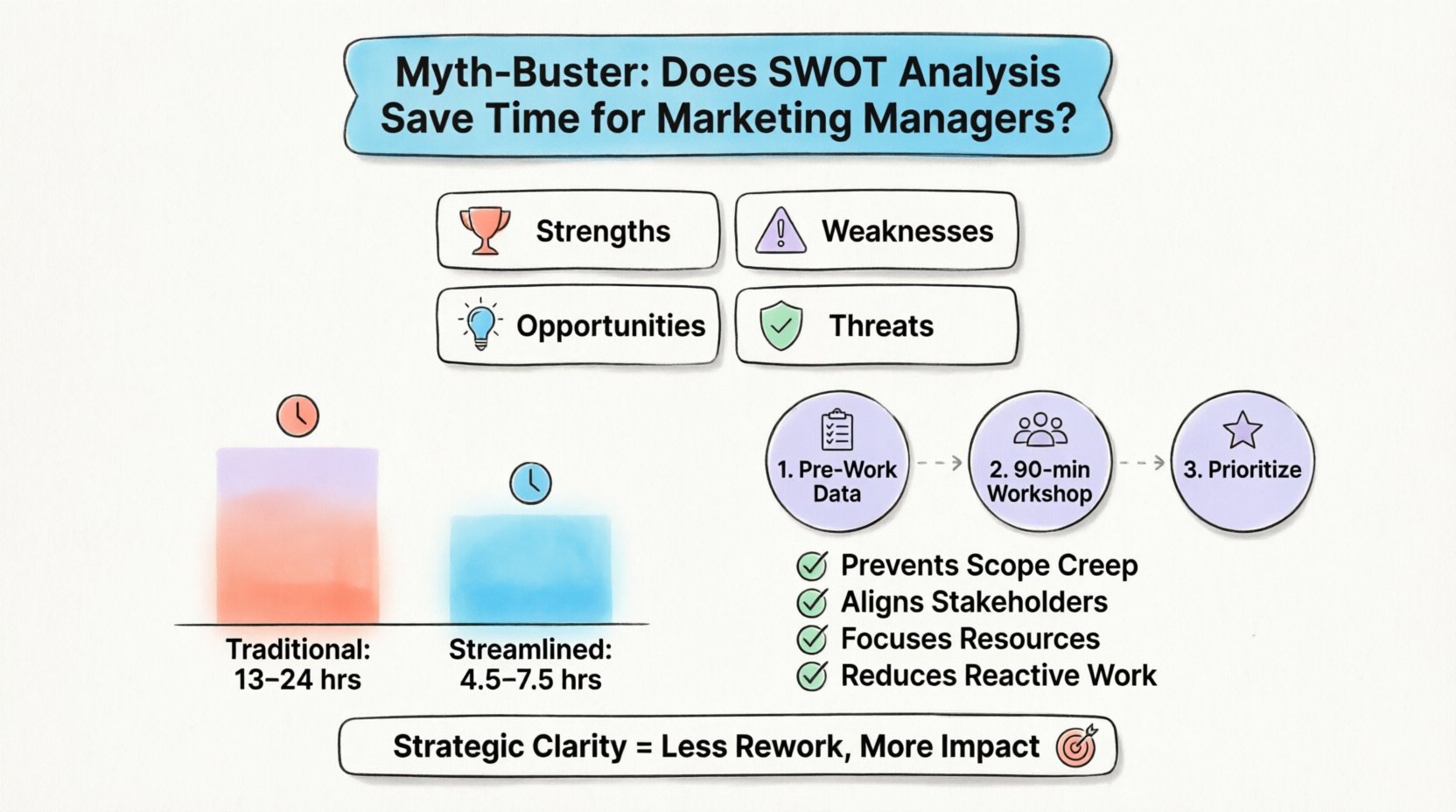
Marketing managers operate in a high-velocity environment. Every hour spent on strategy is an hour taken away from execution, campaign monitoring, or team management. A common hesitation arises when strategic frameworks are introduced. The perception is that deep-dive analysis consumes valuable time that could be spent on immediate revenue-generating activities. This guide examines the efficiency of the SWOT analysis specifically for marketing leadership.
We will explore whether this framework is a time sink or a time saver. We will break down the mechanics, the workflow, and the long-term ROI of strategic planning without relying on external software dependencies.
Before debating the time cost, we must define the tool. A SWOT analysis is a structured method for evaluating four key areas:
For a marketing manager, this is not just a list. It is a diagnostic tool. It forces a pause to look at the current state before committing resources to the next quarter.
Many leaders view strategic planning as a luxury. The myth suggests that a SWOT analysis requires days of meetings and hours of data entry. This perception often stems from how the process is traditionally taught, rather than how it is executed in a fast-paced environment.
Consider the traditional approach that creates the illusion of inefficiency:
When these elements are removed, the time requirement shifts dramatically. The goal is not to create a document, but to create clarity.
Why does this framework save time in the long run? It acts as a filter for decision-making. Every marketing decision consumes budget and labor. A SWOT analysis helps validate whether a decision aligns with current capabilities and market realities.
Here is how it recovers time:
To ensure this process saves time, the workflow must be streamlined. Here is a practical approach that avoids the pitfalls of traditional planning sessions.
Do not start with a blank slate. Collect data before the team meets. This prevents the meeting from being spent on research.
Set a strict time limit. 90 minutes is often sufficient for a focused session. Use a physical whiteboard or a shared digital space. Do not use complex software for this specific task.
Not all points are equal. Use a simple scoring system to rank items. This step ensures the team focuses on the top three items in each quadrant rather than getting bogged down in details.
The following table illustrates the difference between a traditional, unstructured approach and a streamlined, efficiency-focused approach.
| Activity | Traditional Approach (Hours) | Streamlined Approach (Hours) | Time Saved |
|---|---|---|---|
| Data Collection | 5-10 | 2-3 | 3-7 |
| Facilitated Workshop | 4-8 (Multiple sessions) | 1.5 (Single session) | 2.5-6.5 |
| Documentation & Reporting | 4-6 | 1-2 | 3-4 |
| Total Estimated Time | 13-24 Hours | 4.5-7.5 Hours | 6-16.5 Hours |
The savings are significant. This time can be redirected toward campaign execution or team development.
Even with a streamlined process, certain behaviors can turn a quick check-in into a time drain. Awareness of these pitfalls is crucial.
Efficiency comes from integration. Do not treat the SWOT as a standalone event. Embed it into existing workflows.
To visualize the time-saving aspect, consider two scenarios involving a marketing manager.
The manager launches a new campaign without a prior SWOT analysis. Two weeks later, a competitor releases a similar product (Threat). The team has to pivot strategies mid-flight. The cost includes wasted ad spend, overtime for the team, and delayed messaging.
The manager completes a streamlined SWOT analysis before the campaign. The “Threats” section highlights the competitor’s pending launch. The strategy is adjusted to emphasize unique value propositions that the competitor cannot match. The campaign launches on schedule.
The time invested in Scenario B pays for itself many times over in Scenario A.
Data quality dictates the speed of analysis. Garbage in, garbage out. If the data is messy, the analysis takes longer. To optimize this:
Not every situation requires a full analysis. Efficiency also means knowing when to skip steps.
The tool is only as good as the culture using it. Encourage a mindset where analysis is valued as much as action. When the team understands that a 2-hour meeting saves 20 hours of rework, participation improves.
How do you know if this is working? Track the time spent on planning versus execution over time.
The debate often centers on whether planning is a waste of time. The evidence suggests that the opposite is true. Without a clear understanding of strengths and weaknesses, execution is blind. The SWOT analysis provides the map.
For the busy marketing manager, the goal is not perfection. It is direction. A quick, focused analysis provides direction. It allows the team to move forward with confidence, reducing the time spent on course corrections later. By streamlining the process and integrating it into existing rhythms, the framework becomes an asset rather than a burden.
Time is the one resource that cannot be replenished. Investing it wisely in strategic clarity ensures that every subsequent hour of work contributes to the broader objectives. The SWOT analysis, when executed efficiently, is a net positive for time management.
