 Visual Paradigm Desktop |
  Visual Paradigm Online
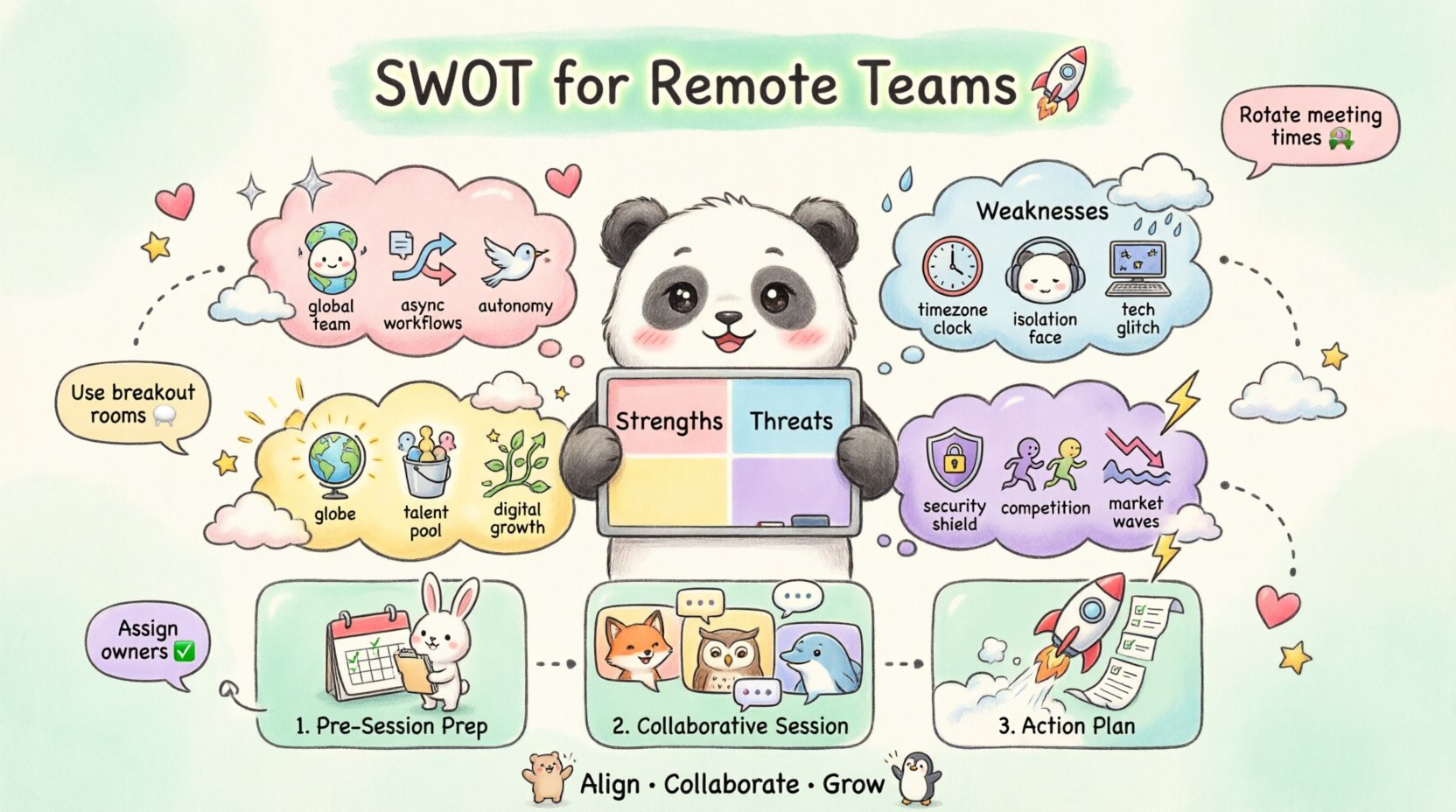
Leading a distributed workforce requires a shift in how we approach strategic planning. Traditional office dynamics no longer apply when team members are scattered across different time zones and home environments. The SWOT analysis remains a cornerstone of strategic management, yet adapting this framework for remote collaboration introduces unique challenges and opportunities. 🚀
This guide explores the mechanics of conducting a SWOT analysis specifically designed for remote teams. We will examine how to facilitate these sessions effectively without physical proximity, ensure meaningful participation, and translate insights into actionable outcomes. Whether you manage a small startup or a large enterprise, the principles of structured remote planning remain consistent. Let us dive into the methodology.
SWOT stands for Strengths, Weaknesses, Opportunities, and Threats. It is a strategic planning technique used to evaluate the competitive position of a project or business unit. In a physical office, this often happens in a conference room with sticky notes on a whiteboard. For remote teams, the medium changes, but the objective remains: to gain clarity on internal capabilities and external factors.
When distributed teams engage in this exercise, they must overcome the barrier of digital fatigue. The goal is not just to fill out a template but to foster alignment. Remote work often isolates employees, making the shared understanding of company status vital. A virtual SWOT session serves as a touchstone for the entire organization.
Standard strategy sessions often fail to account for the nuances of distributed work. A generic SWOT analysis might miss critical remote-specific risks. Without a tailored approach, teams may overlook the unique friction points that arise when collaboration is mediated by screens and internet connections.
Addressing Asynchronous Challenges
Remote teams rely heavily on asynchronous communication. A strategy session must respect this reality. If the planning process assumes everyone is online simultaneously, it creates bottlenecks. The SWOT framework needs to accommodate input gathered before the meeting and synthesis that happens after.
Cultivating Psychological Safety
In a virtual environment, it is harder to read body language. Team members may hesitate to admit weaknesses or threats if they feel exposed on a video call. The facilitator must explicitly create space for vulnerability. This requires a deliberate effort to build trust before the analysis begins.
Aligning Global Perspectives
Distributed teams often span multiple continents. What is a strength in one region may be a weakness in another. A centralized strategy might not fit local realities. The SWOT process should capture these regional variances to ensure the strategy is robust across all locations.
Success in a remote strategy session is 90% preparation. The logistics of time zones, technology, and communication must be ironed out before the first brainstorming session begins. Rushing this phase often leads to disengagement and poor data quality.
Choosing a time that works for everyone is difficult. Avoid scheduling during core business hours if your team is global. Instead, rotate the timing to share the burden. For the digital workspace, utilize a shared platform that supports real-time collaboration. This could be a shared document or a digital whiteboard that allows multiple users to edit simultaneously.
Technical Checklist:
Before inviting the team, clarify the purpose of the SWOT. Is this for annual planning? For a specific project launch? For addressing a recent performance dip? Clear objectives guide the conversation. If the scope is too broad, the session will become unfocused. If it is too narrow, you may miss strategic insights.
Share the agenda at least 48 hours in advance. This allows participants to reflect on their areas of expertise and gather relevant data. Remote workers need time to process information without the immediate pressure of a meeting room.
Do not expect everyone to generate ideas from scratch during the call. Assign pre-work tasks. Ask team members to list three potential strengths and three potential weaknesses in their specific domain. This ensures that the meeting starts with momentum rather than silence. It also gives introverts time to formulate thoughts without the anxiety of speaking up live.
The actual session requires active facilitation. In a physical room, a facilitator might walk around and check on individuals. Online, you must be intentional about engagement. The structure of the meeting should dictate how the four quadrants are discussed.
Start with a brief icebreaker to humanize the participants. Acknowledge the time zone differences and thank everyone for their participation. Establish ground rules: one person speaks at a time, cameras are optional if bandwidth is low, and all ideas are valid. This reduces the cognitive load on participants.
Begin with internal factors. These are easier to agree upon because they rely on shared experience. Use the digital whiteboard to create four distinct columns. Invite participants to add their pre-work items to the board. Facilitators should encourage participants to elaborate on why an item fits the category.
Do not let the conversation drift into problem-solving yet. The goal is identification. If the team starts suggesting fixes for weaknesses, gently steer them back to cataloging the issue first.
This section requires looking outward. It is often harder to generate ideas here because it involves market research and trend analysis. Encourage the team to look at industry news, competitor activity, and customer feedback.
During this phase, ask probing questions. “What changes in our industry could impact our revenue?” “What new tools are our competitors adopting?” These questions prompt deeper thinking.
To make this guide practical, let us look at specific examples relevant to distributed organizations. These examples highlight the nuances that a traditional SWOT might miss.
| Quadrant | Traditional Focus | Remote Team Focus |
|---|---|---|
| Strengths | Office location, face-to-face networking | 24/7 productivity, access to global talent, reduced overhead |
| Weaknesses | Office noise, commute times | Siloed information, culture erosion, technology dependency |
| Opportunities | Local partnerships, physical events | Global expansion, digital product scaling, flexible work models |
| Threats | Local competition, zoning laws | Data breaches, internet outages, remote culture dilution |
Strengths: Communication Efficiency
Remote teams often develop concise communication habits. Without the ability to chat in the hallway, messages must be clear. This clarity can be a massive strength when documenting processes or writing specifications.
Weaknesses: Meeting Fatigue
Virtual meetings can feel more draining than in-person ones. The lack of non-verbal cues requires more mental energy to interpret intent. If the team schedules too many synchronous sessions, productivity drops. This is a critical weakness to address in the SWOT.
Opportunities: Asynchronous Scaling
Leverage the time zone difference. While Team A sleeps, Team B works. This allows for a 24-hour development cycle. It is an opportunity to increase output without increasing headcount.
Threats: Security Compliance
Remote work increases the attack surface. Personal devices and home networks are less secure than corporate infrastructure. This is a constant threat that requires ongoing vigilance and investment in security protocols.
Collecting data is useless without execution. The most common failure in SWOT analysis is letting the findings sit in a document. For remote teams, the risk of losing momentum is higher because there is no physical presence to reinforce the plan.
Not all items on the list are equal. Use a prioritization matrix to rank items based on impact and feasibility. Focus on the high-impact, high-feasibility items first. This creates quick wins that build confidence in the process.
Assign a specific owner to every action item. In a remote setting, ambiguity leads to inaction. Ensure the owner has the authority and resources to complete the task. Document this assignment in a shared project management space so everyone can see progress.
Set a date to review the progress of the action items. This could be a monthly or quarterly check-in. Remote teams need regular rhythm to stay aligned. If the action plan is not reviewed, it will likely be forgotten amidst daily operational tasks.
Even with a solid plan, remote SWOT sessions can go off the rails. Being aware of common pitfalls helps you navigate them.
How do you know if the SWOT analysis was valuable? Look for tangible changes in team behavior and output. Did the action items get completed? Did the team feel more aligned? Did the communication improve?
Key Performance Indicators:
Review these metrics regularly. If the plan is not moving the needle, be willing to pivot. The SWOT is a living document, not a static report. It should evolve as the team and the market change.
Inclusivity is critical in remote planning. If some voices are missing, the strategy will be flawed. Here are techniques to ensure everyone contributes.
Conducting a SWOT analysis for remote teams is more than a box-checking exercise. It is an opportunity to align a dispersed workforce around a common vision. By acknowledging the unique challenges of digital collaboration, you can build a strategy that is resilient and adaptable.
The process requires patience, clear communication, and disciplined follow-through. When executed well, it transforms the way the team thinks about its capabilities and its future. It bridges the gap between individual contributions and collective goals. In a world where work is increasingly distributed, the ability to strategize remotely is a competitive advantage.
Focus on the details, respect the time zones, and keep the conversation open. The insights gained will guide the team through uncertainty and toward growth. Remember, the goal is not perfection, but progress. Start the session, gather the data, and move forward with confidence.
