 Visual Paradigm Desktop |
  Visual Paradigm Online
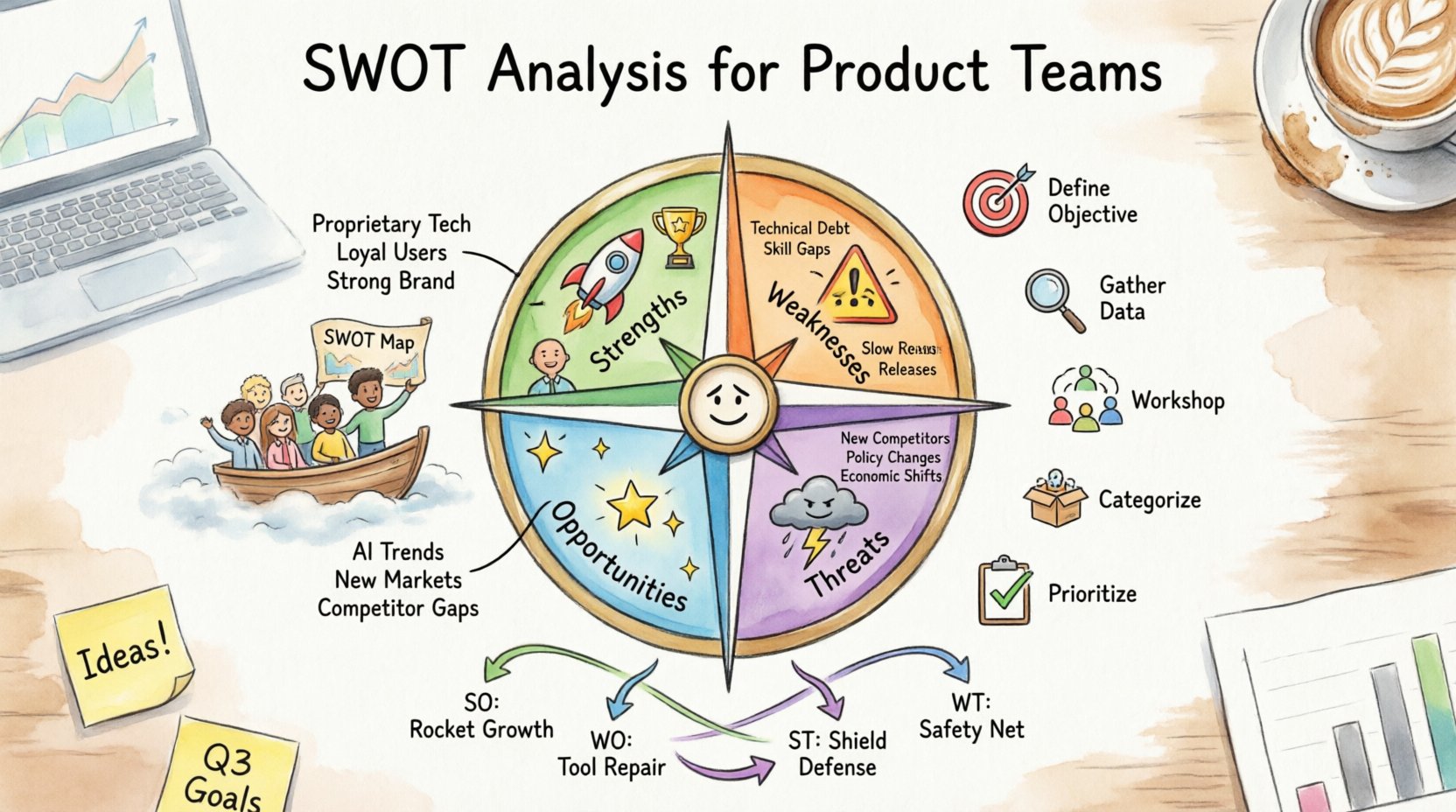
Product strategy often feels like navigating a vessel through dense fog. Without a clear map, decisions rely on intuition rather than evidence. Teams frequently find themselves building features that do not resonate or launching initiatives that face unexpected market headwinds. To steer effectively, you need visibility. The SWOT analysis provides that visibility by structuring internal capabilities and external realities into a clear framework. This guide explores how product teams can utilize this method to make informed decisions without relying on speculation.
SWOT stands for Strengths, Weaknesses, Opportunities, and Threats. It is a strategic planning tool used to evaluate the competitive position of a product or organization. While often associated with corporate management, the framework translates directly to product development when adapted for specific team contexts. It separates factors that are within your control from those that exist outside of it.
These elements are internal to the product team or the organization. They are aspects you can influence directly through resource allocation, process changes, or hiring.
These elements exist in the market or environment. The team cannot control them, but they must respond to them.
Product management involves constant trade-offs. You cannot build everything. You must prioritize. SWOT analysis provides the context needed to justify these choices to stakeholders. It moves the conversation from “I think we should do this” to “Data indicates this is the best path.”
Here are specific reasons to implement this analysis:
Executing a SWOT analysis requires discipline. It is not a one-time brainstorming session. It is a research-driven exercise. Follow these steps to ensure accuracy.
Before gathering data, state the specific goal. Are you analyzing the roadmap for the next quarter? Are you evaluating a new product line? Is it a review of the current platform architecture? A clear scope prevents the analysis from becoming too broad.
Do not rely on memory. Collect evidence from various sources. This includes:
Bring together cross-functional representatives. Include product, engineering, design, and sales. Different perspectives reveal blind spots. For instance, sales might see a market opportunity that engineering overlooked due to technical constraints.
Place every finding into one of the four quadrants. Be honest. It is easy to label a weakness as a strength due to optimism bias. Challenge every entry. Ask “Why is this true?” and “Can we measure this?”
Not every item in the SWOT is equally important. Use a scoring system to rank them. Focus your strategy on the high-impact items. A long list of weaknesses is overwhelming; a prioritized list is actionable.
Visualizing the analysis helps teams see connections between items. Below is a structured view of how these factors might appear in a product context.
| Category | Focus | Example for Product Teams |
|---|---|---|
| Strengths (Internal) | What we do well | High code quality, strong community engagement, proprietary API. |
| Weaknesses (Internal) | Where we struggle | Slow release cycles, lack of mobile testing, high onboarding time. |
| Opportunities (External) | Market potential | Emerging AI trends, competitor price hikes, new geographic markets. |
| Threats (External) | External risks | Platform policy changes, economic downturns, new entrants. |
Creating the matrix is only half the work. The real value comes from connecting the dots. This is where the TOWS matrix comes into play. It forces you to cross-reference the quadrants to generate specific strategies.
Use Strengths to maximize Opportunities. This is your growth engine.
Overcome Weaknesses by taking advantage of Opportunities. This is your improvement phase.
Use Strengths to minimize Threats. This is your defense strategy.
Minimize Weaknesses to avoid Threats. This is your survival mode.
Even with a solid framework, teams can stumble. Be aware of these common errors that reduce the effectiveness of the analysis.
A SWOT analysis should not exist in a vacuum. It needs to feed into the tools and processes the team already uses. Here is how to integrate it.
Use the SWOT findings to define your Objectives. If a Threat is identified, an Objective might be “Mitigate Risk.” The Key Results would measure the reduction of that risk. If an Opportunity is found, the Objective becomes “Capture Market Share,” with Key Results tracking adoption rates.
When planning the roadmap, filter items through the SWOT lens. Does this feature leverage a Strength? Does it address a Weakness? If an item does not align with the SWOT strategy, question its priority. This ensures the roadmap remains strategic rather than reactive.
Use the SWOT as a starting point for sprint or release retrospectives. Ask the team: “Did we face the Threats we identified? Did we capitalize on the Opportunities?” This creates a feedback loop that keeps the analysis fresh.
Understanding the theory is one thing; seeing it in action is another. Consider these scenarios.
A team must migrate a legacy platform to a modern architecture.
Strategy: Use the senior engineers’ knowledge (Strength) to build a robust testing suite (addressing Weakness) before the migration, ensuring the launch happens before competitors (Threat) capture the market.
A team wants to add a new module to their product.
Strategy: Leverage user trust (Strength) to drive organic adoption (addressing Weakness) and quickly fill the gap left by the competitor (Opportunity) while ensuring compliance (Threat).
How do you know if the SWOT analysis was successful? You track the outcomes of the strategies derived from it.
Review these metrics at the end of the quarter. If the metrics do not improve, revisit the SWOT. Perhaps the data was wrong, or the strategy was flawed. The framework is a tool for learning, not a crystal ball.
Strategy is not about predicting the future with certainty. It is about preparing for multiple futures. The SWOT analysis gives product teams a structured way to prepare. It reduces noise and highlights signal. By rigorously examining internal capabilities and external conditions, teams can build products that survive and thrive.
Start small. Pick a specific initiative and run a focused analysis. Refine the process. Share the results. Over time, this habit becomes part of the organizational culture. Decisions become less about guesswork and more about grounded strategy. That is the foundation of sustainable product growth.
