 Visual Paradigm Desktop |
  Visual Paradigm Online
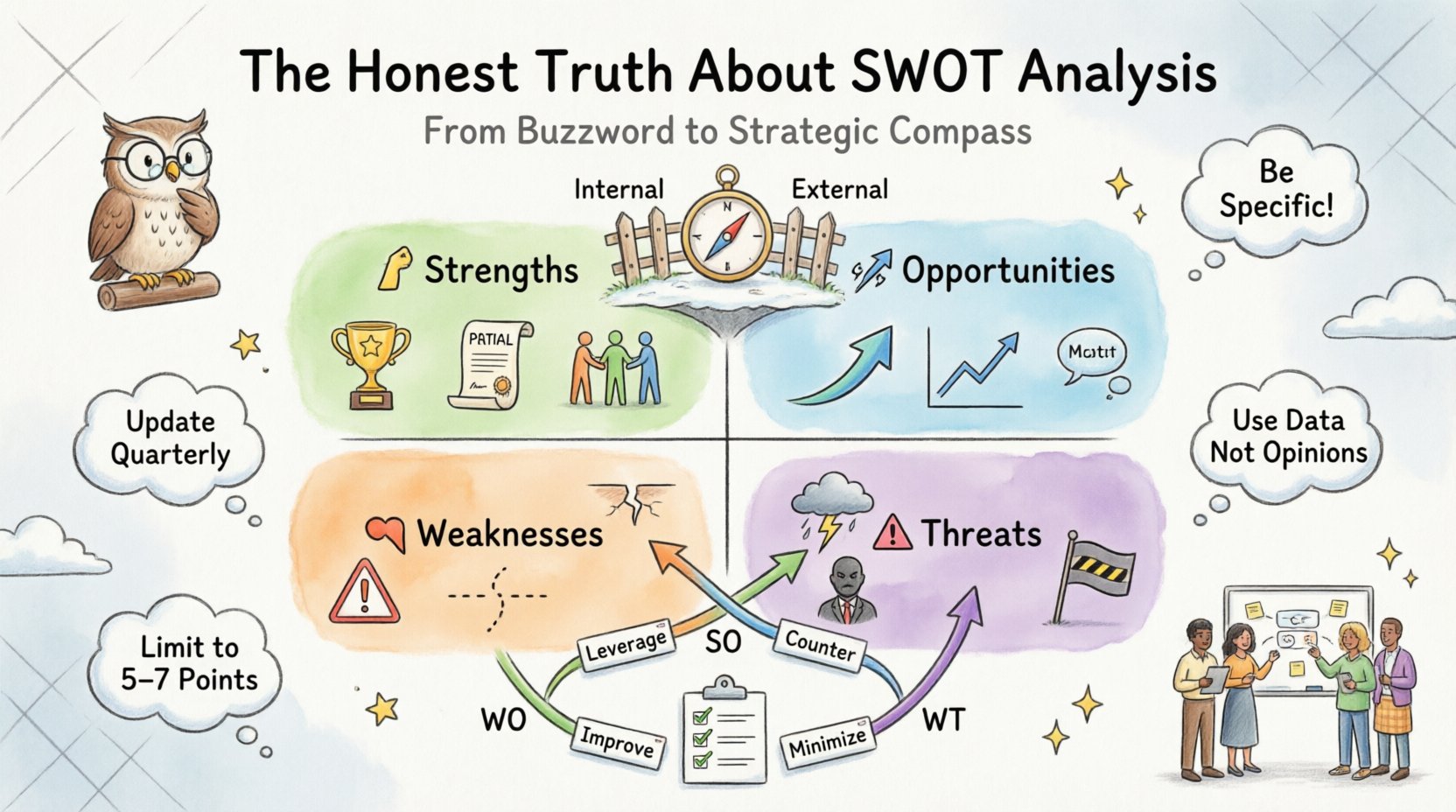
Strategic planning is often cluttered with acronyms that promise clarity but deliver confusion. Among the loudest names in this space is the SWOT analysis. For years, organizations have treated it as a mandatory checkbox on a compliance form rather than a genuine strategic tool. It has become synonymous with stale meetings, generic bullet points, and documents that gather dust on a shared drive.
However, dismissing the framework entirely throws the baby out with the bathwater. When executed with rigor, data, and honest self-reflection, SWOT remains one of the most robust methods for organizing complex business information. The difference between a buzzword exercise and a practical asset lies in the depth of the inquiry and the willingness to confront uncomfortable truths.
This guide strips away the corporate polish to examine what SWOT actually does, how to build one that drives decision-making, and where the common traps lie. We will explore the mechanics of the framework, the psychology of the participants, and the specific steps required to move from analysis to execution.
SWOT stands for Strengths, Weaknesses, Opportunities, and Threats. At its core, it is a strategic planning technique used to evaluate these four elements of a project or business venture. The model was originally developed in the 1960s at Stanford Research Institute, long before the digital age transformed how companies operate. Its longevity suggests a fundamental utility, yet its application has often been diluted.
Think of the framework not as a static report, but as a diagnostic scan. It forces a pause in daily operations to look outward at the market and inward at the organization. The value is not in the list itself, but in the conversations that occur while generating the list.
Most failures with this method stem from conflating the categories. A common error is listing an external factor in the internal column. Clarity here is the first step toward accuracy.
To move beyond buzzwords, we must examine each quadrant with precision. Vague statements like “good team” or “market growth” are insufficient. Specificity transforms data into strategy.
Strengths are what you do better than anyone else, or resources you possess that give you an edge. They are within your control. When identifying these, avoid arrogance; focus on evidence.
Example: Instead of writing “High Quality,” write “ISO 9001 certified manufacturing process with a 99.8% defect-free rate.”
Weaknesses are areas where you lack resources or where your processes lag behind competitors. This is the hardest quadrant for many teams to fill because it requires admitting fault. Honesty here is vital for risk mitigation.
Example: Instead of “Poor marketing,” write “No dedicated content strategy resulting in 40% lower organic traffic than competitors.”
Opportunities are external trends or changes in the market that you can exploit. They are not actions you take; they are conditions you can leverage. These are often missed because teams focus too heavily on current operations.
Example: Instead of “Grow sales,” write “Entry into the emerging Southeast Asian market where demand for our category is growing at 15% annually.”
Threats are external factors that could cause trouble for the business. Unlike weaknesses, you cannot control these, but you can plan for them. Ignoring threats is a recipe for disaster.
Example: Instead of “Competitors,” write “New regulation requiring stricter data handling, increasing operational costs by 10%.”
A critical distinction in this analysis is the locus of control. Confusing internal and external factors renders the matrix useless. The following table clarifies the boundary between what you can change and what you must adapt to.
| Category | Focus | Control Level | Example |
|---|---|---|---|
| Strengths | Internal | High | Skilled workforce, proprietary software |
| Weaknesses | Internal | High | Outdated IT infrastructure, high turnover |
| Opportunities | External | Low | Market deregulation, new demographic shift |
| Threats | External | Low | Supply chain disruption, economic downturn |
When facilitators lead a session, they must constantly police the boundaries. If a participant says, “We need to change the tax laws to fix our cash flow,” that is a weakness masquerading as a threat, or a wish masquerading as a strategy. Tax laws are external. Fixing cash flow is internal.
Even with a solid understanding of the four quadrants, teams often sabotage the process. Recognizing these traps is the first step to avoiding them.
To generate practical value, the process of creating the analysis matters as much as the output. Follow this structured approach to ensure rigor.
Are you analyzing the entire company, a specific department, or a single product launch? A broad scope often leads to vague results. Narrow the focus to allow for granular detail. Define the specific objective of the analysis before gathering data.
Do not rely on a single meeting. Distribute surveys or request written input from key stakeholders beforehand. This allows quieter voices to contribute and gives people time to reflect on facts rather than reacting emotionally in real-time.
Bring the team together to review the input. Use a whiteboard or a shared document. Group similar items together. Challenge every statement. Ask “Why?” and “How do we know?” until you reach the root cause. If a point cannot be defended, remove it.
Not all points are equal. Use a scoring system to rank items by impact and urgency. A threat that could bankrupt the company is more important than a threat that might delay shipping by a week. Validate the top items with leadership to ensure alignment.
Many organizations stop at the list. They generate the SWOT and file it away. This is where the opportunity is lost. The real power comes from cross-referencing the quadrants to generate strategies. This is often called the TOWS Matrix.
Creating these four strategy types forces the team to connect the dots. It prevents the analysis from remaining a descriptive exercise and turns it into a prescriptive roadmap.
Like any tool, SWOT has a specific use case. It is not a cure-all for every business problem.
How do you know if the SWOT analysis worked? The answer lies in the actions taken afterward. If the analysis is successful, you should see a correlation between the identified factors and the resulting strategic decisions.
If you cannot point to a specific decision that changed because of the SWOT, the exercise failed. The output must be tangible.
It is important to acknowledge that the SWOT analysis is a social exercise as much as a strategic one. It reveals the collective mindset of the organization. If the team is overly optimistic, the Strengths and Opportunities will be inflated. If the team is fearful, the Weaknesses and Threats will dominate.
A skilled facilitator understands group dynamics. They must ensure that the loudest voices do not dictate the reality. They must protect the integrity of the data against the desire for a positive narrative. This requires a culture of psychological safety where facts are valued over feelings.
The SWOT analysis is a tool, not a strategy itself. It organizes thought, but it does not generate it. Its value is proportional to the rigor applied to it. When treated as a sacred ritual, it becomes a box to tick. When treated as a living document, it becomes a compass.
Separating the corporate buzzwords from practical value requires discipline. It demands that we stop accepting vague statements. It demands that we look at the hard data. It demands that we connect our internal reality with the external world. When done right, it provides clarity in a complex environment.
Start by auditing your current approach. Are your points specific? Is the data evidence-based? Are you connecting the quadrants? If not, refine the process. The goal is not to produce a pretty chart, but to produce a better business.
For most organizations, a quarterly review is sufficient. However, if you are in a hyper-growth phase or a volatile industry, monthly reviews may be necessary. The key is relevance.
Technically, yes. However, a single perspective often misses blind spots. A diverse group ensures that different departments see different risks and opportunities.
No. PESTLE (Political, Economic, Social, Technological, Legal, Environmental) is specifically for analyzing the external macro-environment. SWOT includes external factors but also focuses heavily on internal capabilities. They are often used together.
Disagreement is valuable. It highlights uncertainty. Do not force a consensus immediately. Mark the item as “Debatable” and gather more data to resolve the discrepancy. The debate itself clarifies the reality.
Absolutely. Many professionals use a personal SWOT to plan career moves, identify skill gaps, and assess market demand for their specific role.
