 Visual Paradigm Desktop |
  Visual Paradigm Online
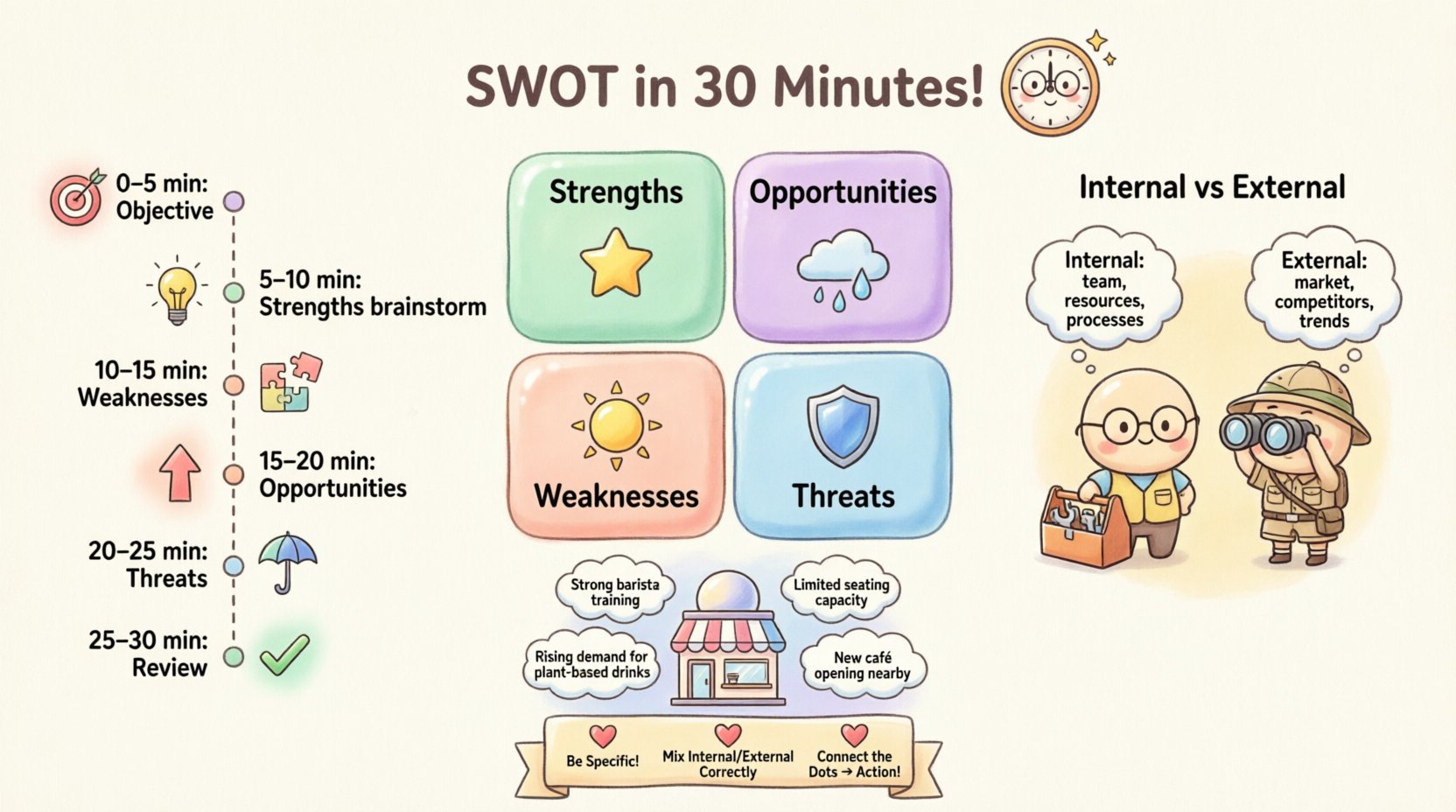
Strategic planning often feels like a heavy task requiring weeks of research and endless meetings. However, the core of effective strategy can be distilled into a fundamental framework. The SWOT analysis remains one of the most enduring tools for business assessment. It forces clarity by categorizing internal capabilities and external possibilities into four distinct areas. This guide provides a streamlined approach to executing a SWOT analysis efficiently. You do not need complex software or a dedicated strategy team to begin. A focused session can yield actionable insights in under thirty minutes.
Before diving into the template, it is essential to understand what each component represents. A SWOT analysis is a matrix that organizes information regarding a specific project, product, or business unit. The acronym stands for Strengths, Weaknesses, Opportunities, and Threats. The distinction lies in whether the factor is internal or external.
Mapping these correctly is the first step toward accuracy. Strengths and Weaknesses describe your current standing. Opportunities and Threats describe your potential future landscape.
Many organizations delay decision-making because they feel they need perfect data. While data is valuable, momentum is often more critical. A quick SWOT session forces stakeholders to focus on the most impactful issues. It prevents analysis paralysis where teams get stuck collecting information indefinitely. By limiting the time to thirty minutes, you encourage instinctive yet informed responses. This rapid approach highlights the immediate priorities without getting bogged down in minutiae.
Efficiency begins before the timer starts. Preparation ensures that the thirty-minute window is used for discussion rather than logistics. Gather the necessary participants. A group of four to six people is often ideal. This size allows for diverse viewpoints without becoming unmanageable.
To maintain order, you need a visual structure. The template is a simple grid divided into four quadrants. Below is a representation of how to organize the information.
| Internal (Control) | External (Environment) |
|---|---|
| Strengths What do you do well? |
Opportunities What trends can you exploit? |
| Weaknesses What needs improvement? |
Threats What obstacles exist? |
Each cell should be populated with concise bullet points. Avoid long sentences. Clarity is key for later analysis. Aim for three to five points per quadrant to keep the focus sharp.
Dividing the time ensures you cover all bases without rushing. Here is a suggested timeline for the session.
Start by agreeing on what you are analyzing. Is it the entire company, a specific product launch, or a department? Write this objective at the top of the board. Everyone must share the same understanding of the scope.
Focus on what is currently working. Ask questions like:
Record every idea. Do not judge or filter at this stage.
Shift to internal challenges. This requires honesty. Questions to consider include:
Remember, a weakness is not a failure; it is an area for development.
Look outward. What changes in the market could benefit you? Consider:
Opportunities are external conditions that you can leverage.
Consider external risks. What could hinder your progress? Examples include:
Identifying threats early allows for contingency planning.
Take a moment to read the full list. Remove duplicates. If a point is vague, note it for later clarification. Select the top three items from each quadrant to focus on immediately.
To illustrate how this works in reality, consider a small local coffee shop planning for the next quarter. The team meets for thirty minutes to assess their position.
From this list, the team identifies that the lack of an online system is a weakness preventing them from capitalizing on the delivery opportunity. This connects a Weakness to an Opportunity, creating a clear action item.
Even with a structured template, errors can occur. Being aware of these common mistakes ensures the quality of your output.
Completing the grid is only the first phase. The value lies in connecting the dots. This process is often called TOWS analysis, which pairs the factors to generate strategies.
Once you have these pairings, assign owners and deadlines. This transforms the document from a theoretical exercise into a working plan.
To ensure the analysis is robust, apply a critical lens to every point. Use the following questions to validate your entries.
Answering these questions helps filter noise. It separates significant factors from background noise.
While this guide focuses on a thirty-minute session, the tool is not limited to one-off events. It can be integrated into quarterly reviews or annual planning cycles. However, keep the sessions concise. A long, drawn-out meeting dilutes the impact.
Consider updating the SWOT annually. Market conditions change, and so do your internal capabilities. A fresh perspective every year keeps the strategy aligned with reality. If you are launching a new product, run a specific SWOT for that project. This targeted approach yields more relevant data than a general company overview.
Even with a clear template, questions often arise during implementation.
Disagreement is natural. Note the differing points as separate items. Later, use data to resolve the conflict. If data is unavailable, acknowledge the risk and assign it a lower priority until more information is gathered.
Absolutely. You can apply the framework to career planning, personal development, or life goals. The internal and external logic remains the same.
If you have more than ten items per quadrant, you need to prioritize. Vote on the top three. If the list keeps growing, you are likely mixing detailed tasks with broad strategies. Zoom out to the strategic level.
Transparency builds alignment. Share the final output with relevant stakeholders. It ensures everyone understands the current position and the planned direction. Keep the raw brainstorming notes private if they contain sensitive critiques.
Success in strategic planning does not come from complex models. It comes from clear thinking and decisive action. The SWOT template offers a structured way to organize thoughts. By limiting the time and focusing on the essentials, you create a tool that drives progress. The goal is not perfection; it is clarity. With a simple grid and a focused group, you can uncover the path forward. Start with the template. Fill the quadrants. Connect the factors. Move forward.
Remember that the document is a living artifact. It should evolve as the business evolves. Keep it visible. Refer to it during meetings. Let it guide your resource allocation. This consistent use ensures the analysis remains relevant and effective.
