Visual Paradigm Desktop | Visual Paradigm Online

The Lazy Manager’s Guide to Quick SWOT Analysis: Get Results Fast Without the Headache

Strategic planning often feels like an exercise in futility. You have deadlines, meetings, and operational fires to put out. Sitting down to analyze your business’s future can seem like a luxury you cannot afford. Yet, without a clear understanding of your position, you are navigating blind.

The SWOT analysis is the standard tool for this. However, traditional methods can drag on for weeks, involving endless meetings and vague data points. This guide strips away the bloat. It focuses on efficiency, clarity, and actionable outcomes. We will cover how to conduct a quick SWOT analysis in under an hour, ensuring you get value without the headache.

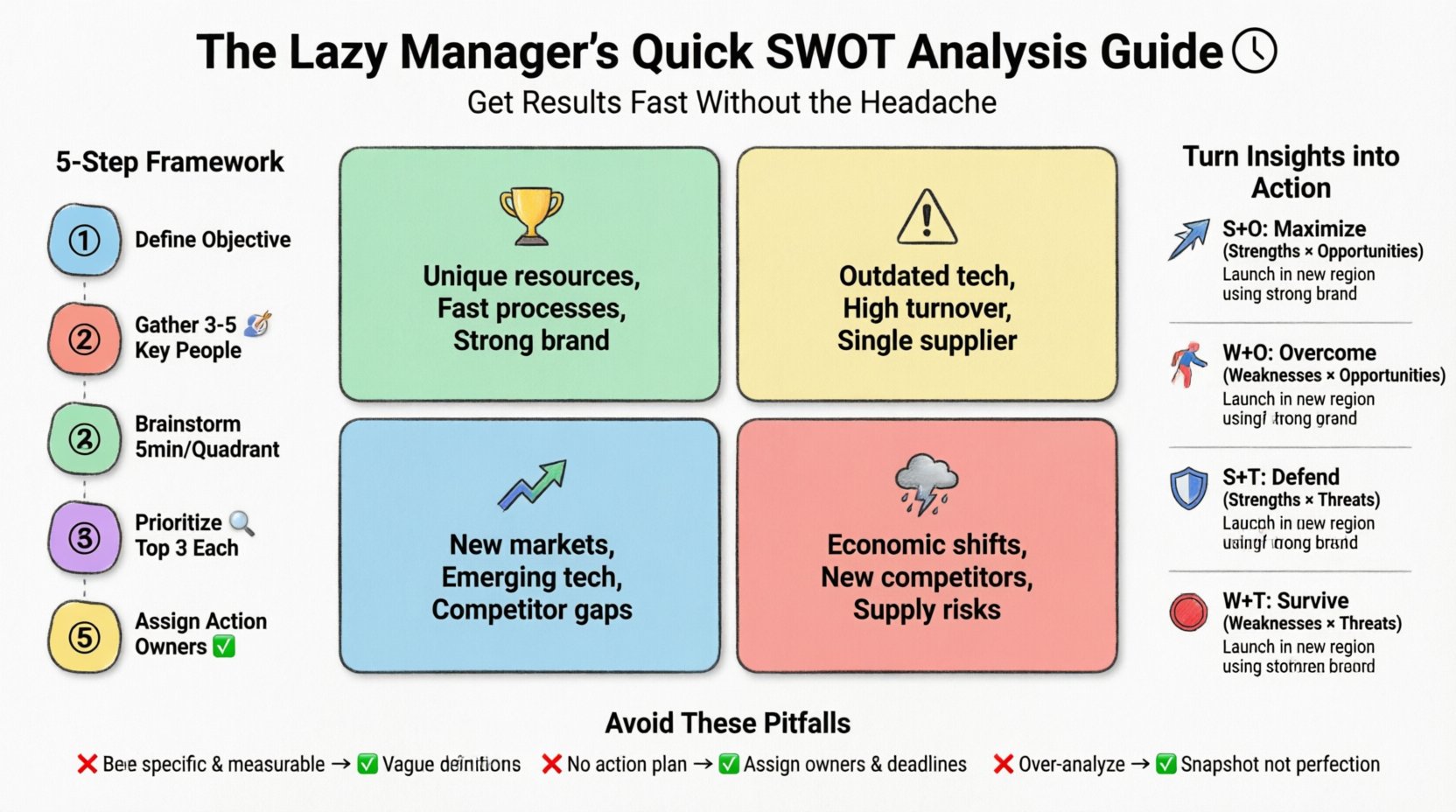
Infographic: Quick SWOT Analysis Guide for Managers - Clean flat design showing the 30-minute framework with 5 steps (define objective, gather team, brainstorm quadrants, prioritize top 3, assign owners), central 2x2 SWOT matrix with Strengths (trophy icon), Weaknesses (warning icon), Opportunities (growth chart), and Threats (storm cloud) in pastel colors, plus TOWS strategy combinations and common pitfalls to avoid, designed with rounded shapes, black outlines, and ample white space for student-friendly social media sharing

What is a SWOT Analysis? 🧐

SWOT stands for Strengths, Weaknesses, Opportunities, and Threats. It is a framework used to evaluate the internal and external factors affecting your organization.

  • Strengths (Internal): What you do well. Resources, capabilities, and advantages.
  • Weaknesses (Internal): Where you struggle. Gaps, limitations, and areas for improvement.
  • Opportunities (External): Market trends or changes you can leverage.
  • Threats (External): Risks from the environment that could harm performance.

Most managers skip the deep dive because they fear the complexity. But you do not need a consultant to do this. You need a structured approach that respects your time.

Why Strategic Planning Often Fails ❌

Before we begin the process, it is important to understand why previous attempts might have felt like a waste of time. Recognizing these pitfalls ensures you do not repeat them.

  • Vague Definitions: Writing “good service” as a strength is useless. You need specific metrics.
  • Lack of Data: Relying on gut feeling instead of facts leads to bias.
  • Too Many Participants: Large groups lead to groupthink and endless debate.
  • No Action Plan: Identifying problems without assigning solutions results in a report that sits on a shelf.
  • Over-Analysis: Spending weeks on data collection when a snapshot would suffice.

The “lazy” approach is not about doing less work; it is about doing the right work efficiently. It means cutting the fat and focusing on the signal.

The 30-Minute Framework ⏱️

Here is the method. You do not need a whiteboard marathon. You need focus and a simple document.

Step 1: Define the Objective 🎯

Start by asking one question: What decision are we making? A SWOT for a new product launch looks different than a SWOT for annual budget planning. Narrowing the scope keeps the team focused.

  • Is this for a specific project?
  • Is this for a departmental review?
  • Is this for the whole organization?

Step 2: Gather the Right People 👥

Invite 3 to 5 key individuals. Avoid bringing in the whole department. You need decision-makers and those with ground-level knowledge. Too many voices dilute the quality of input.

Step 3: Brainstorm in Quarters 📊

Dedicate 5 minutes per quadrant. Do not mix them up. If you discuss threats while listing strengths, the conversation becomes chaotic. Write everything down first, then edit.

Step 4: Prioritize and Select 🔍

You will likely generate 20 items per quadrant. That is too many. Select the top 3 for each category. If you cannot choose, the list is not specific enough. Go back and refine.

Step 5: Assign Action Owners ✅

Every selected item needs an owner. If no one is responsible, nothing happens. This step turns the analysis into a plan.

Deep Dive: The Four Quadrants 🔎

Let us look at what to write in each section. Specificity is the key to a useful document.

Strengths (Internal Positive) 🏆

These are things you control. Ask yourself:

  • What unique resources do we have? (e.g., proprietary technology, cash reserves)
  • What processes are faster or cheaper than competitors?
  • Do we have a strong brand reputation?
  • Is our team highly skilled in a niche area?
  • Do we have exclusive partnerships?

Example: Instead of “Good Team,” write “Team holds certifications that allow us to process claims 20% faster than industry average.”

Weaknesses (Internal Negative) ⚠️

This is the hard part. You must be honest. Ask:

  • Where are we losing money?
  • What technology is outdated?
  • Do we have high staff turnover in key roles?
  • Is our customer support response time slow?
  • Are we dependent on a single supplier?

Admitting a weakness is not failure; it is risk management. You cannot fix what you do not name.

Opportunities (External Positive) 📈

These are outside forces you can exploit. Look at the market:

  • Are there new regulations that favor our model?
  • Has a competitor gone out of business, freeing up their customers?
  • Is there a demographic shift we can target?
  • Are emerging technologies cheaper now?
  • Can we enter a new geographic market?

Opportunities require resources to capture. Ensure you have the capacity to act.

Threats (External Negative) 🌪️

These are risks you cannot control, only mitigate. Consider:

  • Is there a potential economic recession?
  • Are there new competitors entering the space?
  • Could supply chain disruptions occur?
  • Are consumer preferences shifting away from our product?
  • Is there a risk of data security breaches?

The SWOT Matrix in Action 📋

Visualizing the data helps you see connections. Below is a simplified example of how to structure the final output.

Strengths Weaknesses
  • Established customer base
  • Low overhead costs
  • Outdated marketing software
  • Limited international reach
Opportunities Threats
  • Expand to neighboring regions
  • Launch mobile app
  • New competitor pricing
  • Regulatory changes

Turning Points into Plans 🛠️

Analysis without action is just a hobby. Once you have your list, you must cross-reference them. This is often called a TOWS matrix, but you can do it mentally or on a simple grid.

1. S-O Strategies (Maximize) 🚀

Use your strengths to take advantage of opportunities.

  • Example: Use our low overhead costs (Strength) to undercut the new competitor (Opportunity) on price for the first quarter.

2. W-O Strategies (Overcome) 🧗

Overcome weaknesses by taking advantage of opportunities.

  • Example: Use the emerging mobile market (Opportunity) to justify investment in new app development, fixing the outdated software issue (Weakness).

3. S-T Strategies (Defend) 🛡️

Use strengths to minimize threats.

  • Example: Leverage our established customer base (Strength) to offer loyalty programs that retain users despite the new competitor (Threat).

4. W-T Strategies (Survive) 🛑

Minimize weaknesses to avoid threats.

  • Example: Diversify suppliers immediately to mitigate the risk of supply chain disruption (Threat) since we are currently dependent on one (Weakness).

Common Pitfalls to Avoid 🚫

Even with a fast method, errors can creep in. Watch out for these common mistakes.

  • Confusing Internal and External: A “weak competitor” is not your weakness. It is a threat or opportunity. Only things you control are internal.
  • Being Too Broad: “High quality” is not a strength. “Zero defect rate in manufacturing” is.
  • Ignoring the Data: Do not guess. If you claim a threat exists, have a source. If you claim a strength, have proof.
  • Forgetting the Timeline: A SWOT is valid for a specific period. Revisit it every quarter or after major market shifts.
  • Stopping at Identification: Never end the meeting without assigning tasks.

Implementation Checklist ✅

Use this list to ensure your session was productive.

  • [ ] Objective was defined clearly.
  • [ ] Participants were limited to key decision-makers.
  • [ ] Each quadrant had specific, measurable items.
  • [ ] Top 3 items were selected per quadrant.
  • [ ] Action items were assigned to specific people.
  • [ ] A deadline was set for the first review.
  • [ ] The document was stored in a shared, accessible location.

FAQs: Quick SWOT Analysis ❓

How often should I run a SWOT analysis?

For strategic planning, once a year is standard. For specific projects, run it at the start and mid-point. Do not overuse it, or the data loses meaning.

Can I do this alone?

You can draft it alone, but it will lack perspective. A quick review with a trusted colleague helps catch blind spots. Group sessions are best done with 3-5 people.

What if we have too many threats?

This indicates high risk. Prioritize the top 3 threats and allocate resources to mitigation plans immediately. If you have too many strengths, you may be underutilizing your capacity.

Is a digital tool required?

No. A simple document works. Digital tools can help track progress later, but for the brainstorming phase, keep it simple to avoid distraction.

What if the team disagrees on a point?

Do not let debate stall the process. Note the disagreement and assign it to a small subgroup to research further. Move on to the next item.

Final Thoughts 💡

Efficiency in management is not about speed at the expense of quality. It is about removing unnecessary friction from the decision-making process. A quick SWOT analysis gives you a clear map of your current reality without getting lost in the weeds.

By focusing on specific, actionable items and assigning ownership immediately, you transform a theoretical exercise into a practical tool. You do not need to be a strategist to lead your team effectively. You just need the right framework and the discipline to follow it.

Start small. Commit to the 30-minute method. Watch your clarity improve and your planning time shrink. The market moves fast; your analysis should too.

Loading

Signing-in 3 seconds...

Signing-up 3 seconds...