 Visual Paradigm Desktop |
  Visual Paradigm Online
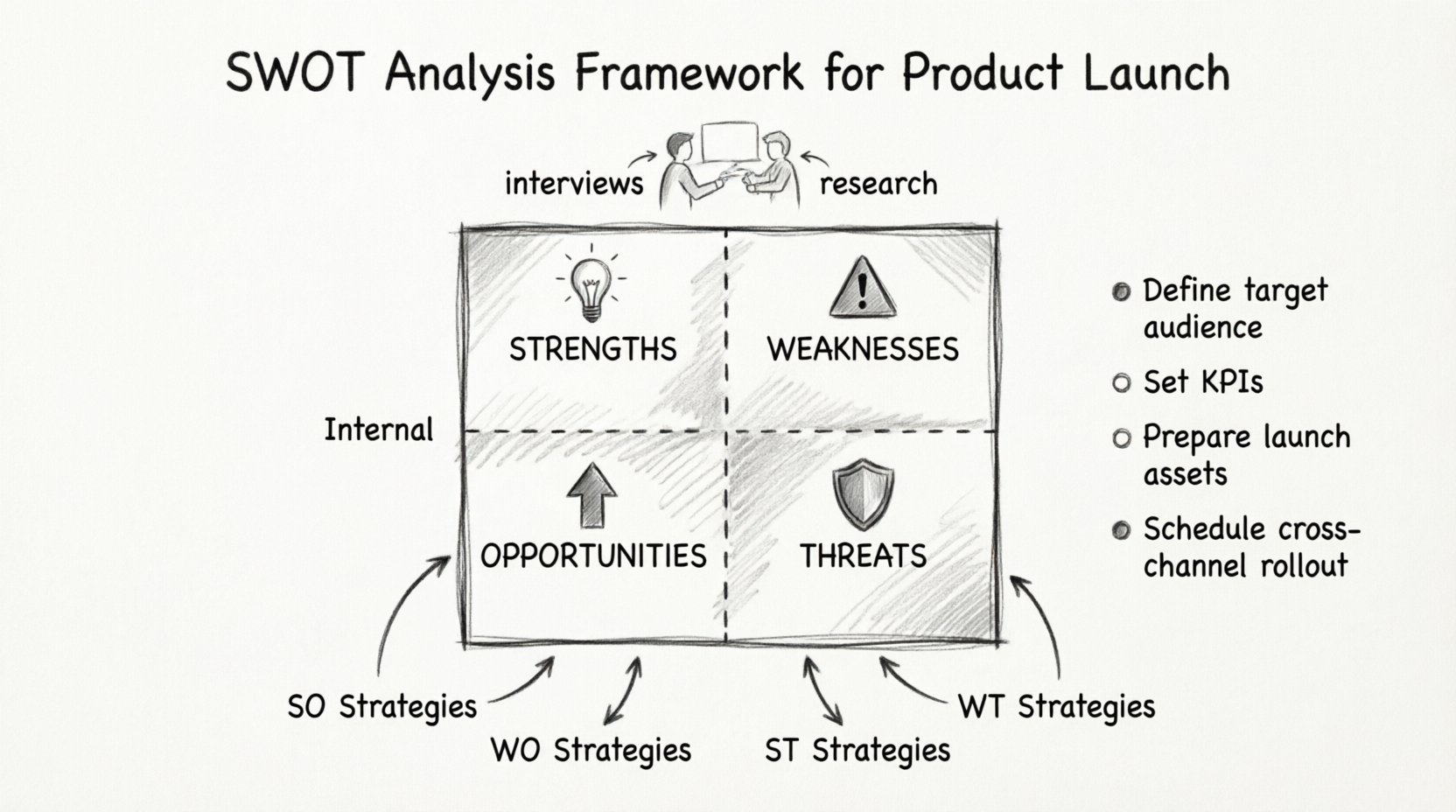
Launching a new product is a high-stakes endeavor. It involves capital, time, and reputation. Before committing resources, you need a clear understanding of the landscape. A SWOT analysis provides this clarity. It structures your thinking around internal capabilities and external market conditions. This guide walks you through constructing a robust SWOT analysis specifically tailored for product launches. We will focus on actionable insights rather than theoretical concepts.
A SWOT analysis breaks down a project into four distinct quadrants. These represent the factors that influence success or failure. It is not merely a list; it is a strategic tool. When applied to a product launch, it forces the team to confront reality.
The first step is distinguishing between what you control and what you do not. This distinction is critical for resource allocation.
Confusing these two categories leads to poor strategy. You cannot fix an external threat directly, but you can build defenses against it. You cannot ignore an internal weakness, but you can fix it.
| Factor | Category | Focus | Key Question |
|---|---|---|---|
| Strengths | Internal | Advantages | What do we do better than anyone else? |
| Weaknesses | Internal | Disadvantages | Where are we lacking compared to competitors? |
| Opportunities | External | Positives | What market trends can we exploit? |
| Threats | External | Negatives | What obstacles could block our success? |
Using a table ensures that every category is addressed equally. It prevents the team from dwelling only on strengths while ignoring potential risks.
You cannot build a reliable analysis on guesses. The preparation phase is about data collection. This step ensures that your conclusions are grounded in evidence.
Speak with the people who know the product and the market best. This includes:
Ask open-ended questions. Avoid leading questions that suggest a specific answer. For example, do not ask, “Is our pricing too high?” Instead, ask, “How do customers perceive our value relative to the price?”
Look outward. You need to understand the environment in which the product will exist.
Strengths are your internal assets. In the context of a product launch, these are the reasons why your product can win. Be specific. Vague strengths like “good team” are less useful than “team with five years of experience in API integration”.
Once you list your strengths, ask how to leverage them. If you have a strong brand, use it to lower friction in the sales cycle. If you have superior technology, use it to highlight performance benchmarks.
Strengths are the foundation of your competitive advantage. However, they can become liabilities if they lead to complacency. Regularly audit your strengths to ensure they remain relevant.
Weaknesses are internal limitations. Acknowledging them is difficult but necessary. Hiding weaknesses during a launch strategy session invites disaster.
For every weakness, identify a mitigation plan. If budget is tight, focus on organic growth channels like content marketing or community building. If technical debt is high, allocate a portion of the sprint capacity to refactoring.
Do not try to fix everything at once. Prioritize weaknesses that directly impact the launch. A minor internal inefficiency is less critical than a gap in core functionality.
Opportunities are external possibilities. They are trends or gaps in the market that your product can fill. Unlike strengths, you do not create these; you recognize and seize them.
Opportunities must align with your strengths. If you identify a trend but lack the capacity to serve it, it is not a viable opportunity for this launch. Cross-reference your opportunities with your strengths to find the sweet spot.
For example, if you have a strong engineering team (Strength) and a market trend toward real-time data processing (Opportunity), you can position your product as the market leader in speed.
Threats are external risks. They are forces that could cause your launch to fail. These are often the hardest to see because they are outside your control. Preparation is the only defense.
For threats, you need contingency plans. If a competitor launches a price war, have a response ready. If a key vendor fails, have a backup source.
Monitor these threats continuously. A threat today might be a reality tomorrow. Set up alerts for competitor news, industry regulations, and economic indicators relevant to your sector.
Completing the four quadrants is only half the work. The real value comes from connecting them. This is where you turn analysis into a strategy.
Use your Strengths to maximize Opportunities. This is your growth engine. If you have a strong brand and a new market trend, launch a campaign that highlights your authority.
Overcome Weaknesses by taking advantage of Opportunities. This is about improvement. If you lack resources but have a market gap, consider a partnership to fill the gap without building in-house.
Use your Strengths to minimize Threats. This is your defense. If you have a loyal customer base, use it to retain users against a new competitor.
Minimize Weaknesses and avoid Threats. This is your survival mode. If you have a technical debt issue and a security threat, pause feature development to fix the foundation.
A SWOT analysis must be a living document. It should not sit in a drawer. Share it with the team to ensure alignment.
Even with a good framework, teams make mistakes. Avoid these common errors to ensure the analysis is effective.
After the launch, the SWOT analysis serves as a baseline. Compare actual results against your initial assessment. This validates your strategic thinking and improves future planning.
A SWOT analysis is a tool for clarity. It does not guarantee success, but it reduces uncertainty. By systematically evaluating your internal and external landscape, you make informed decisions. This process requires honesty, data, and collaboration. When executed well, it provides a roadmap for a successful product launch.
Remember, the goal is not perfection. The goal is to move forward with eyes open. Use this framework to guide your team, allocate resources wisely, and navigate the complexities of the market with confidence.
1. Schedule a workshop with your team.
2. Gather the necessary data.
3. Draft the four quadrants.
4. Develop the cross-matching strategies.
5. Execute and review.
By following these steps, you build a foundation for sustainable growth. The product launch is just the beginning. The analysis continues to inform your roadmap as you evolve.
