 Visual Paradigm Desktop |
  Visual Paradigm Online
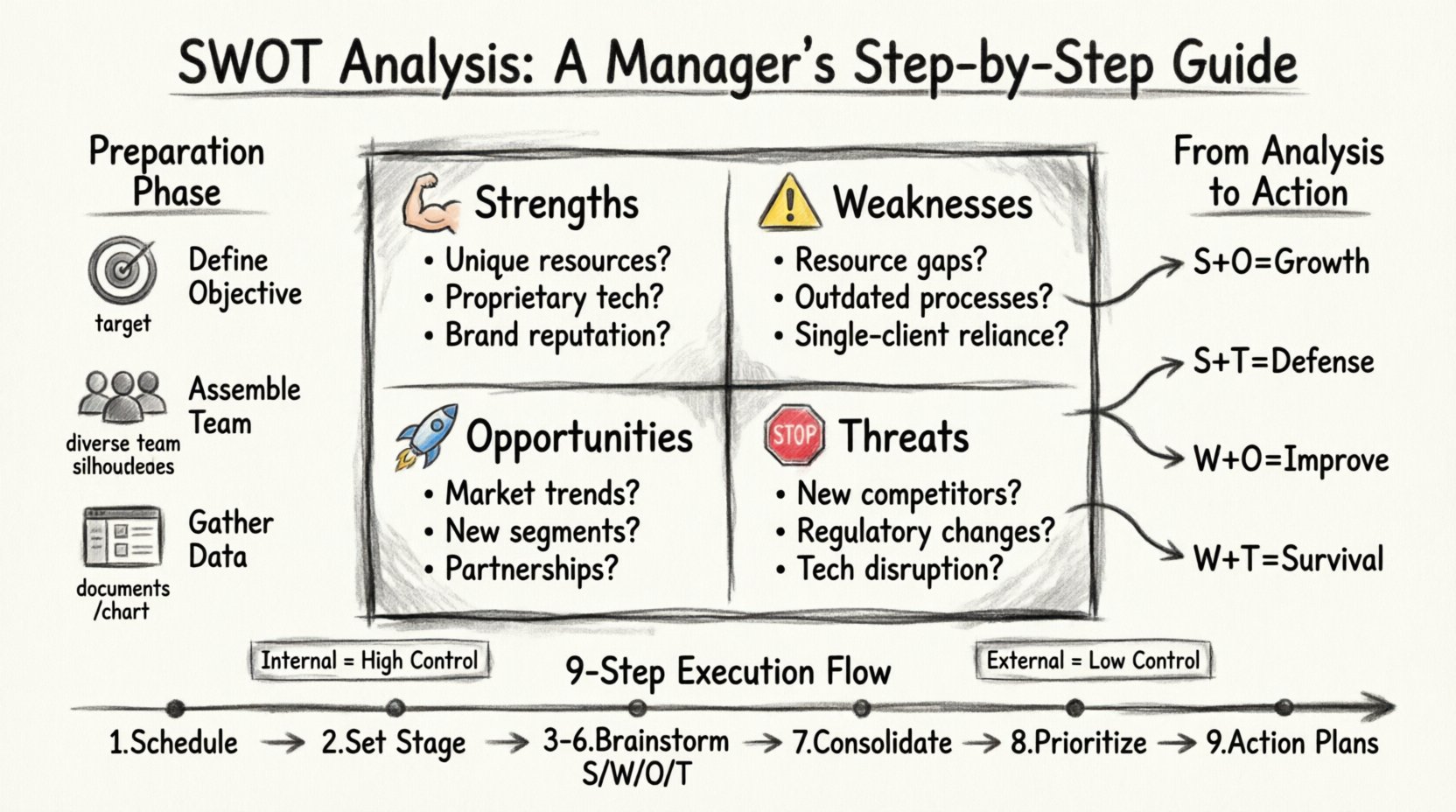
Strategic planning requires a clear understanding of where an organization stands today and where it could be tomorrow. For managers, the SWOT analysis remains one of the most effective tools for this purpose. It provides a structured framework to evaluate the internal and external factors influencing a business unit or project. This guide details how to conduct a SWOT analysis effectively without relying on complex software or jargon.
A SWOT analysis is a strategic planning technique used to identify Strengths, Weaknesses, Opportunities, and Threats. It is not merely a checklist; it is a diagnostic tool that helps leadership teams see the big picture. By categorizing factors into internal and external categories, managers can make informed decisions that align resources with goals.
The acronym stands for:
This method allows for a balanced view of the current situation. It prevents overconfidence by highlighting weaknesses and prevents unnecessary pessimism by identifying opportunities. The process is flexible enough to apply to a new product launch, a departmental restructuring, or a long-term corporate strategy.
To conduct a meaningful analysis, you must understand what belongs in each quadrant. Vague entries reduce the utility of the report. Specific data points and concrete observations drive better outcomes.
Strengths are factors within your control. These are the assets that allow you to perform better than competitors. When brainstorming strengths, consider the following:
For example, a logistics company might list its specialized fleet as a strength. A software firm might list its highly skilled engineering team. The key is to be honest. Do not list strengths that are actually generic industry standards, such as “having a website,” unless your website offers a distinct advantage over competitors.
Weaknesses are also internal factors, but they hinder performance. Acknowledging these is difficult but necessary for growth. Weaknesses are areas where you need improvement to compete effectively.
Identifying weaknesses requires transparency. If a team is understaffed, list it. If a process is outdated, document it. Hiding these issues during the analysis phase leads to failure in the execution phase.
Opportunities are external factors that you can leverage. They often arise from market trends, changes in regulations, or technological advancements. These are not things you control, but they are things you can act upon.
For instance, a rise in remote work might be an opportunity for a company selling home office equipment. A change in tax law might be an opportunity for a financial advisory firm. The goal is to match these external possibilities with your internal strengths.
Threats are external factors that could cause trouble. You cannot control these, but you can prepare for them. Ignoring threats is a common reason for business decline.
Recognizing a threat early allows for mitigation strategies. If a new competitor is entering the market, you might adjust your pricing or enhance your customer service to maintain loyalty.
Before drawing the grid, preparation is key. A rushed analysis yields shallow insights. The preparation phase sets the stage for a productive session.
Start by clarifying the purpose of the analysis. Is this for a quarterly review? A new product launch? A crisis management plan? The objective dictates the scope. A strategic goal requires a different set of criteria than an operational fix.
Do not conduct this alone. A diverse group provides a more complete picture. Include members from different departments such as sales, operations, finance, and human resources. Each perspective highlights different strengths and weaknesses that a single manager might miss.
Brainstorming without data is speculation. Collect relevant information beforehand. This could include sales reports, customer feedback surveys, competitor pricing sheets, or industry market reports. Having facts on the table grounds the discussion in reality rather than opinion.
Once prepared, follow this structured process to ensure consistency and depth.
Distinguishing between internal and external factors is often the most confusing part of the process. The following table clarifies the distinction.
| Category | Control Level | Examples |
|---|---|---|
| Internal (Strengths/Weaknesses) | High | Employee skills, brand reputation, cash flow, location, culture. |
| External (Opportunities/Threats) | Low | Economic trends, competitor actions, regulatory changes, technology shifts. |
If you are unsure if a factor is internal or external, ask: “Can we change this directly?” If the answer is yes, it is likely internal. If the answer is no, it is external.
A SWOT analysis that sits in a folder is useless. The value lies in the conversion of insights into strategy. This phase is often called TOWS Matrix development, though the core concept is simply linking the quadrants.
These are your aggressive growth strategies. How can you use your internal assets to capture external chances? For example, if you have a strong brand (Strength) and a new market is opening (Opportunity), you should launch a targeted campaign immediately.
These are defensive strategies. How can you use your internal advantages to protect against external risks? If you have strong cash reserves (Strength) and a recession is coming (Threat), you can weather the storm while competitors struggle.
These are improvement strategies. Sometimes, an opportunity is too big to ignore, but you lack the capacity. You must fix the internal gaps to take advantage. If you want to enter a tech sector (Opportunity) but lack expertise (Weakness), invest in training or hiring.
These are survival strategies. If you have a weakness and a threat are aligned, the risk is high. You must reduce the weakness to avoid being exposed. If you have poor customer service (Weakness) and a new competitor is entering (Threat), you risk losing market share rapidly. Improve service immediately.
Even experienced managers make mistakes during this process. Being aware of these common errors helps maintain the integrity of the analysis.
Consider a mid-sized coffee shop chain looking to expand. They conduct a session to prepare for the next fiscal year.
Strategic Action: Match S to O: Leverage the loyal base to promote the new sustainable line. They are likely to support ethical sourcing. Match W to O: Use the loyalty program to offset the low marketing budget by encouraging word-of-mouth referrals. Match S to T: Use the strong brand reputation to differentiate from the new national chains that offer generic products. Match W to T: Improve the loyalty app to ensure customers do not switch to the competitors due to convenience.
To make this a standard practice, integrate the SWOT analysis into your regular management cadence. Do not treat it as an isolated event.
There is no fixed rule, but an annual review is standard for strategic planning. For dynamic industries, a quarterly review is advisable. The frequency depends on how fast the market changes.
Yes. While physical whiteboards are useful, digital collaboration tools work well for remote teams. Ensure all participants have access to the same document or board during the session.
This is rare and indicates a need for a deeper investigation. If you genuinely find no strengths, it suggests a fundamental issue with the business model or the market fit. Re-evaluate the data sources.
Absolutely. Career planning often benefits from a personal SWOT analysis. It helps individuals understand their skills, gaps, and career opportunities.
No. It complements financial forecasting. The SWOT provides the qualitative context, while the forecast provides the quantitative data. Both are needed for a complete picture.
Conducting a SWOT analysis is a foundational skill for any manager. It brings clarity to complex situations and forces a confrontation with reality. The goal is not to produce a perfect document, but to facilitate a productive conversation about the future. By following these steps and avoiding common pitfalls, you can build a robust strategy that stands the test of market changes.
Remember, the value is in the action, not the analysis. Ensure that every item identified leads to a decision, a task, or a strategic shift. With disciplined execution, this framework becomes a powerful engine for continuous improvement and sustainable growth.
