 Visual Paradigm Desktop |
  Visual Paradigm Online
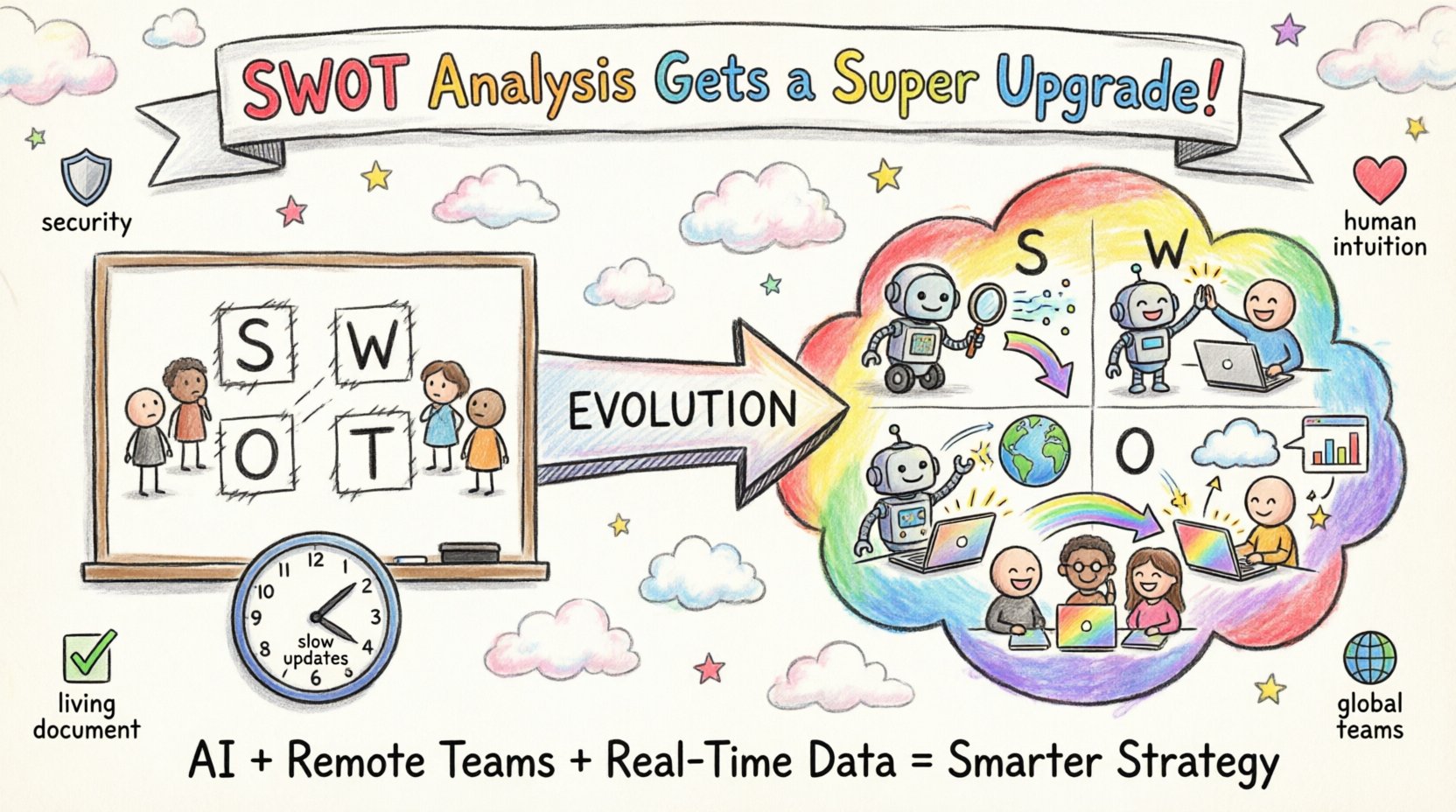
Strategic planning has always been the backbone of organizational stability. Among the various frameworks available, the SWOT analysis remains a staple for identifying internal strengths and weaknesses, alongside external opportunities and threats. However, the landscape of business is shifting beneath our feet. The integration of artificial intelligence and the normalization of remote work are not just trends; they are structural changes that demand a re-evaluation of traditional methodologies.
When we look at the future outlook, the static nature of a four-quadrant chart drawn on a whiteboard no longer suffices. We are entering an era where data flows in real-time and teams are distributed across multiple time zones. This guide explores how the SWOT framework adapts to these new realities without losing its core utility. We will examine the mechanics of this evolution, the role of technology, and the human elements that remain irreplaceable.
For decades, the SWOT analysis served organizations well. It provided a snapshot of the current state of affairs. However, that snapshot was often taken with a delayed shutter speed. By the time a team gathered to discuss strengths and weaknesses, the market conditions had often already shifted. This lag time is the primary friction point in the modern era.
Consider the following constraints inherent in the traditional approach:
In a fast-paced economy, a static document is a liability. The future requires a dynamic framework that updates continuously and includes voices from every corner of the organization.
Artificial intelligence brings a new dimension to strategic analysis. It is not about replacing human judgment, but augmenting it with processing power and pattern recognition. AI tools can scan vast amounts of unstructured data to surface insights that a human team might miss during a brainstorming session.
Here is how AI transforms each quadrant of the analysis:
AI can analyze internal performance metrics, employee feedback, and customer satisfaction scores to pinpoint genuine strengths. Instead of relying on self-reported data, algorithms can correlate performance data with specific departments or initiatives. This reveals where the organization actually excels versus where it claims to excel.
Weaknesses are often hidden in operational silos. Machine learning models can process workflow data to identify bottlenecks. For example, if communication delays occur consistently between specific teams, the AI can flag this as a systemic weakness. This moves the conversation from “we think we have a problem” to “the data shows a 20% drop in throughput here.”
AI excels at monitoring external environments. It can scrape news, social media, competitor filings, and regulatory changes to identify emerging opportunities. Natural language processing can analyze sentiment around a new product category, allowing the organization to pivot before competitors do.
Threats are often invisible until they materialize. Predictive analytics can model potential risks based on historical data and current economic indicators. This shifts the strategy from reactive defense to proactive mitigation. Organizations can simulate various scenarios to see how different threats might impact their specific operational model.
| Component | Traditional Approach | AI-Enhanced Approach |
|---|---|---|
| Data Source | Internal reports, anecdotal evidence | Real-time data feeds, public records, internal logs |
| Speed | Quarterly or annual updates | Continuous monitoring and alerts |
| Scope | Limited to meeting participants | Global data ingestion |
| Bias | High risk of human bias | Algorithmic pattern recognition (requires oversight) |
The shift to remote work has fundamentally altered how teams collaborate. A SWOT analysis held in a physical room excludes the remote workforce. This exclusion creates blind spots. If the customer support team is fully remote, their insights into client pain points are vital. If they are not included in the analysis, the “Threats” quadrant is incomplete.
Remote work introduces unique factors that must be integrated into the SWOT framework:
To adapt, organizations must utilize asynchronous collaboration tools. This allows team members to contribute to the analysis at different times, ensuring that the quietest voices are heard alongside the loudest. The process becomes less about a meeting and more about a continuous contribution stream.
The most effective future strategy combines AI capabilities with remote work flexibility. This hybrid model creates a living SWOT document. It is not a file that is updated once a year; it is a dashboard that updates as data flows in.
Here is what this workflow looks like in practice:
This approach ensures that the strategy remains relevant. It acknowledges that the business environment is fluid and that the planning process must be equally fluid.
As we integrate more data into our strategic planning, we must address the ethical implications. AI models are trained on data, and if that data contains bias, the resulting analysis will reflect that bias. This is a significant risk for SWOT analysis.
Organizations must be vigilant about:
Ignoring these factors can lead to strategic failures. A plan built on biased data is a plan built on a foundation of sand. The future of SWOT analysis is not just about better data; it is about better ethics.
While AI and remote tools are powerful, they cannot replace human intuition. Strategy is ultimately a human endeavor. It involves understanding culture, motivation, and the unwritten rules of an organization.
AI can tell you what is happening, but humans must understand why. For instance, a dip in productivity might show up as a “Weakness” in the data. However, a human leader might know that this is due to a recent change in leadership or a market shift that hasn’t hit the numbers yet. This context is crucial.
The future SWOT analysis is a partnership between human insight and machine processing. Leaders must curate the data AI provides and filter it through their experience. This ensures that the analysis remains grounded in reality rather than becoming a purely theoretical exercise.
Adopting this evolved framework requires a shift in mindset and process. It is not enough to simply buy new technology. The organization must change how it thinks about planning.
Begin by reviewing how SWOT analysis is currently conducted. Identify bottlenecks, excluded voices, and outdated data sources. Understand where the friction lies.
Ensure that the data feeding into the analysis is clean, accurate, and accessible. Poor data quality leads to poor strategy. Define who owns the data and who is responsible for its integrity.
Remote teams need specific skills to contribute effectively to digital strategy. Train them on how to provide structured feedback and how to interpret data insights without getting overwhelmed.
Move away from static PDFs. Use digital platforms that allow for continuous updates. Version control becomes critical here to track how the strategy evolves over time.
Even with real-time data, scheduled reviews are necessary. These are not just for updating the chart, but for discussing the strategic implications of the changes. Set a cadence that matches the speed of your industry.
Looking further ahead, several trends will shape the next decade of SWOT analysis. These are areas where organizations should prepare.
These technologies will make the SWOT analysis more robust, but they will also increase the complexity. The ability to synthesize this information will become a key competitive advantage.
In the context of remote work and AI, risk management becomes more complex. A distributed workforce creates vulnerabilities in communication and security. AI creates vulnerabilities in data privacy and dependency.
Organizations must build resilience into their strategic planning. This means:
Resilience is not just about surviving a crisis; it is about adapting to change. The SWOT analysis is a tool for building that resilience. It helps identify where the organization is fragile and where it is strong.
How do we know if this evolved SWOT analysis is working? Traditional metrics like “number of initiatives launched” are insufficient. We need to measure the agility of the strategy itself.
Key performance indicators for this new model include:
By tracking these metrics, leaders can ensure the process remains efficient and valuable. If the process becomes too cumbersome, it will lose its value. Simplicity must be maintained even as complexity increases.
The evolution of SWOT analysis is inevitable. Organizations that cling to the static, paper-based versions of the past will find themselves at a disadvantage. Those that embrace the dynamic, data-driven, and inclusive approach of the future will be better positioned to navigate uncertainty.
It is important to remember that technology is an enabler, not a solution. The core of strategic planning remains the same: understanding where you are, where you want to go, and how to get there. The tools have changed, but the human need for direction has not.
By combining the analytical power of AI with the diverse perspectives of a remote workforce, leaders can create a SWOT analysis that is alive, breathing, and responsive. This is the future of strategic planning. It requires discipline, ethics, and a willingness to adapt. But the reward is a strategy that truly reflects the reality of the modern business world.
As we move forward, the focus must remain on clarity and action. The complexity of the tools should not obscure the simplicity of the goal. Keep the framework flexible, keep the data honest, and keep the people central to the process.
