 Visual Paradigm Desktop |
  Visual Paradigm Online
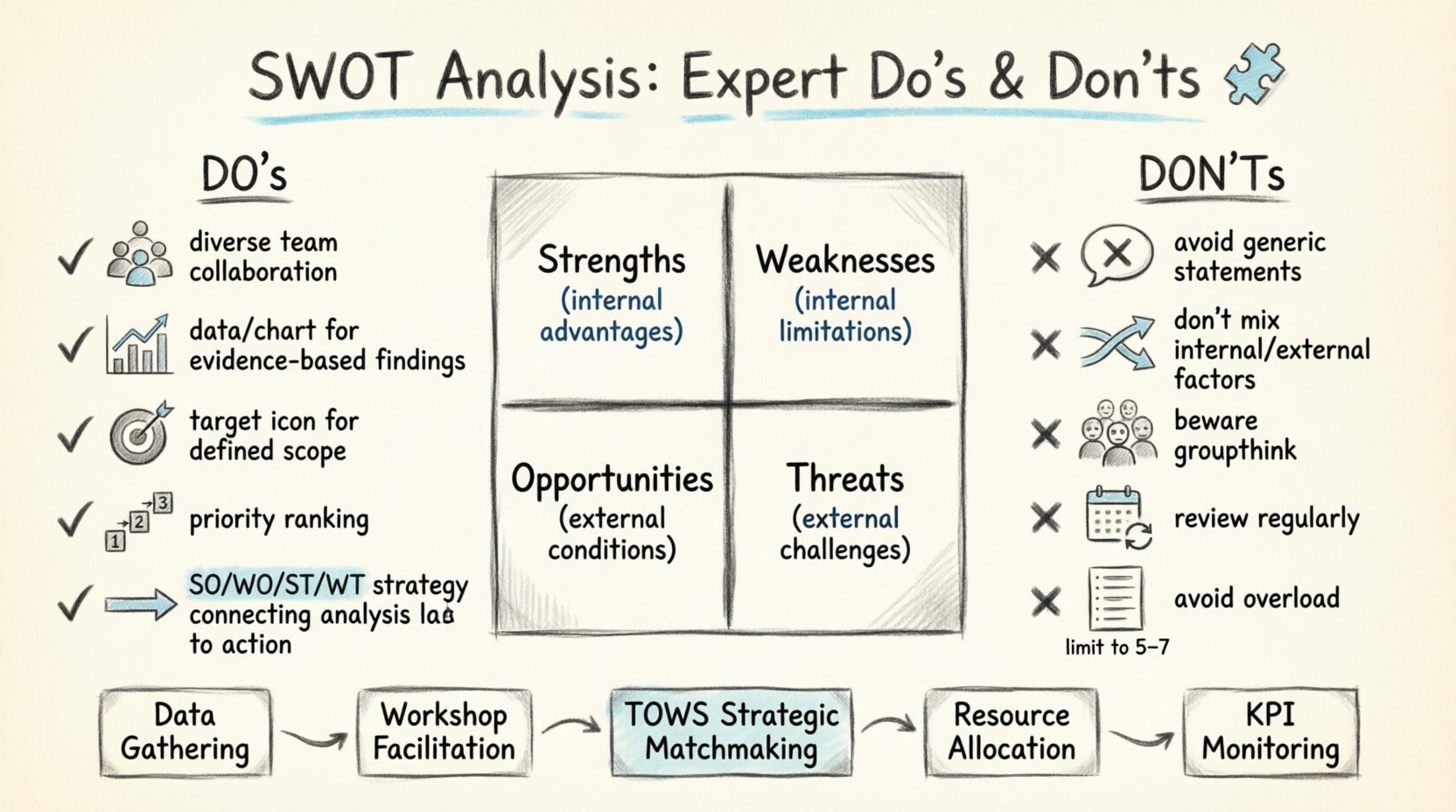
Strategic planning forms the backbone of organizational success. Among the various frameworks available, the SWOT analysis remains a staple for corporate strategy managers. It provides a structured approach to evaluating the internal and external factors that influence performance. However, the utility of this tool depends entirely on the rigor applied during its execution. Many teams treat SWOT as a formality rather than a diagnostic instrument. This guide outlines the essential practices and pitfalls to navigate when conducting a SWOT analysis.
Effective strategic management requires clarity. A well-executed SWOT analysis moves beyond generic lists. It demands deep data validation and honest internal assessment. For the corporate strategy manager, the goal is not just to produce a document, but to inform decision-making processes. This article details the operational standards required to derive actionable intelligence from the framework.
Before diving into execution, one must understand the architecture of the analysis. The acronym stands for Strengths, Weaknesses, Opportunities, and Threats. The distinction lies in the locus of control.
Confusion often arises between internal and external factors. Strengths and Weaknesses belong to the organization. Opportunities and Threats belong to the market environment. Keeping this boundary clear is the first step toward validity.
To ensure the analysis yields high-quality results, follow these operational guidelines. These steps prioritize accuracy and strategic alignment.
A strategy session cannot be isolated to the executive suite. Diverse perspectives are necessary to identify blind spots. Include representatives from operations, finance, sales, and human resources.
Subjective opinions weaken the analysis. Every claim made in the matrix should be supported by evidence. This shifts the conversation from “I feel” to “The data shows”.
A common failure is attempting to analyze the entire corporation when the issue is specific to a product line or region. Define the scope clearly at the start of the session.
Lists of strengths and weaknesses can become endless. Not every factor holds equal weight. Use a scoring mechanism to rank items based on their potential impact on the strategic goal.
A SWOT analysis is useless if it sits in a drawer. The output must feed directly into the strategic planning cycle.
Identifying what not to do is often as important as knowing what to do. The following pitfalls frequently undermine the integrity of the process.
Phrases like “Good Customer Service” or “Strong Brand” are too vague. They do not provide actionable insight. Specificity drives strategy.
This is the most common error. Placing “Market Trends” under Strengths or “Employee Turnover” under Opportunities creates confusion.
Teams often converge on the first obvious answer to save time. This suppresses dissenting views that might reveal critical weaknesses.
The business environment is dynamic. A SWOT analysis conducted once a year may be obsolete by the next quarter. Regular reviews are necessary.
A list of 50 strengths is harder to act on than a list of 5. Brevity ensures focus.
The following table summarizes the contrast between effective execution and common failures.
| Dimension | Effective Practice (Do) | Ineffective Practice (Don’t) |
|---|---|---|
| Data Source | Verified metrics and external reports | Personal opinions and assumptions |
| Scope | Specific business unit or product line | The entire organization vaguely |
| Participants | Cross-functional stakeholders | Only the strategy team |
| Output | Actionable strategies linked to goals | A static list of bullet points |
| Language | Specific and measurable | Generic and subjective |
| Frequency | Regular reviews and updates | Annual or never |
The quality of the analysis is determined by the quality of the input data. Strategy managers must oversee the collection phase to ensure integrity.
Begin with an internal audit. Review financial statements, operational efficiency reports, and customer feedback logs. Look for patterns over time rather than single data points.
Simultaneously, gather intelligence on the external environment. This requires monitoring industry shifts, regulatory changes, and competitor activities.
The session itself requires skilled facilitation. The strategy manager acts as the facilitator to keep the conversation productive.
Prepare the physical or digital workspace beforehand. Ensure all participants have access to necessary data prior to the meeting. This prevents wasting time searching for information.
Encourage debate but manage dominance. Ensure quiet members contribute. Use techniques like “brainwriting” where individuals write ideas silently before sharing them.
The final phase is translation. The SWOT matrix must convert into a strategic plan. This involves matching specific items to specific initiatives.
Use the TOWS matrix method to generate strategies.
Once strategies are identified, assign resources. Budget, personnel, and time must be allocated to the initiatives that address the most critical items in the SWOT.
Several misconceptions persist in the industry. Addressing these ensures the tool is used correctly.
Many mistake the list itself for the strategy. The list is the diagnosis. The strategy is the treatment. Do not confuse the map with the territory.
While it helps identify problems, it is not designed to solve them in isolation. It is a planning tool. Use it to set direction, not to fix a specific operational glitch.
It is often treated as a static document. In reality, it is a living framework. Market conditions change, and the SWOT must evolve to reflect reality.
Strategy management does not end with the report. Continuous monitoring is required to ensure the strategic direction remains valid.
Define KPIs that measure the success of the strategies derived from the SWOT. Regular reporting ensures that deviations are caught early.
Establish mechanisms for feedback. Frontline employees often see market shifts before executives. Create channels for them to report changes that might impact the SWOT factors.
SWOT analysis works best when integrated with other strategic tools. It provides the context for deeper analysis.
Use PESTLE (Political, Economic, Social, Technological, Legal, Environmental) to flesh out the Opportunities and Threats sections. This ensures external factors are categorized comprehensively.
Apply Porter’s framework to analyze industry competitiveness. This adds depth to the Threats and Opportunities quadrants regarding supplier and buyer power.
For the corporate strategy manager, the SWOT analysis is a responsibility. It requires discipline to maintain standards. It requires courage to report negative findings. It requires clarity to communicate findings to stakeholders.
By adhering to these best practices, organizations can transform a simple framework into a robust engine for strategic growth. The difference between success and failure often lies in the depth of the analysis and the rigor of the follow-through.
Focus on data. Engage the right people. Be specific. Connect to action. These principles will guide the team through complex strategic landscapes. The market will shift, but a disciplined approach to analysis will provide a stable foundation for decision-making.
