 Visual Paradigm Desktop |
  Visual Paradigm Online
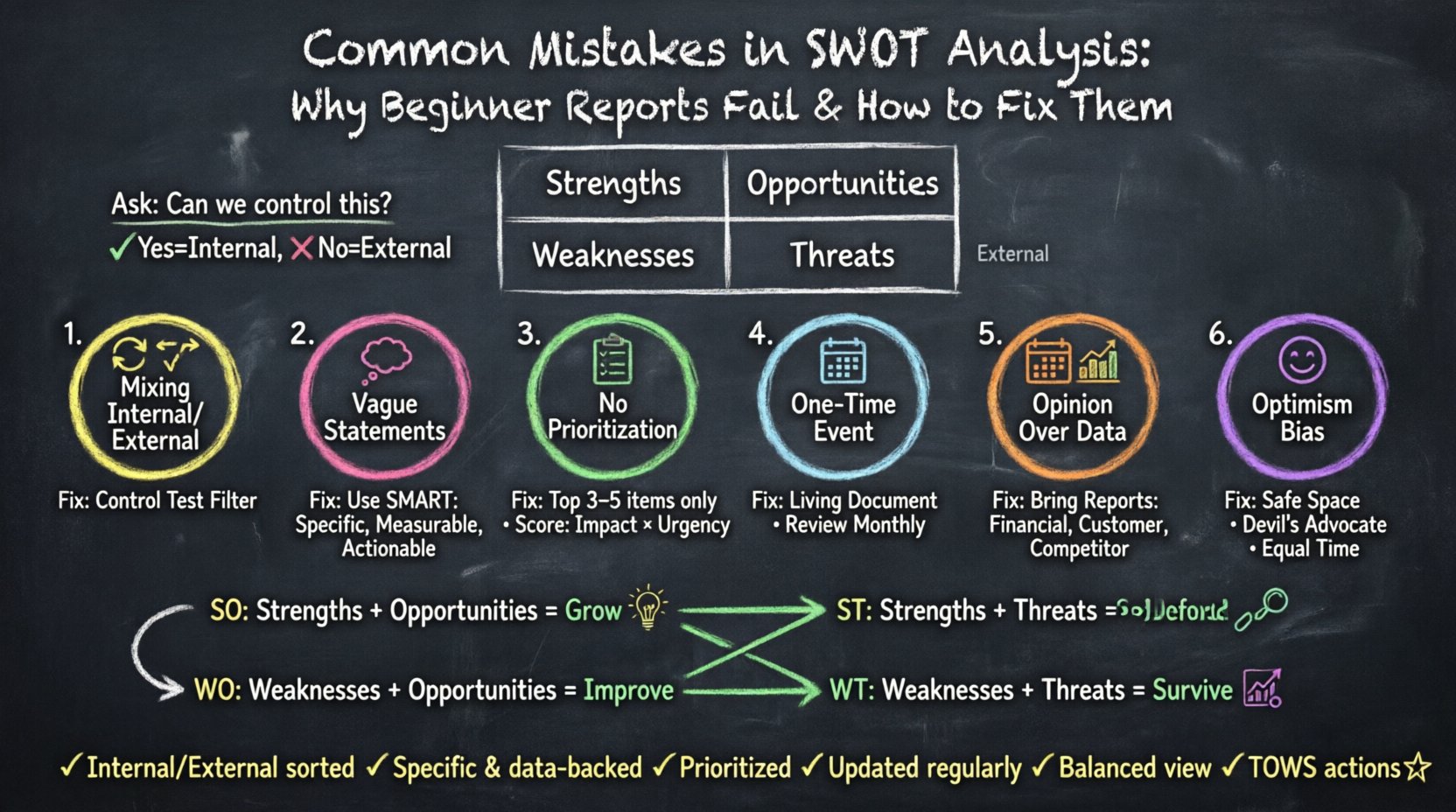
Strategic planning is the backbone of any successful organization. Among the various frameworks available, the SWOT analysis remains one of the most widely used tools for evaluating a business position. However, despite its popularity, many reports fail to deliver actionable insights. This often stems from fundamental errors in execution. Understanding these pitfalls is the first step toward creating a document that actually drives decision-making.
This guide dissects the most frequent errors found in SWOT analysis reports. We will explore why these mistakes occur, the negative impact they have on strategy, and provide concrete methods to correct them. By the end, you will have a clearer understanding of how to build a robust analysis that stands the test of scrutiny.
Before identifying where things go wrong, we must establish what a proper SWOT analysis entails. It is a strategic planning technique used to identify Strengths, Weaknesses, Opportunities, and Threats. The framework helps organizations evaluate internal capabilities and external market conditions.
The goal is not just to list these items, but to understand the interplay between them. A simple list is rarely enough to guide strategy.
One of the most persistent errors is misclassifying factors. Teams often place external market trends inside the “Strengths” or “Weaknesses” quadrants, or they list internal capabilities under “Opportunities” or “Threats”.
Confusion here leads to flawed strategies. You cannot control the economy (external), so it does not belong in your Strengths. You cannot outsource your company culture (internal), so it is not an external Threat.
Apply a strict filter before writing anything down. Ask: Can we control this?
Consider this example:
| Statement | Classification | Correct Category |
|---|---|---|
| Our software has a bug. | Positive | Weakness (Internal) |
| A competitor just lowered prices. | Negative | Threat (External) |
| We have a patent for our tech. | Positive | Strength (Internal) |
| New government regulations favor our sector. | Positive | Opportunity (External) |
Ensuring this distinction is clear prevents the analysis from becoming a generic list of feelings rather than a strategic map.
Beginner reports often suffer from a lack of specificity. Phrases like “Good reputation,” “High quality,” or “Competitive pricing” are common. While true, they offer no direction for action. Every company claims to have high quality. How does yours differ?
Vagueness renders the analysis useless for problem-solving. If you identify a weakness as “Poor marketing,” you do not know where to start fixing it.
Use the SMART criteria for your points. Be specific, measurable, and actionable.
Specific data points force the team to confront reality. They also make it easier to track progress later.
A common tendency is to list everything. Teams often produce a SWOT with 50 items in each quadrant. A list of this magnitude is overwhelming. It dilutes focus. If everything is important, nothing is important.
Strategic resources are finite. You cannot fix every weakness or pursue every opportunity simultaneously. Without prioritization, the analysis becomes a graveyard of ideas.
Apply a scoring system. Rate each item based on two metrics:
Focus only on the top 3 to 5 items in each quadrant. These are the drivers of your strategy. The rest can be noted for future review but should not clutter the main document.
SWOT analysis is often treated as a quarterly or annual checkbox exercise. Once the meeting is over, the document is filed away. This static approach ignores the dynamic nature of business environments.
Markets shift, technologies evolve, and internal teams change. A report created six months ago may no longer be relevant today. Relying on stale data leads to outdated strategies.
Integrate the analysis into ongoing planning cycles. Treat it as a living document.
This ensures the analysis reflects the current state of the organization, allowing for agile adjustments.
Many SWOT sessions are based on opinions rather than evidence. Participants might say, “We think the market is shrinking,” without looking at sales data or market reports. This optimism bias or pessimism bias skews the results.
Opinions are valuable, but they must be backed by facts. Without data, the analysis is merely a discussion group, not a strategic tool.
Conduct preliminary research before the meeting. Gather the following:
Bring this data to the table. It grounds the discussion in reality and reduces the influence of the loudest voice in the room.
It is human nature to focus on the positive. Teams often spend the majority of time listing Strengths and Opportunities while glossing over Weaknesses and Threats. This creates a false sense of security.
If you ignore your weaknesses, you cannot fix them. If you ignore threats, you cannot prepare for them. A SWOT that only looks forward without looking inward is dangerous.
Create a safe environment for honest critique. Explicitly state that the goal is improvement, not blame.
True strength lies in knowing your vulnerabilities and having a plan to mitigate them.
Once the SWOT is complete and corrected, the next step is often neglected: connecting the dots. A SWOT matrix lists items, but it does not suggest actions. This is where the TOWS Matrix comes in. It transforms the static list into a dynamic strategy.
For example:
This level of synthesis is what separates a beginner report from a strategic asset.
To ensure your next SWOT analysis is robust, follow this checklist before finalizing the document.
Using this checklist ensures that the final output is not just a formality, but a tool for execution.
Why does this matter so much? Because strategy drives execution. If the strategic foundation is weak, the execution will fail.
Avoiding these common mistakes saves time, money, and reputation. It ensures that the effort put into planning translates into actual business value.
Building a high-quality SWOT analysis requires discipline. It is not about filling a grid; it is about understanding the business landscape.
By adhering to these principles, you move from a beginner mindset to a professional strategic approach. The tool itself is simple, but the application requires depth and rigor.
The difference between a failed report and a successful strategy often lies in the details. It is the difference between saying “We are good” and saying “We have a 95% retention rate because of our onboarding process.” It is the difference between listing “Competitors” and analyzing “Competitor X’s pricing model vulnerability.”
Take the time to refine your process. Gather the data. Challenge the assumptions. Connect the dots. When you do, the SWOT analysis becomes a powerful engine for growth rather than a forgotten document on a shelf.
Start reviewing your current reports today. Identify one mistake from this list and correct it. That small step will improve the quality of your strategic planning immediately.
