 Visual Paradigm Desktop |
  Visual Paradigm Online
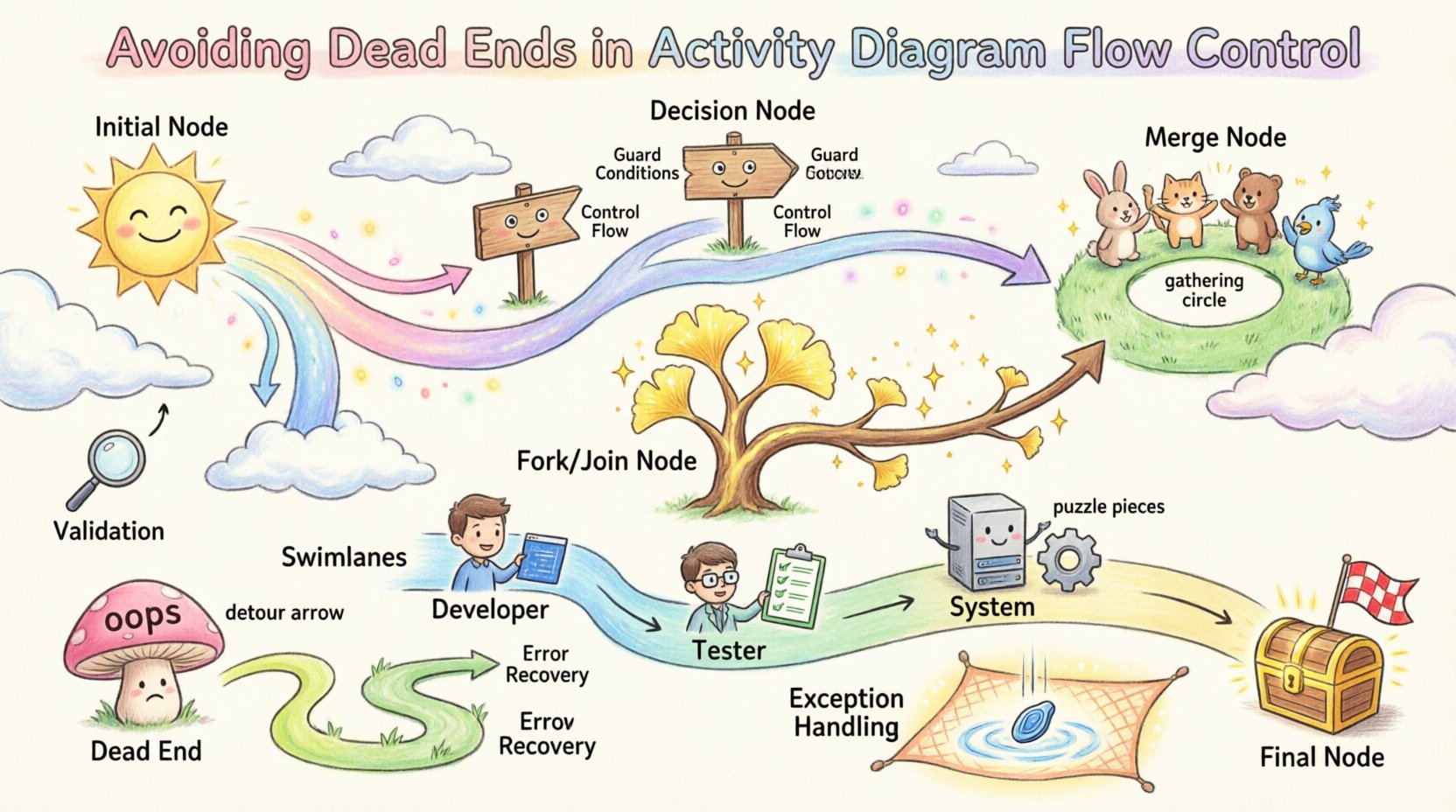
Activity diagrams serve as the backbone of process modeling within software engineering and system design. They provide a visual representation of the dynamic aspects of a system, detailing the flow of control from one activity to another. However, a common pitfall in this discipline is the creation of dead ends. A dead end occurs when a flow reaches a state where no further action is possible without an explicit final node or an error handling mechanism. These interruptions can lead to system hangs, undefined states, and critical failures during execution.
This guide explores the intricacies of flow control in activity diagrams. We will examine the mechanisms required to ensure every path leads to a defined outcome. By understanding the underlying principles of control flow, you can construct robust models that accurately reflect system behavior without unexpected interruptions. The goal is clarity, precision, and reliability in your design artifacts.
At its core, an activity diagram maps the sequence of actions within a process. Flow control dictates how the system transitions between these actions. Without proper control, a process might branch in a direction that offers no exit. To prevent this, one must understand the basic building blocks that govern movement through the diagram.
When modeling complex processes, it is easy to lose track of where a specific token or thread of execution is heading. A robust flow control strategy ensures that every token that enters the system eventually leaves it. This requires a deliberate design approach where no path is left hanging.
Dead ends often arise from incomplete logic or oversimplified branching. Before refining a diagram, it is essential to audit it for paths that terminate prematurely. A dead end is visually identifiable as an edge that points to nowhere, or an action that has no outgoing flow except to a final node that was not intended.
Here are common scenarios where dead ends occur:
To mitigate these risks, perform a path tracing exercise. Start at the initial node and follow every possible path to its termination. If a path ends without hitting a final node, you have identified a dead end.
Several standard constructs exist to manage flow. Mastering these allows you to direct traffic through your model effectively. Each construct serves a specific purpose in maintaining continuity.
| Construct | Function | Flow Behavior |
|---|---|---|
| Decision Node | Evaluates a condition to choose a path | One input, multiple outputs |
| Merge Node | Combines multiple incoming flows | Multiple inputs, one output |
| Fork Node | Splits one flow into parallel paths | One input, multiple outputs |
| Join Node | Waits for all parallel paths to complete | Multiple inputs, one output |
| Activity Final Node | Terminates the entire activity | Multiple inputs, no output |
Using these constructs correctly ensures that the logical flow remains continuous. For instance, a decision node without a corresponding merge node can lead to disjointed logic. Similarly, a fork without a join can result in orphaned threads of execution.
Parallel execution is a powerful feature in modern systems. Activity diagrams allow you to represent this using fork and join nodes. However, parallelism introduces complexity regarding synchronization. If not managed correctly, parallel paths can create dead ends or race conditions.
When a fork node is used, the control flow splits into multiple simultaneous threads. Each thread executes independently until they reach a join node. The join node acts as a synchronization barrier. It waits for all incoming flows to arrive before allowing the single outgoing flow to proceed.
Consider the following requirements for parallel flow:
A common mistake is to create a fork where one path is significantly longer than the others. If the short path completes and hits a merge or final node prematurely, the long path may become irrelevant or stranded. Always ensure all parallel branches converge at a valid synchronization point.
Swimlanes organize activities by organizational units, roles, or system components. They clarify who or what is responsible for a specific action. While swimlanes improve readability, they can also introduce flow control issues if transitions cross boundaries incorrectly.
When a flow crosses from one swimlane to another, it represents a handoff. This handoff must be explicit. An implicit handoff often leads to ambiguity about when control is transferred. To maintain clear flow:
Dead ends in swimlanes often happen when a process step is assigned to a lane that has no mechanism to continue the process. For example, if Lane A sends data to Lane B, but Lane B has no action to process that data, the flow stops. Every lane must be capable of handling the inputs it receives.
Real-world systems encounter errors. A robust activity diagram must account for these scenarios. Ignoring exceptions is a primary cause of dead ends. If a process fails at step five, where does the flow go? If there is no answer, the model is incomplete.
Implementing exception handling involves defining alternative paths for failure scenarios. These paths should lead to either a recovery action or a graceful termination.
Key strategies for error management include:
By explicitly modeling failure, you prevent the system from entering a state where it waits indefinitely for a condition that will never be met. This reduces the risk of hanging processes in production environments.
Once the diagram is drafted, validation is necessary. This process involves checking the diagram against a set of rules to ensure flow integrity. Validation can be manual or automated using modeling tools.
Manual validation steps include:
Refinement involves simplifying the model without losing detail. Complex diagrams are harder to validate. If a section of the diagram is overly convoluted, consider breaking it down into sub-activities.
| Validation Step | Action | Goal |
|---|---|---|
| Node Count | Count inputs and outputs per node | Identify dangling edges |
| Loop Check | Trace loops for termination | Prevent infinite loops |
| Condition Check | Review guard conditions | Ensure all paths are reachable |
| Final Node Check | Verify termination points | Prevent dead ends |
Even experienced modelers encounter recurring issues. Recognizing these patterns helps in avoiding them in future designs.
A well-structured diagram is easier to maintain over time. As systems evolve, the diagrams must evolve with them. Adhering to best practices ensures longevity and clarity.
Focus on these areas:
By following these guidelines, you create models that are not just accurate representations of the current state, but also guides for future development and debugging. The effort invested in preventing dead ends now saves significant time during implementation and testing phases.
Beyond basic constructs, advanced patterns offer more nuanced control. These include iterative loops, dynamic object creation, and complex state transitions.
Iterative loops require careful attention to termination. A loop node must have a clear exit condition. If the condition depends on external data, ensure that the data source is reliable. If the data source is unavailable, the loop may never exit.
Dynamic object creation introduces new entities into the flow. When a new object is created, the diagram should show where this object goes next. If the object is created but not consumed, it is a resource leak. Ensure every created object has a defined lifecycle within the activity.
State transitions often require intermediate nodes. A state change is not instantaneous. It involves validation, processing, and confirmation. Representing these steps explicitly prevents the assumption that a state change happens without effort. This granularity helps in identifying where delays or failures might occur.
Activity diagrams do not exist in isolation. They often integrate with sequence diagrams, state machine diagrams, and class diagrams. Consistency across these artifacts is crucial.
When integrating with sequence diagrams:
Discrepancies between diagrams lead to confusion. A flow that looks correct in an activity diagram might be impossible if the sequence diagram shows missing messages. Cross-referencing these artifacts during the design phase ensures a cohesive system architecture.
Ensuring flow integrity is a continuous process. It requires vigilance at every stage of modeling. By understanding the constructs, validating paths, and planning for exceptions, you eliminate dead ends before they become problems.
The following checklist serves as a final review tool:
Adhering to these standards results in high-quality models. These models serve as reliable blueprints for development, reducing ambiguity and increasing confidence in the system design. The strategic management of activity diagram flow control is not just about drawing lines; it is about ensuring the logic of the system holds up under scrutiny. This discipline transforms abstract requirements into concrete, executable paths.
As you refine your skills, remember that clarity is the primary objective. A diagram that is easy to understand is a diagram that is less likely to be misunderstood. Focus on creating paths that are logical, complete, and robust. This approach minimizes risk and maximizes the value of your design work.
