
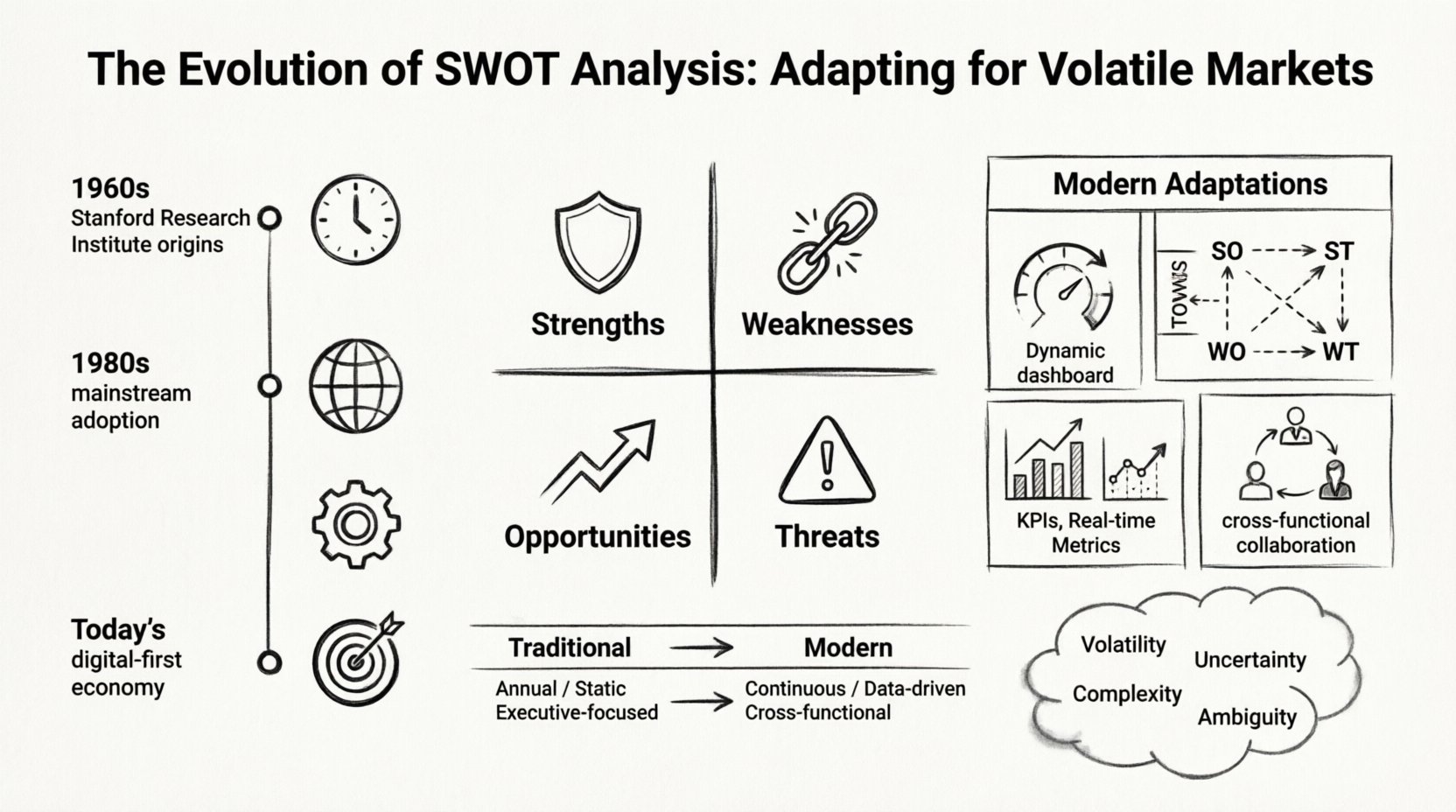
Strategic planning has long relied on established frameworks to navigate uncertainty. Among these, the SWOT analysis stands as a cornerstone of business strategy. Developed decades ago, this tool was designed to bring clarity to complex decision-making processes. However, the business landscape has shifted dramatically since its inception. Markets are no longer stable; they are fluid, interconnected, and rapidly changing. The question facing organizations today is not whether to use SWOT, but how to adapt this classic framework for modern volatility.
This guide explores the lifecycle of the SWOT analysis, examining its origins, its traditional application, and the necessary evolutions required to make it effective in a digital-first economy. We will move beyond the static checklist approach to discuss dynamic strategic planning methods that integrate real-time data and cross-functional collaboration.
Understanding where a tool comes from provides context for how it should be used today. The concept behind SWOT did not appear overnight. It traces back to the 1960s and 1970s at the Stanford Research Institute. Researchers like Albert Humphrey led projects aimed at improving corporate planning. The original acronym stood for Strengths, Weaknesses, Opportunities, and Threats.
During that era, the goal was largely stability. Large corporations sought to maximize internal capabilities while minimizing external risks. The environment was relatively predictable compared to today. Decisions were made on annual cycles, and market shifts were often measured in years rather than weeks. This context shaped the initial design of the framework, which favored a static snapshot of the organization.
Over time, the framework migrated from academic research into mainstream business practice. By the 1980s, it was a staple in management textbooks. MBA programs taught it as a fundamental skill. However, as the pace of innovation accelerated, the tool began to show signs of strain. The linear nature of the model did not always account for the exponential growth of technology or the speed of global economic shifts.
Before adapting the framework, it is necessary to define its core components clearly. The traditional SWOT analysis divides factors into two categories: internal and external. It further divides these into positive and negative aspects.
In a traditional workshop, teams would gather and brainstorm items for each quadrant. The output was typically a two-by-two matrix. While simple, this simplicity often led to oversimplification. Teams might list vague concepts like “good management” under Strengths without defining what that meant or how it translated to revenue.
The modern business environment is defined by volatility, uncertainty, complexity, and ambiguity. This acronym, VUCA, describes the context in which today’s strategies must operate. A static SWOT analysis, created once a year, often becomes obsolete before it is even presented to leadership. By the time a strategy is executed, the “Opportunities” listed might no longer exist, and the “Threats” might have already materialized.
Several factors contribute to this obsolescence:
Relying on a static document for strategic direction in this climate creates a false sense of security. It suggests that the plan is complete when it is actually just a starting point. To survive, organizations must treat strategic analysis as a continuous process rather than an annual event.
To remain relevant, the SWOT analysis must evolve. This does not mean discarding the model entirely. The core logic of categorizing internal and external factors remains sound. However, the delivery, frequency, and integration of the analysis must change.
Instead of a single annual document, modern SWOT analysis should be a living dashboard. Data points should be updated regularly. For example, if a competitor launches a new product, the “Threats” section should reflect this immediately. This requires a cultural shift where strategy is seen as agile.
SWOT is rarely used in isolation anymore. It pairs effectively with other strategic tools to add depth and context. Combining SWOT with PESTLE analysis (Political, Economic, Social, Technological, Legal, Environmental) ensures that external factors are thoroughly scrutinized. Similarly, integrating with OKRs (Objectives and Key Results) ensures that the insights gained from the analysis translate into actionable goals.
A significant evolution is the shift from SWOT to TOWS. While SWOT lists factors, TOWS focuses on generating strategies by matching them. It forces the team to answer specific questions:
This shift moves the conversation from analysis to action. It prevents the common pitfall of identifying a weakness without a plan to address it.
Qualitative brainstorming has its place, but modern analysis benefits from quantitative data. Instead of guessing a strength, teams should look at metrics like customer retention rates or Net Promoter Scores. Instead of assuming a threat, teams should monitor industry reports or sentiment analysis data. This grounds the analysis in reality rather than perception.
The following table highlights the key differences between the classic approach and the adapted modern version.
| Feature | Traditional SWOT | Modern Adapted SWOT |
|---|---|---|
| Frequency | Annual or Bi-annual | Continuous or Quarterly |
| Input Source | Internal brainstorming | Data-driven + External Intelligence |
| Output | Static Document | Actionable Strategy & Metrics |
| Focus | Listing Factors | Connecting Factors to Strategy |
| Ownership | Executive Team | Cross-Functional Teams |
Running a SWOT analysis today requires a different facilitation style. The goal is to avoid groupthink and ensure diverse perspectives are heard. Here is a structured approach to conducting a session without relying on specific software products.
Before the meeting, gather relevant information. This includes financial reports, customer feedback, market research, and competitor analysis. Distribute this material to participants in advance. This ensures that the discussion is grounded in facts, not assumptions. When participants arrive, they should already have a baseline understanding of the current state.
Invite people from different levels of the organization. Front-line employees often see threats and weaknesses that leadership misses. Similarly, they may see opportunities for innovation. A room full of only executives will produce a different result than a mixed group. Aim for 6 to 10 participants to maintain focus while ensuring variety.
Use a whiteboard or digital collaborative space. Divide the space into the four quadrants. Start with Strengths and Weaknesses, then move to Opportunities and Threats. Use time-boxing to keep the session moving. For example, allocate 15 minutes per quadrant. Encourage participants to be specific. Avoid vague terms.
Not all factors are created equal. Use a dot-voting system to prioritize the top three items in each quadrant. This forces the group to make decisions about what truly matters. It prevents the list from becoming a laundry list of every possible issue. Focus energy on the critical few.
Once the top priorities are identified, move to the TOWS matrix. Discuss how the top Strengths can leverage the top Opportunities. Discuss how Weaknesses might expose the organization to Threats. Draft specific initiatives to address these connections. Assign owners and timelines to these initiatives immediately.
Set a date to review the analysis. This could be monthly or quarterly. Ask: Did the Opportunities become realities? Did the Threats materialize? Did our Strengths hold up? This review loop ensures the strategy remains relevant.
Even with modern adaptations, the SWOT analysis can fail if executed poorly. Recognizing these pitfalls is essential for success.
Different industries face unique challenges. The application of the framework must reflect these nuances.
In tech, the speed of change is the primary driver. A SWOT analysis for a software company must focus heavily on technological obsolescence. Opportunities might include API integrations or cloud migration. Threats often come from open-source alternatives or platform dependency. The review cycle should be quarterly.
Regulatory compliance is a major factor. Threats often involve policy changes or patent expirations. Strengths might include proprietary research or established trust. Opportunities lie in telehealth expansion or personalized medicine. Data privacy is a critical component of the analysis here.
Customer experience is the differentiator. Strengths include supply chain efficiency or brand loyalty. Weaknesses might be inventory management or last-mile delivery costs. Opportunities involve omnichannel integration. Threats include shifting consumer behaviors or economic inflation impacting discretionary spending.
Data is the backbone of modern strategic analysis. Manual analysis is prone to error and bias. Integrating data analytics allows teams to see patterns that are invisible to the naked eye.
For example, customer churn data can reveal a hidden Weakness in product satisfaction. Social listening tools can highlight emerging Opportunities in customer sentiment. Financial modeling can quantify the impact of a specific Threat on the bottom line. This quantitative layer adds weight to the qualitative discussions.
However, data should inform, not dictate. Numbers tell you what is happening, but human insight explains why. The combination of data-driven evidence and human creativity creates the most robust strategy.
As we look toward the future of strategic planning, several trends are emerging. Artificial Intelligence will play a larger role in gathering and synthesizing information. AI tools can scan market news, competitor filings, and economic reports to update the “Threats” and “Opportunities” quadrants in real-time.
Furthermore, the distinction between internal and external may blur. With the rise of ecosystems and partnerships, a partner’s weakness can become your threat. A competitor’s strength can become your opportunity through collaboration. The framework must account for these network effects.
Strategic agility will become the defining competitive advantage. Organizations that can pivot based on new data will outperform those stuck to a rigid annual plan. The SWOT analysis, when treated as a dynamic system rather than a static document, supports this agility.
To ensure the SWOT analysis delivers value in a volatile market, adhere to these guidelines:
The classic SWOT analysis remains a powerful tool, but its power lies in how it is applied. In the past, it served as a snapshot for a stable world. Today, it must serve as a compass for a moving target. By adapting the framework to prioritize speed, data, and action, organizations can navigate uncertainty with confidence. The goal is not to predict the future perfectly, but to build the resilience to respond to it effectively.