
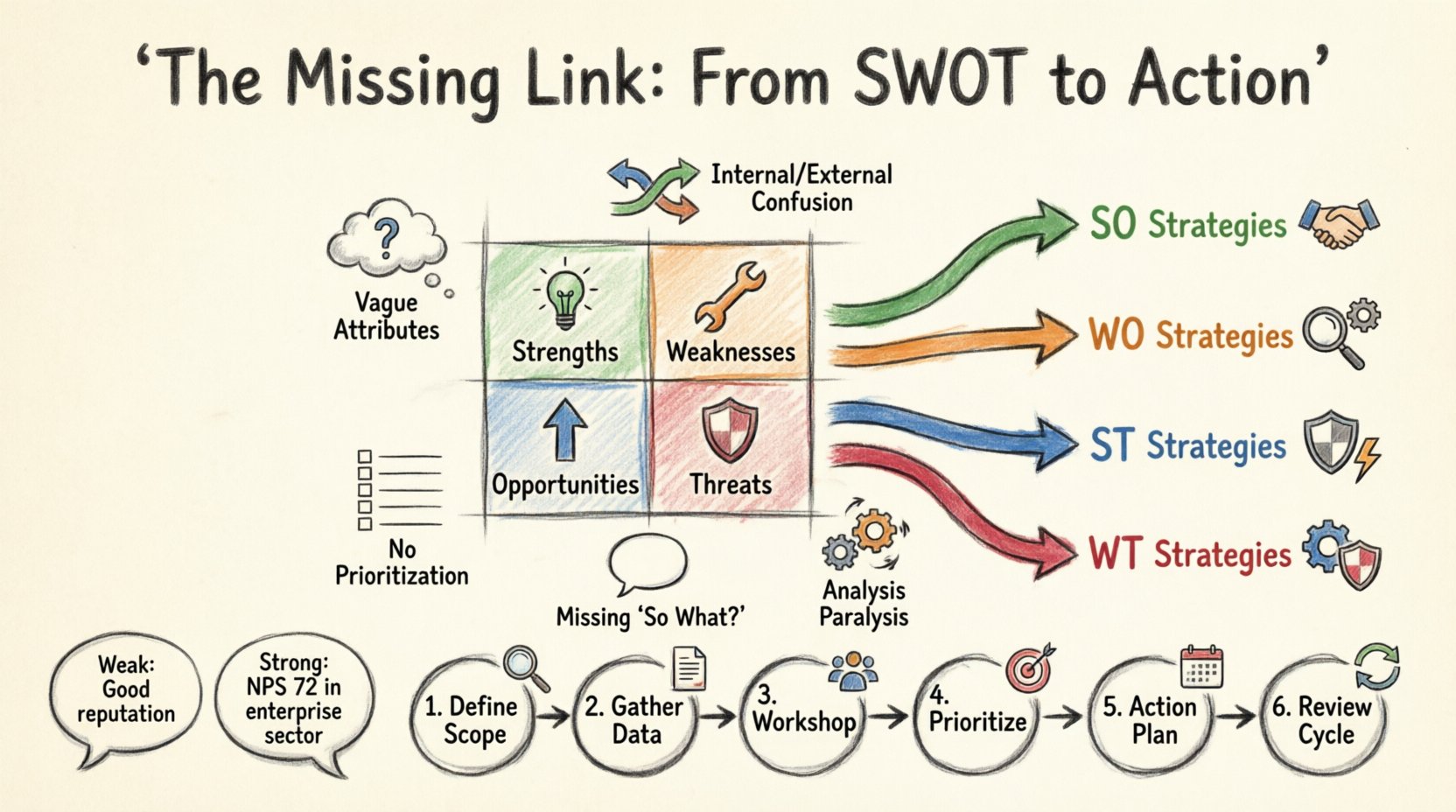
Strategic planning is often where ambitious ideas go to die. You gather the team, you open the spreadsheet, and you start ticking boxes. Strengths here. Weaknesses there. Opportunities on the horizon. Threats lurking in the shadows. 📉
But when the dust settles, the strategy document sits on a shelf. It becomes a historical artifact rather than a living guide. This is not uncommon. In fact, it is the standard operating procedure for many organizations. The tool itself—SWOT analysis—is robust, time-tested, and fundamentally sound. Yet, the execution is where the breakdown occurs.
If your strategic planning process feels like a box-ticking exercise that yields no tangible results, you are likely suffering from a specific set of cognitive and structural errors. This guide dissects the anatomy of a failed SWOT analysis and provides a concrete framework to repair it. We are not here to sell you a new methodology. We are here to refine the one you already have.
Before diagnosing the failure, we must agree on the function of the tool. SWOT stands for Strengths, Weaknesses, Opportunities, and Threats. It is a framework for situational analysis. Its primary goal is to bridge the gap between internal capabilities and external realities.
When done correctly, this matrix forces leadership to confront uncomfortable truths about internal limitations while remaining alert to market shifts. However, many teams treat it as a brainstorming session rather than a diagnostic tool. The difference lies in depth. A brainstorming session generates volume. A diagnostic tool generates insight.
Why does this specific framework so frequently lose its potency? It is rarely because the concept is flawed. It is because of how it is applied. Below are the five most prevalent failure points.
One of the most common errors is generating a list of generic descriptors. Phrases like “good team,” “strong brand,” or “high quality” appear frequently in these documents. These are not strategic assets; they are platitudes.
Without data, a strength is just an opinion. Without specific data, a weakness is just a complaint. You must ground every entry in evidence.
Clarity is paramount. The distinction between the internal (Strengths/Weaknesses) and the external (Opportunities/Threats) is the backbone of the matrix. Teams often blur this line.
For example, “increasing demand for our product” is an Opportunity, not a Strength. You cannot control the market demand; you can only respond to it. A Strength would be your capacity to scale production to meet that demand.
When you misclassify factors, your strategy becomes misaligned. You might try to “strengthen” a market trend (impossible) or “exploit” a capability you don’t have (impossible). Keeping the quadrants distinct ensures you are fighting the right battles.
SWOT matrices often end up as laundry lists. They contain twenty strengths and fifteen threats. When everything is important, nothing is important. A strategic plan requires focus. It requires trade-offs.
If you have a list of ten critical threats, your team cannot address them all simultaneously. You must prioritize based on impact and probability. This forces a conversation about where to allocate resources. Without prioritization, the SWOT remains a static inventory rather than a dynamic roadmap.
Many organizations spend weeks analyzing data but never move to action. They believe the analysis itself is the strategy. It is not. The SWOT is merely the input. The output must be a decision.
For every item in the SWOT, you must answer one question: “So what?” If a strength is identified, what does it enable? If a threat is identified, what does it endanger? If you cannot answer this, the item is noise.
This question forces the team to connect the dots. It transforms a list of facts into a narrative of consequence. It is the bridge between diagnosis and prescription.
The “missing link” in most strategies is the transition from the SWOT matrix to the TOWS Matrix. The SWOT lists items. The TOWS (also known as a strategic cross-matching matrix) combines them to generate strategies.
This is where the magic happens. It forces you to look for relationships between the quadrants.
You do not just list items; you pair them. This creates four distinct strategic directions:
Most teams skip this step. They leave the SWOT as a list of attributes. By integrating the TOWS framework, you convert attributes into actions.
To ensure clarity, let’s look at a side-by-side comparison of how vague inputs degrade strategy versus how specific inputs build it.
| Category | Weak Entry (Generic) | Strong Entry (Actionable) |
|---|---|---|
| Strength | Good customer service. | 24/7 support team with 95% resolution rate on first contact. |
| Weakness | Outdated technology. | CRM system lacks API integration, slowing sales cycle by 14 days. |
| Opportunity | Market growth. | Competitor X is exiting the Southeast region, creating a 10% share gap. |
| Threat | New regulations. | New compliance law increases data storage costs by 20% in Q3. |
Notice the difference in the “Strong” column. They contain metrics, specific contexts, and clear implications. This allows for immediate resource allocation.
If you are preparing to run a SWOT analysis, follow this structured approach. It removes the guesswork and ensures the output is usable.
Do not analyze “the company.” Analyze a specific product, a specific department, or a specific market entry. Broad scopes yield broad results. Narrow scopes yield actionable intelligence. Define the horizon clearly.
You need diversity of thought. Include individuals from sales, engineering, customer support, and finance. However, limit the group size. A large group leads to groupthink or dominant voices drowning out others. A core group of 5-7 people is often ideal for deep work.
Do not start with a blank whiteboard. Bring data. Bring reports. Bring customer feedback. Bring financial statements. Force the team to cite sources for their claims. This prevents the “I feel like” syndrome.
Conduct the brainstorming session with strict timeboxing. Give 15 minutes for each quadrant. Use sticky notes. This allows for movement and rearrangement of ideas. Encourage debate. If someone says “We are strong,” ask “Against whom?” and “How do we know?”
Once the lists are populated, move to the TOWS matrix. Group similar items. Use dot voting to prioritize the top 3 items in each quadrant. Do not keep more than three. If you have more, you do not have a strategy; you have a wish list.
For the top priorities, assign an owner and a deadline. A strategy without an owner is a suggestion. A strategy without a deadline is a dream. Link these actions to existing OKRs or KPIs to ensure they are tracked.
Even with a perfect framework, human psychology can sabotage the process. Be aware of these biases during your session.
Mitigation requires a designated “Red Team.” Assign one person or a subset of the group to play devil’s advocate. Their job is to challenge every assumption. This adds friction, but friction creates heat, and heat creates clarity.
A SWOT analysis is not a one-time event. It is a snapshot in time. The market changes. The internal team changes. The technology changes. If you created this document six months ago, it is likely obsolete today.
Establish a review cycle. Quarterly reviews are standard. Monthly reviews are better for fast-moving industries. During these reviews, revisit the original list. Ask:
This iterative approach keeps the strategy alive. It prevents the “shelf-ware” problem where the document is created once and forgotten. It turns the SWOT into a dashboard for strategic health.
How do you know if your SWOT analysis worked? You do not measure the quality of the list. You measure the outcome of the actions derived from the list.
Key performance indicators for a successful strategic process include:
If you cannot answer these questions, the analysis was an academic exercise. If you can answer them with data, the analysis was a strategic asset.
Building a robust strategy is not about finding the perfect tool. It is about rigorous application of a known framework. The SWOT analysis is a mirror. It reflects your reality. If the reflection is blurry, it is not the mirror’s fault; it is the cleaning.
By moving away from vague lists, focusing on internal vs. external distinctions, and forcing the connection to action via the TOWS matrix, you transform a static document into a dynamic engine. This requires discipline. It requires data. It requires the courage to admit weaknesses.
But the result is worth the effort. A strategy that works is not a lucky accident. It is the product of clear thinking and deliberate execution. When you stop treating SWOT as a checkbox and start treating it as a compass, your organization gains the clarity needed to navigate complex markets.
Start by auditing your current documents. Are they lists? Or are they plans? The difference is action. Make sure your strategy drives that action forward.