
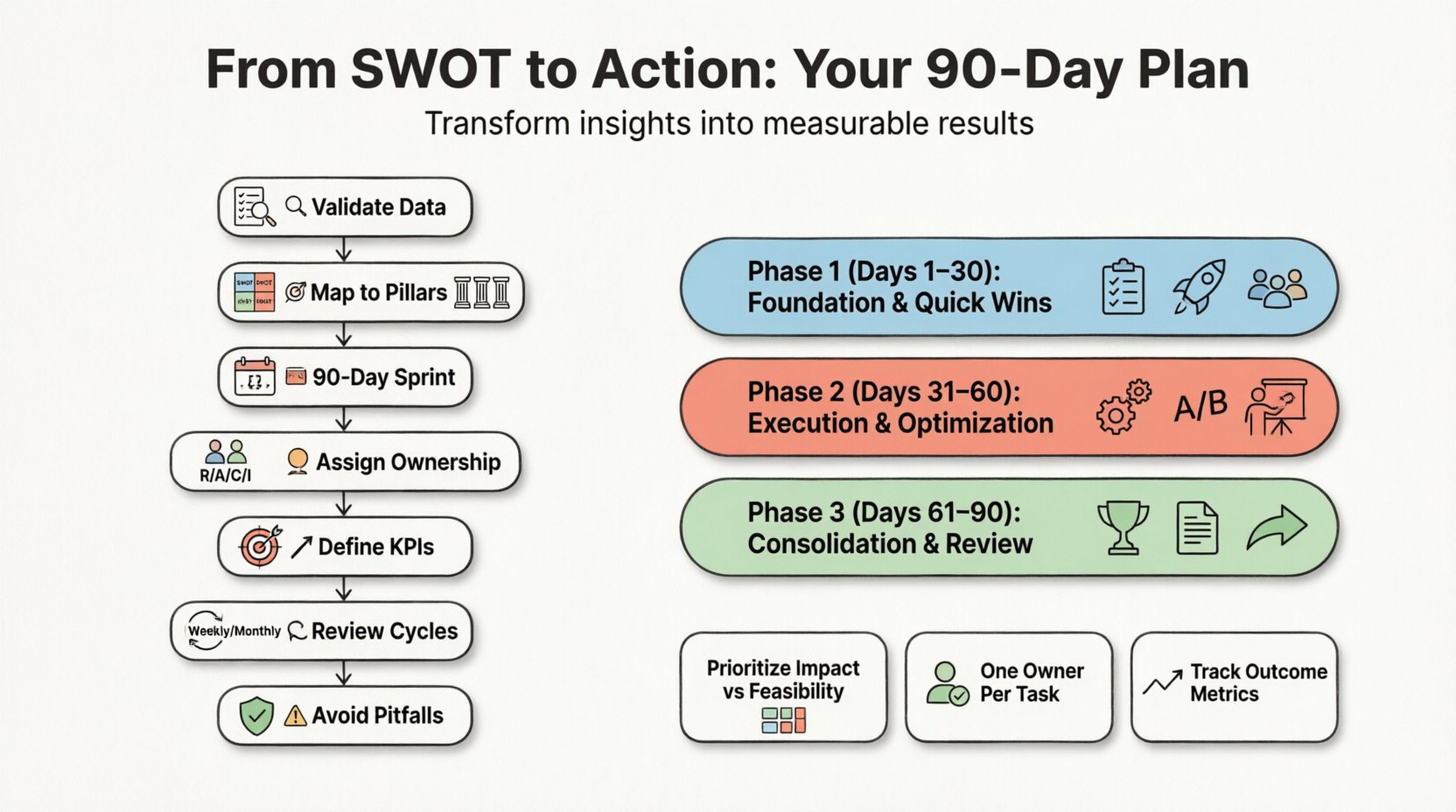
Strategic planning often starts with a blank page, a spreadsheet, or a whiteboard session filled with sticky notes. The SWOT analysis is a staple in this process, yet it frequently ends up gathering digital or physical dust. Many managers conduct the analysis, list the Strengths, Weaknesses, Opportunities, and Threats, and then move on to the next quarterly meeting. The gap between identifying these factors and executing a tangible plan is where most strategies fail.
This guide provides a practical framework for bridging that gap. We will walk through transforming abstract insights into a concrete 90-day action plan. This approach ensures that your team moves from passive observation to active execution without getting bogged down in complexity. By following this structured companion, you can align your department’s goals with organizational objectives and drive measurable results.
Before diving into the execution phase, it is vital to understand why the traditional SWOT process often stalls. A common issue is treating the SWOT as a static document rather than a dynamic tool for decision-making. When the analysis is completed, it becomes a record of the past rather than a blueprint for the future.
To avoid these pitfalls, the transition from analysis to action requires a rigorous filtering process. You must convert qualitative insights into quantitative targets.
The foundation of a successful 90-day plan is accurate data. Before planning, you must validate the SWOT findings. This step ensures that you are solving real problems and capitalizing on genuine opportunities.
Strengths and weaknesses are internal factors. They require honest self-assessment. Ask the following questions to verify these points:
Opportunities and threats are external factors. These require market intelligence and environmental scanning.
Once validated, categorize each item on a matrix based on two criteria: Impact and Feasibility. This helps in determining which items deserve a spot in the 90-day plan.
Not every item in your SWOT needs an action item. Focusing on everything leads to burnout. Instead, group your SWOT items into strategic pillars. These pillars represent the core areas of growth or improvement for the quarter.
For example, a typical department might have pillars such as Operational Efficiency, Customer Experience, and Revenue Growth. Map each SWOT point to one of these pillars.
| SWOT Category | Strategic Question | Example Action |
|---|---|---|
| Strength | How can we leverage this to gain an advantage? | Leverage high retention rate to launch a referral program. |
| Weakness | What must we fix to stop the bleeding? | Reduce onboarding time by implementing a new training module. |
| Opportunity | What can we capture that we currently miss? | Enter a new geographic market using existing distribution channels. |
| Threat | How do we mitigate the risk? | Diversify supplier base to reduce dependency on a single vendor. |
This mapping exercise ensures that every action item has a clear purpose tied to the broader strategy.
A 90-day plan is essentially a short-term sprint. It is long enough to achieve significant milestones but short enough to maintain momentum. Dividing the plan into three 30-day phases helps in managing workload and tracking progress.
The first month should focus on setting the infrastructure and achieving quick wins to build momentum. These actions are usually high-impact and low-effort.
The second month is the core execution period. This is where the heavy lifting happens. Focus on the primary initiatives identified in your SWOT mapping.
The final month focuses on wrapping up loose ends, consolidating gains, and preparing for the next quarter.
A plan without owners is just a wish list. You must assign specific roles to ensure execution.
Use the RACI framework (Responsible, Accountable, Consulted, Informed) to clarify roles for each task.
Be realistic about what your team can handle. If the SWOT analysis suggests 20 major initiatives, but you have resources for only 5, you must choose wisely.
Write these constraints explicitly in your plan document. Transparency regarding limitations prevents frustration later.
How will you know if the 90-day plan was successful? You need Key Performance Indicators (KPIs) for every strategic pillar. Avoid vanity metrics that look good but do not correlate with business value.
For each action item in your 90-day plan, define one outcome metric.
Example:
Tracking these metrics weekly allows you to stay on course. If a metric stalls, you know immediately that an intervention is required.
Consistency is key to execution. Establish a rhythm of meetings dedicated solely to reviewing the action plan. Do not let these get drowned out by operational fire-fighting.
A short 30-minute meeting with the core execution team.
A longer session (1-2 hours) with broader stakeholders.
At the end of the quarter, hold a formal review. Analyze what worked and what didn’t.
This retrospective is crucial for continuous improvement. It turns the 90-day plan into a learning loop.
Even with a solid plan, things can go wrong. Anticipating common issues helps you navigate them smoothly.
It is tempting to add new ideas as the quarter progresses. Stick to the plan. If a new opportunity arises, log it for the next cycle unless it is a critical emergency.
Do not spend months refining the plan. Perfection is the enemy of execution. Aim for “good enough” to start, then iterate based on feedback.
A 90-day sprint can be intense. Monitor team workload. If capacity is exceeded, cut lower-priority tasks rather than extending hours indefinitely.
Ensure departments communicate. A marketing action plan might rely on sales data. Maintain cross-functional touchpoints to ensure alignment.
Transforming a SWOT analysis into a 90-day action plan is not a one-time event. It is a discipline of clarity, accountability, and consistency. By following this framework, you move your team from discussing problems to solving them.
The goal is not just to produce a document, but to produce results. When you link your analysis directly to specific actions, deadlines, and owners, you create a culture of execution. This approach empowers managers to lead with confidence and teams to deliver with purpose.
Start your next quarter with this structure in mind. Validate your data, map your actions, assign ownership, and track your metrics. The path from insight to impact is paved with these deliberate steps.
 Real-World SWOT Analysis Case Study: How a Startup Pivoted Using Simple Frameworks
 Best Practices for SWOT Analysis: Avoiding Generic Lists in Corporate Strategy Sessions
 Deep Dive: Understanding the Hidden Connections Between Internal Strengths and External Threats
 SWOT Analysis for Digital Transformation: A Step-by-Step Guide for Modern Teams