
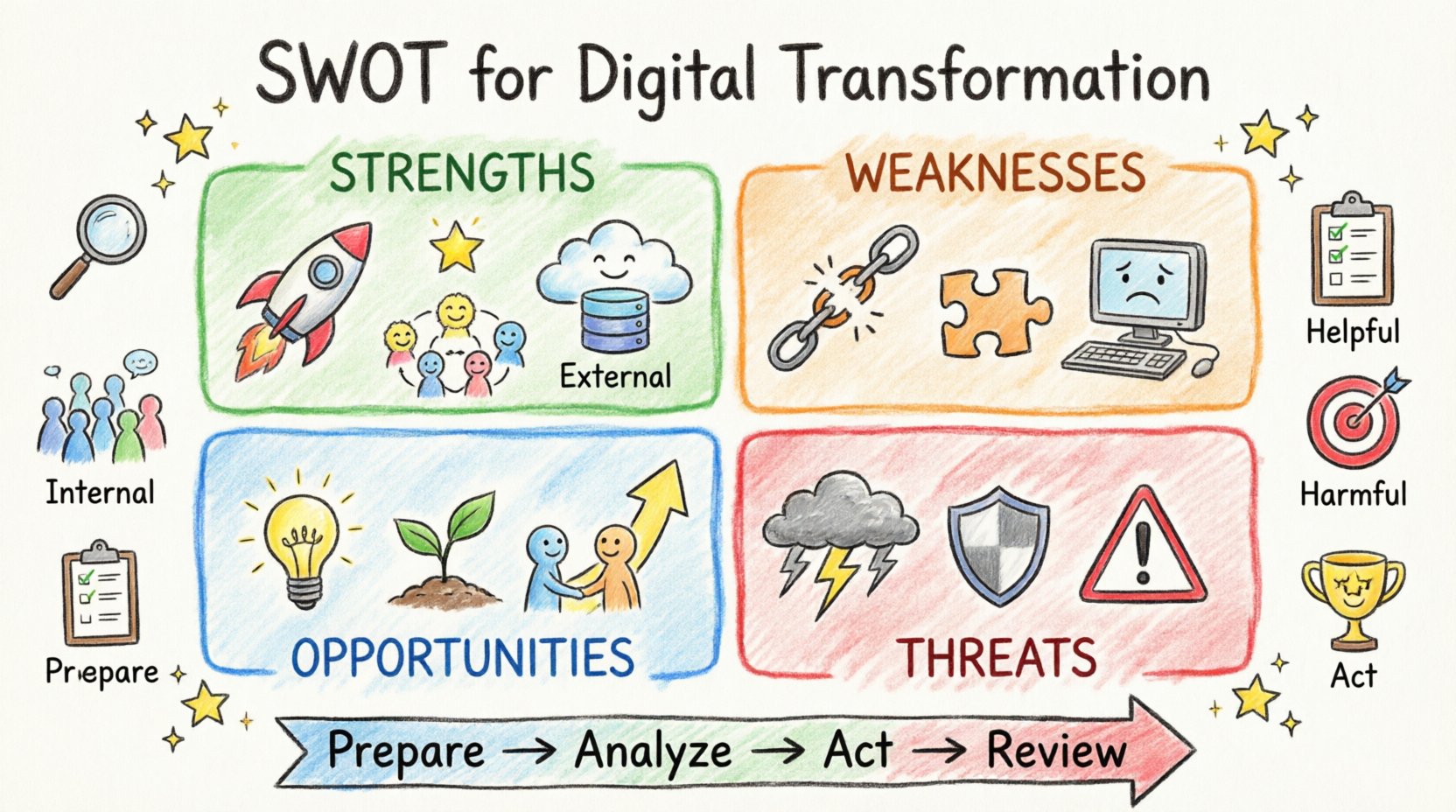
Organizations today face a relentless pace of change. Technology evolves, customer expectations shift, and competitors adapt quickly. In this environment, moving forward without a clear map is risky. Digital transformation is not merely about installing new software; it is a fundamental shift in how an organization operates and delivers value. To navigate this complex landscape effectively, teams need structured frameworks. The SWOT analysis remains a cornerstone tool for strategic planning. However, applying it to digital transformation requires a specific approach that accounts for technology, culture, and market dynamics.
This guide provides a detailed walkthrough of conducting a SWOT analysis tailored for modern digital initiatives. We will explore how to identify internal capabilities and external pressures. We will also discuss how to translate findings into actionable strategies. By the end, you will understand how to leverage this framework to build resilience and drive growth.
Digital transformation projects often fail due to a lack of clear alignment between technology and business goals. A generic strategy often misses the nuances of the current organizational state. A SWOT analysis forces a team to pause and assess reality objectively. It separates what the organization controls from what it must react to.
Without this assessment, teams risk investing in tools that do not solve core problems. They may overlook cultural barriers that hinder adoption. A structured review prevents these common pitfalls.
Before diving into the four quadrants, preparation is essential. A successful analysis requires diverse perspectives. You cannot rely on the IT department alone, nor can the executive team decide in isolation. The process must involve cross-functional collaboration.
Digital transformation is broad. Is the focus on customer experience? Operational efficiency? Or data analytics? Defining the specific scope ensures the data gathered is relevant. A broad scope often leads to vague conclusions. A narrow scope yields actionable insights.
Gather representatives from various departments. Include leadership, operations, customer support, and technical staff. Each group sees different aspects of the organization.
Opinions are valuable, but data provides evidence. Collect metrics before the workshop. Look at performance reports, customer feedback, system logs, and market research. Relying on memory alone introduces bias.
Strengths are internal attributes that give the organization an advantage. In a digital context, these are assets that can be leveraged for transformation.
Example Question: “What do we do better than anyone else in our industry?” “Which digital tools do we already use effectively?”
Weaknesses are internal limitations that place the organization at a disadvantage. Honest identification here is critical. Ignoring weaknesses leads to project failure.
Example Question: “Where do we lack resources?” “What processes slow us down?” “What technologies are we missing that competitors have?”
Opportunities are external factors that the organization could exploit to its advantage. These are trends or market conditions that align with the organization’s strengths.
Example Question: “What trends in the market can we take advantage of?” “How can we use our data to create new revenue streams?”
Threats are external factors that could cause trouble for the organization. These are risks that exist outside of the team’s direct control.
Example Question: “What obstacles do we face?” “What are our competitors doing that we are not?” “Are there regulatory changes we must prepare for?”
Listing items in four categories is only the first step. The real value comes from connecting them. You need to understand how the internal factors interact with external forces. This is often done using a TOWS matrix approach, where you cross-reference the quadrants.
| Factor | Traditional SWOT | Digital Transformation SWOT |
|---|---|---|
| Focus | General business operations | Technology integration and data usage |
| Timeframe | Long-term static view | Agile, iterative, and dynamic |
| Key Driver | Market share and physical assets | Customer experience and digital agility |
| Stakeholders | Senior management and investors | IT, Product, Operations, and Customers |
Understanding these differences ensures the analysis remains relevant to the digital context. A traditional view might overlook the speed at which technology changes.
Consider a mid-sized retail organization planning a digital upgrade.
| Internal | Positive (Helpful) | Negative (Harmful) |
|---|---|---|
| External Factors | Strengths Strong brand loyalty. Experienced sales staff. |
Weaknesses Outdated inventory system. Limited e-commerce presence. |
| Opportunities | Maximize Strengths Use loyalty data to personalize online offers. Train sales staff to guide customers to the app. |
Overcome Weaknesses Upgrade inventory system to sync online/offline. Launch a mobile-first shopping experience. |
| Threats | Use Strengths Leverage brand trust to compete against new online-only startups. Use staff expertise to provide hybrid service. |
Defend Against Weaknesses Protect against data breaches in old systems. Mitigate loss of customers to competitors with better apps. |
Once the matrix is complete, the team must prioritize. Not every item requires immediate action. Resources are finite. You must decide which strategies yield the highest return.
Map the findings to specific projects. For example, if “Outdated inventory system” is a weakness and “Customer demand for real-time stock” is an opportunity, the initiative is “Implement real-time inventory synchronization.”
Every initiative needs an owner. Designate a team member or department responsible for the outcome. This ensures accountability.
Define how success will be measured. If the goal is to improve digital adoption, the KPI might be the percentage of orders placed via the mobile app. Without metrics, progress is impossible to track.
Even with a clear plan, teams encounter obstacles. Being aware of these helps navigate them.
Teams often look for data that supports their pre-existing beliefs. They might exaggerate strengths to feel good or downplay threats to avoid anxiety. Encourage dissenting opinions during the workshop.
Phrases like “improve technology” are not useful. They must be specific. Instead, use “reduce server latency by 20%” or “integrate API with legacy CRM.”
Technology is easy to buy. Culture is hard to change. A digital strategy that ignores employee buy-in will struggle. Include cultural readiness in the Strengths and Weaknesses assessment.
A SWOT analysis is not a one-time event. The digital landscape changes rapidly. Revisit the analysis regularly. Quarterly reviews are often appropriate.
To keep the strategy alive, integrate the SWOT findings into ongoing planning cycles.
The SWOT analysis should not exist in a vacuum. It must feed into the broader organizational strategy. The insights gained here inform the vision, mission, and long-term goals.
For instance, if the analysis reveals a significant threat regarding data privacy, the strategic goal might become “To be the most secure data handler in our sector.” This shifts the entire organization’s focus. If the analysis highlights a strength in speed, the strategy might prioritize rapid deployment of features.
Integration ensures that digital transformation is not an IT project, but a business strategy supported by technology.
How do you know the analysis was useful? Success is measured by the quality of the decisions made and the speed of execution.
Digital transformation is a journey, not a destination. It requires continuous assessment and adaptation. The SWOT analysis provides the compass for this journey. It offers a structured way to look inward and outward. It turns ambiguity into clarity.
By following these steps, modern teams can build a strategy that is grounded in reality. They can leverage their unique strengths to seize opportunities. They can mitigate weaknesses and defend against threats. This disciplined approach leads to sustainable growth and resilience in a digital world.
Start the assessment today. Gather your team. Look at the data. And build a plan that moves your organization forward with confidence.