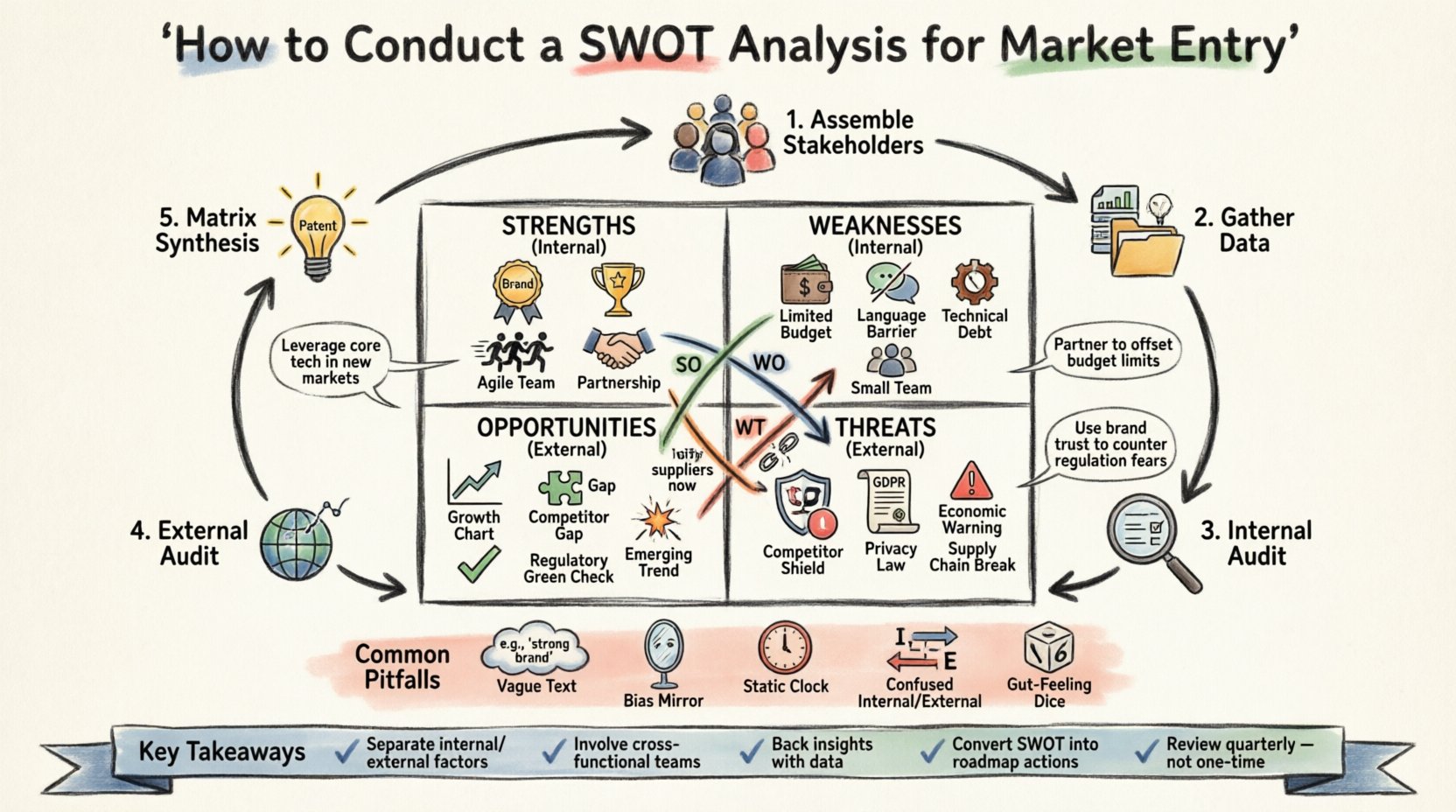
Entering a new market is one of the most significant decisions a Product Manager can make. It involves substantial investment, risk, and strategic planning. Before committing resources, you need clarity on your position relative to the landscape. This is where the SWOT analysis becomes essential. It provides a structured framework to evaluate your current standing and future potential.
For Product Managers, this exercise is not just about filling out a grid. It is about understanding the intersection of internal capabilities and external realities. A well-executed analysis helps in prioritizing features, allocating budget, and setting realistic timelines for launch. This guide walks you through the process with precision, ensuring you build a strategy based on evidence rather than intuition.
🧩 Why SWOT Matters for Market Entry
Market entry is inherently uncertain. You are moving into territory where competitors have established roots, customer behaviors may differ, and regulatory environments could be complex. A SWOT analysis helps mitigate these unknowns by forcing a systematic review of four key areas:
- Strengths: What internal assets do you possess that give you an edge?
- Weaknesses: Where are your internal limitations that could hinder progress?
- Opportunities: What external trends can you leverage for growth?
- Threats: What external factors could cause failure or significant friction?
When applied to market entry, this framework shifts the conversation from “Can we build it?” to “Should we build it, and how do we win?” It aligns stakeholders by providing a shared language for discussing risk and reward.
🔍 Understanding the Four Pillars
Before diving into the steps, it is vital to distinguish between internal and external factors. This distinction determines where the data comes from and how actionable the insights are.
1. Strengths (Internal)
These are positive attributes within your control. In a market entry context, consider:
- Proprietary technology or patents
- Established brand reputation in adjacent markets
- High customer retention rates in current regions
- Agile development teams capable of rapid iteration
- Strong partnerships with local distributors
2. Weaknesses (Internal)
These are areas where you are at a disadvantage compared to competitors or potential entrants. Focus on:
- Limited budget for marketing in the new region
- Lack of local language support
- Technical debt that slows feature deployment
- Small team size relative to the target market size
- Dependency on third-party infrastructure
3. Opportunities (External)
These are favorable external conditions you can exploit. Look for:
- Growing demand for digital solutions in the region
- Competitors struggling with customer service
- Regulatory changes favoring your business model
- Emerging trends that align with your product vision
- Unmet customer needs in the current local ecosystem
4. Threats (External)
These are challenges outside your control that could jeopardize success. Identify:
- Strong local competitors with deep pockets
- Strict data privacy laws (e.g., GDPR equivalents)
- Economic instability affecting purchasing power
- Potential supply chain disruptions
- Changing political landscapes impacting business
📋 Preparing Your Team and Data
A SWOT analysis is not a solo task. It requires cross-functional input to ensure accuracy. Product Managers should lead the initiative, but they must gather insights from various departments.
Step 1: Assemble the Right Stakeholders
Invite representatives from the following teams to ensure a holistic view:
- Sales: They know the customer pain points and competitor pricing.
- Marketing: They understand brand perception and market saturation.
- Engineering: They can assess technical feasibility and scalability.
- Legal/Compliance: They are crucial for regulatory hurdles in new regions.
- Customer Support: They hear the most frequent complaints and feature requests.
Step 2: Gather Quantitative and Qualitative Data
Opinions are valuable, but data is definitive. Collect the following before the workshop:
- Market size reports and growth projections
- Competitor pricing and feature matrices
- Internal performance metrics (churn, NPS, velocity)
- Customer interview transcripts from the target region
- Regulatory compliance checklists
Ensure all data is recent. Outdated market information can lead to flawed strategies.
🛠️ Conducting the Analysis: Step-by-Step
Once data is gathered, schedule a dedicated workshop. Do not rush this. Allocate at least half a day to ensure deep discussion.
Phase 1: Internal Audit (Strengths & Weaknesses)
Start with what you know best. This sets the baseline.
- Ask: “What do we do better than anyone else in this space?”
- Ask: “Where have we lost deals in the past due to our limitations?”
- Ask: “Do we have the engineering bandwidth to support a new market launch?”
Be honest. Acknowledging a weakness early allows you to plan for it. For example, if you lack local language support, you must budget for translation or localization tools immediately.
Phase 2: External Audit (Opportunities & Threats)
Shift focus outward. This requires looking at the ecosystem.
- Ask: “What gaps in the competitor offering can we fill?”
- Ask: “Are there upcoming regulatory changes that affect us?”
- Ask: “What economic indicators suggest a slowdown or boom?”
Keep this section focused on factors outside your direct control. You cannot fix a recession, but you can prepare for it.
Phase 3: The Matrix Table
Create a visual representation of the findings. A table helps stakeholders see the balance of factors.
| Factor |
Definition |
Market Entry Context |
Example |
| Strength |
Internal Advantage |
Unique Tech |
AI-driven analytics engine |
| Weakness |
Internal Disadvantage |
Resource Gap |
No dedicated support team for APAC |
| Opportunity |
External Advantage |
Market Trend |
Rising demand for remote work tools |
| Threat |
External Disadvantage |
Competitor Action |
Major competitor lowering prices |
🔄 Synthesizing Findings into Strategy
Once the grid is filled, the analysis is not complete. You must turn these insights into action items. This is often referred to as TOWS analysis, where you cross-reference the factors to generate strategies.
1. SO Strategies (Maxi-Maxi)
Use strengths to maximize opportunities.
- Action: Leverage your strong engineering team to rapidly build features that address the rising demand for remote work tools.
- Action: Use your brand reputation to secure partnerships with local distributors.
2. WO Strategies (Mini-Maxi)
Overcome weaknesses by taking advantage of opportunities.
- Action: Since you lack a local support team, hire a local agency to handle initial customer inquiries while you build an internal team.
- Action: If budget is tight, focus marketing spend only on the highest probability segments identified in your research.
3. ST Strategies (Maxi-Mini)
Use strengths to minimize threats.
- Action: If a competitor is lowering prices, highlight your superior product stability and support rather than entering a price war.
- Action: Use your proprietary data to create a unique value proposition that is hard to replicate.
4. WT Strategies (Mini-Mini)
Minimize weaknesses to avoid threats.
- Action: If you have technical debt, prioritize refactoring before adding new market-specific features.
- Action: If legal compliance is a threat and your team is small, invest in external legal counsel immediately.
⚠️ Common Mistakes to Avoid
Even experienced teams fall into traps during this process. Being aware of these pitfalls ensures your analysis remains robust.
- Being Too Vague: Avoid generic statements like “Good brand” or “Bad economy.” Be specific. Use “Strong brand in Europe” or “Currency fluctuation risk in Brazil.”
- Ignoring Internal Bias: Teams often overestimate strengths and underestimate weaknesses. Encourage dissenting opinions during the workshop.
- Static Thinking: Market conditions change. Treat this as a living document that requires quarterly reviews, not a one-time exercise.
- Confusing Internal with External: Ensure you do not list a competitor’s action as your weakness. A competitor’s action is a threat; your inability to react is the weakness.
- Skipping the Data: Relying solely on gut feeling leads to confirmation bias. Always back up claims with the data gathered in Phase 1.
📈 Integrating SWOT into Your Roadmap
The final step is translating the analysis into your product roadmap. This ensures the strategy drives execution.
1. Prioritization Framework
Use your SWOT findings to score initiatives. If a feature addresses a major Threat or leverages a key Strength, it should rank higher than a nice-to-have that addresses neither.
2. Resource Allocation
Allocate budget based on the Weaknesses identified. If localization is a critical weakness, move funds from marketing to product development to ensure the UI is ready.
3. Risk Management
Create a risk register based on your Threats. For every major threat, define a mitigation plan. This allows you to react quickly if the market shifts.
4. Success Metrics
Define KPIs that reflect the Opportunities. If the opportunity is “untapped enterprise segment,” your metric should be “Enterprise Pilot Signups” rather than just “Total Signups.”
🛡️ Example Scenario: SaaS Expansion to EMEA
To illustrate, consider a Product Manager planning to launch a project management tool in the EMEA region.
- Strength: The tool integrates with Slack and Microsoft Teams, which are dominant in this region.
- Weakness: The platform does not yet support GDPR-compliant data hosting.
- Opportunity: Competitors are slow to adopt AI features, leaving a gap for automation.
- Threat: New EU regulations may require data sovereignty.
Strategy: The PM prioritizes the GDPR compliance work (addressing Weakness/Threat) before the AI feature launch (Opportunity). This ensures market entry is legal and viable, using the integration strength as a marketing hook.
📝 Conclusion and Next Steps
A SWOT analysis is a foundational tool for strategic planning. It forces discipline and clarity in an uncertain environment. For Product Managers, it bridges the gap between vision and execution.
To move forward:
- Schedule your workshop within the next two weeks.
- Distribute the data request list to stakeholders.
- Ensure the output is documented and shared with leadership.
- Review the analysis quarterly to keep it current.
By following this structured approach, you reduce risk and increase the likelihood of a successful market entry. The goal is not perfection, but informed decision-making.
🔑 Key Takeaways
- Separate internal factors (Strengths/Weaknesses) from external ones (Opportunities/Threats).
- Involve cross-functional teams to avoid blind spots.
- Back every claim with data, not just opinion.
- Convert insights into actionable roadmap items.
- Treat the analysis as a living document, updated regularly.
With this guide, you are equipped to navigate the complexities of market entry with confidence and strategic foresight.