
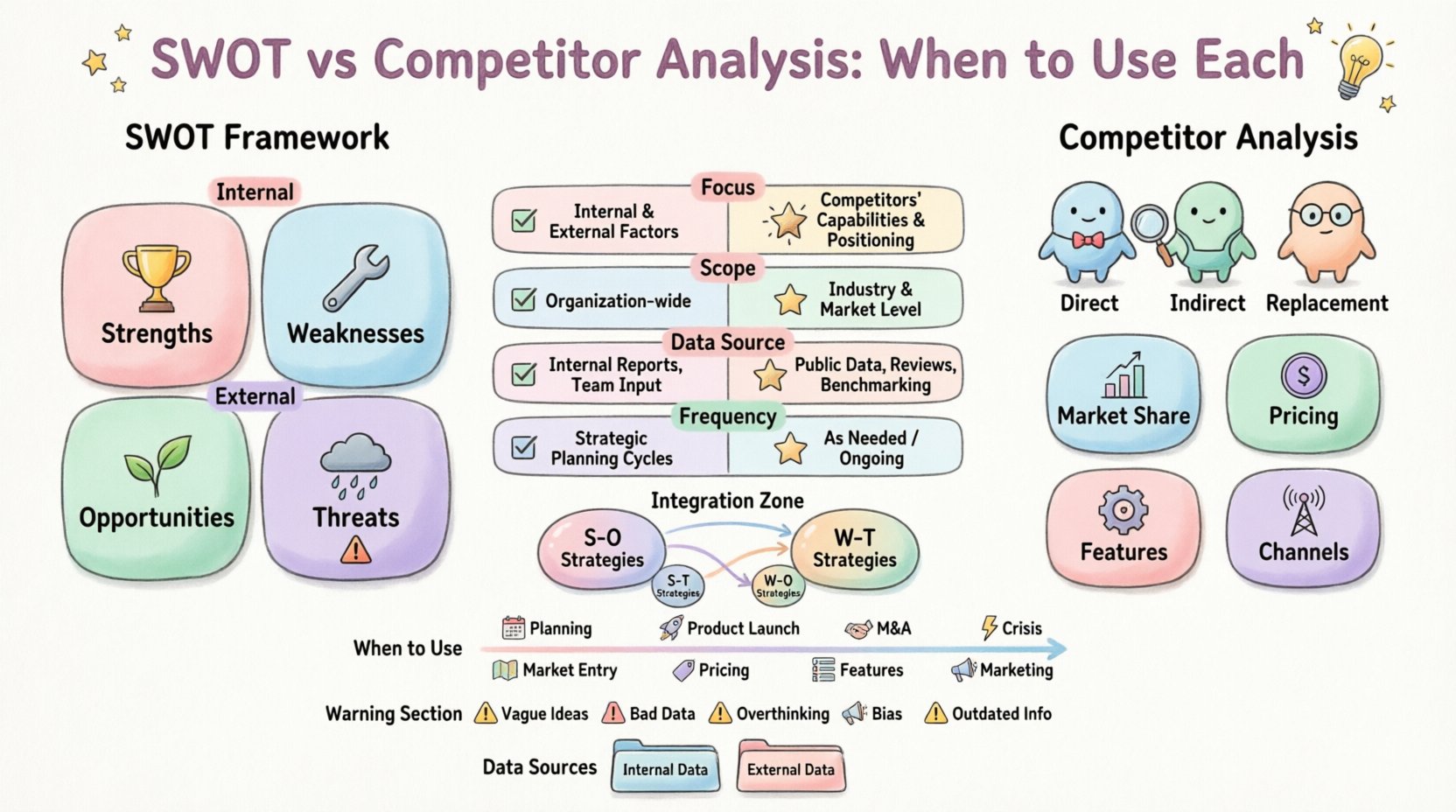
Strategic planning is the backbone of sustainable business growth. Yet, many organizations struggle to distinguish between internal self-assessment and external market evaluation. Choosing the right analytical framework determines whether your strategy is grounded in reality or built on assumptions. Two of the most prevalent methodologies are the SWOT Analysis and Competitor Analysis. While they often overlap in strategic discussions, they serve distinct purposes.
This guide explores the mechanics of each tool, highlighting their unique strengths and optimal application scenarios. Understanding the difference allows leaders to allocate resources effectively and make decisions that align with both internal capabilities and external market realities.
Business strategy requires a dual perspective: looking inward at your organization’s health and looking outward at the market environment. Confusing these two perspectives can lead to flawed strategies. For instance, a company might possess immense internal strength (SWOT) but fail to recognize a shifting market trend that renders that strength obsolete. Conversely, knowing every competitor’s move without understanding your own operational limitations leads to overextension.
Clarity begins with defining the scope of each analysis. The following sections break down the components, methodologies, and specific use cases for both frameworks.
SWOT is an acronym for Strengths, Weaknesses, Opportunities, and Threats. It is a foundational tool used to evaluate the current state of an organization or project. It acts as a diagnostic instrument, revealing the gap between where the business stands and where it wants to go.
These are attributes that give your organization an advantage over others. They are internal factors within your control. Common examples include:
These are internal factors that place your organization at a disadvantage relative to others. Identifying these requires honest introspection. Typical weaknesses include:
Opportunities are external factors that the organization could exploit to its advantage. These often arise from market trends or changes in the regulatory environment. Examples include:
Threats are external factors that could cause trouble for the business. These are often beyond your direct control but can be mitigated. Common threats include:
When conducting a SWOT analysis, the goal is to match Strengths with Opportunities (S-O strategies) and mitigate Weaknesses to avoid Threats (W-T strategies). It is primarily an internal audit that considers external context.
While SWOT looks at the organization as a whole, Competitor Analysis focuses specifically on the market rivals. This process involves identifying your competitors, analyzing their strategies, and determining their strengths and weaknesses relative to yours. The objective is to understand the competitive landscape to identify market gaps and threats.
Not all competition is direct. You must categorize rivals into three tiers:
Once identified, specific data points must be gathered. Key metrics include:
Benchmarking involves comparing your performance against industry standards or specific competitors. This helps set realistic goals. For example, if your customer acquisition cost is significantly higher than the industry average, it signals an operational issue that needs addressing.
To clarify the distinctions, the following table outlines the core differences between SWOT and Competitor Analysis. Understanding this matrix is crucial for selecting the right tool for the current strategic phase.
| Feature | SWOT Analysis | Competitor Analysis |
|---|---|---|
| Primary Focus | Internal capabilities and external environment | Rival organizations and market position |
| Scope | Broad (Organization-wide) | Narrow (Specific market rivals) |
| Data Source | Internal records, employee feedback, market trends | Public data, customer reviews, industry reports |
| Control Level | Internal factors (Strengths/Weaknesses) are controllable | Competitor actions are generally uncontrollable |
| Strategic Output | Risk mitigation and capability building | Market differentiation and positioning |
| Frequency | Periodic (e.g., annually or per project) | Ongoing (Market changes rapidly) |
SWOT is most effective when the primary need is to assess the viability of a new initiative or to evaluate the overall health of the organization. It provides a snapshot of readiness.
At the beginning of a fiscal year or planning cycle, SWOT helps leadership understand the starting point. It ensures that goals are ambitious yet achievable given current resources.
Before launching a new product, a SWOT analysis evaluates if the organization has the resources (Strengths) to support it and if the market environment (Opportunities) is favorable. It also highlights if internal weaknesses (like lack of expertise) could derail the launch.
When considering buying another company or merging, SWOT helps assess cultural fit and operational compatibility. It evaluates if the strengths of one entity can fill the weaknesses of the other.
During a crisis, SWOT helps identify internal reserves that can be leveraged (Strengths) and external pressures to mitigate (Threats). It forces a clear-eyed view of resources during high-pressure situations.
Competitor Analysis is essential when the focus is on market positioning, growth tactics, and defensive strategy. It is reactive to the market but proactive in preparation.
Entering a new geographic region or segment requires understanding who is already there. A competitor analysis reveals saturation levels, pricing floors, and potential partnership opportunities with non-competing players.
If you plan to lower prices or introduce a premium tier, you must know how competitors are priced. This analysis prevents price wars that erode margins or pricing that is too high for the value perceived.
To decide what features to build next, look at what competitors lack. If the market standard is a feature you do not have, it may be a weakness. If competitors have a feature that customers dislike, it is an opportunity to differentiate.
Understanding where competitors advertise helps avoid bidding wars on expensive keywords. It also highlights channels they ignore, offering a blue ocean for customer acquisition.
The most robust strategies do not choose one tool over the other; they synthesize both. SWOT provides the internal truth, while Competitor Analysis provides the external context. Combining them creates a dynamic strategic map.
A more advanced version of SWOT is the TOWS Matrix. This tool explicitly links external factors (from Competitor Analysis) to internal factors. It generates four types of strategies:
Imagine a software company considering a pivot to mobile-first solutions.
SWOT Input: The company has strong engineering talent (Strength) but lacks mobile UI expertise (Weakness).
Competitor Input: A major competitor has just launched a mobile app and is losing customers due to poor performance (Threat/Opportunity).
Integrated Strategy: Leverage engineering talent to build a superior mobile experience (S-T), while hiring a specialized mobile agency to fix the internal skill gap (W-O).
Even with the best tools, execution can falter. Recognizing common errors ensures the analysis remains valuable.
Statements like “We have a good team” or “Competitors are expensive” are unhelpful. Specificity is key.
Competitor analysis relies on public data. If you rely on outdated reports or anecdotal evidence, your strategy will be flawed. Always verify data points across multiple sources.
Conducting these analyses is valuable, but over-analyzing can delay action. Set a deadline for the analysis phase. Once the data is gathered, move to decision-making.
During SWOT, teams often overestimate strengths and underestimate weaknesses due to internal bias. Invite external consultants or cross-functional teams to provide objective feedback.
Market conditions change. A SWOT or Competitor Analysis is not a one-time document. It must be treated as a living reference point. Revisit these analyses quarterly or when significant market shifts occur.
To execute these analyses effectively, you need access to accurate information. Below are standard sources for gathering data without relying on proprietary software.
Selecting the right analytical tool depends on the specific question you are trying to answer. If you need to know if you are ready to grow, SWOT is the answer. If you need to know how to beat the opposition to capture growth, Competitor Analysis is the answer.
Neither tool guarantees success on its own. They are lenses that bring the business landscape into focus. When used correctly, they reduce uncertainty and provide a structured path forward. By maintaining a clear distinction between internal capabilities and external pressures, organizations can navigate market volatility with confidence.
Start by auditing your current strategic processes. Are you relying on intuition alone? Is your competitor knowledge outdated? Implementing these frameworks systematically creates a culture of evidence-based decision-making. This discipline is what separates enduring enterprises from those that fade when market conditions shift.
Remember that strategy is a continuous loop, not a destination. Regularly revisit your SWOT and competitor data to ensure your actions remain aligned with reality. This ongoing vigilance is the true engine of long-term impact.