
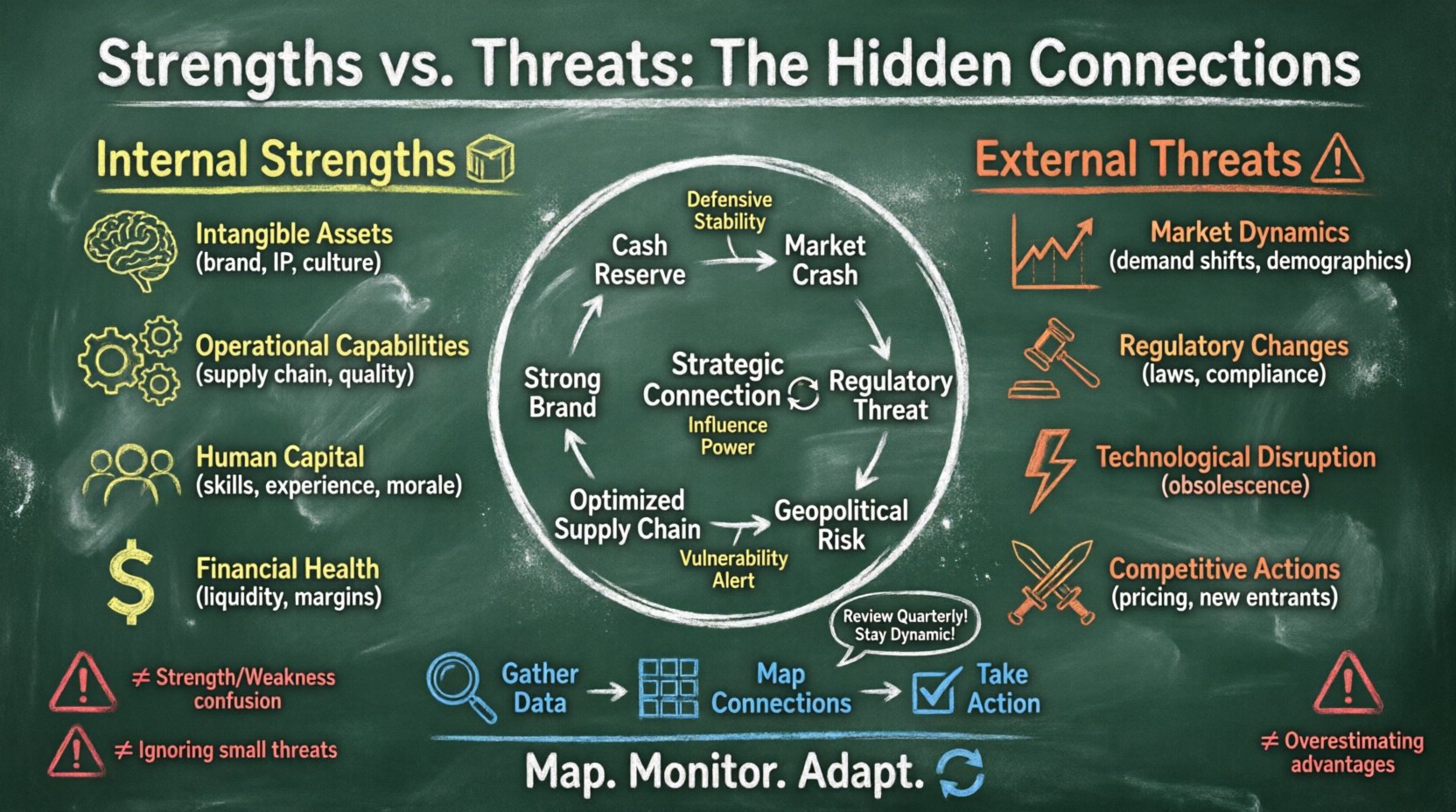
Strategic planning often feels like a static exercise, a one-time checklist to be filed away until the next fiscal year. However, effective analysis requires a dynamic understanding of how an organization’s internal capabilities interact with the volatile forces outside its control. When we discuss the SWOT framework, we frequently treat the four quadrants as isolated silos. We list our strengths, then our weaknesses, then our opportunities, and finally our threats. But the true power lies not in the lists themselves, but in the intersections between them. Specifically, the relationship between internal strengths and external threats is often the most critical determinant of long-term resilience.
This guide explores the nuanced connections between what you are capable of doing and what is happening in the market that could endanger you. By understanding these hidden connections, you can move from reactive defense to proactive strategy. We will examine the anatomy of these factors, how to map their interactions, and the methodologies required to maintain a robust strategic posture without relying on specific tools or software platforms.
Internal strengths are the assets, capabilities, and advantages that an organization possesses. They are the things you control. However, a strength is only a strength if it provides a competitive edge in a specific context. A large cash reserve is a strength in a recession, but it might be a sign of inefficiency in a hyper-growth phase where capital should be deployed. To analyze strengths deeply, we must categorize them beyond simple labels.
When identifying strengths, avoid generic terms like “good team” or “high quality.” Instead, quantify and qualify. Is the team specialized in a niche technology? Is the quality verified by third-party standards? Specificity allows for better alignment with external realities.
External threats are the risks and challenges that exist outside the organization’s control. These are forces in the macro-environment or the industry landscape that could negatively impact performance. Unlike weaknesses, which are internal flaws, threats are external pressures. Ignoring them is a common strategic failure.
Threats are not merely obstacles; they are indicators of where the market is moving. A threat in one area often signals an opportunity in another. Understanding the nature of the threat is the first step toward neutralizing it.
The most critical aspect of strategic analysis is the intersection of strengths and threats. This is where risk management meets opportunity. A strength is useless if it does not address a relevant threat, and a threat is unmanageable if there is no internal strength to counter it. This connection is often overlooked because it requires looking at the organization in two directions simultaneously.
Consider the scenario where a company has a strong cash reserve (Strength) but faces a potential market crash (Threat). The connection is defensive stability. The cash reserve allows the company to weather the storm, acquire distressed assets, or continue R&D while competitors pull back. Conversely, if a company has a strong brand (Strength) but faces a new regulatory threat (Threat), the connection is about influence. A strong brand often grants lobbying power or public trust that can mitigate regulatory pressure.
However, the connection can also be negative. A strength can become a vulnerability if it is rigid. For example, a highly optimized supply chain (Strength) might be a liability if a sudden geopolitical event (Threat) cuts off the specific route it relies on. In this case, the efficiency is a weakness when the environment changes. This is why static analysis fails; the connection is fluid.
To visualize these connections, we can use a structured approach. The following table illustrates how different combinations of strengths and threats dictate specific strategic actions. This framework helps teams move from abstract concepts to concrete plans.
| Internal Strength | External Threat | Strategic Connection | Resulting Action |
|---|---|---|---|
| Proprietary Technology | Competitor Copycat | Speed of Innovation | Accelerate R&D to stay ahead of replication |
| Diverse Supplier Base | Raw Material Shortage | Risk Diversification | Activate alternative suppliers immediately |
| Strong Customer Loyalty | Economic Downturn | Retention Focus | Launch loyalty programs to maintain revenue |
| High Debt Load | Rising Interest Rates | Financial Vulnerability | Refinance debt or reduce capital expenditure |
| Agile Workforce | Rapid Technology Shift | Adaptability | Reskill teams to adopt new tools quickly |
This matrix demonstrates that the connection is not just about matching items. It is about creating a logical bridge between what you have and what you face. The resulting action is the strategy itself.
Conducting this analysis requires a disciplined approach. It is easy to fall into the trap of listing obvious items that everyone already knows. To find the hidden connections, you need depth and data. Here is a step-by-step process to ensure a thorough assessment.
It is important to note that this process should be iterative. The market changes, and so do the connections. A strength today might be a liability tomorrow if the threat landscape shifts. Regular reviews are essential to keep the analysis relevant.
Even with a structured approach, teams often stumble when trying to connect strengths and threats. Understanding these common errors can help you avoid them.
Once the analysis is complete, the work does not end. The value lies in the ongoing monitoring and adjustment of the strategic plan. This requires embedding the assessment into the organizational rhythm.
By maintaining this vigilance, the organization builds resilience. It becomes less about reacting to crises and more about navigating them with a clear understanding of its own capabilities. This level of preparedness is what separates industry leaders from followers.
The relationship between internal strengths and external threats is the heartbeat of strategic management. It is where potential meets reality. When you understand these connections, you stop guessing and start directing. You stop hoping for the best and start preparing for the possible.
This guide has outlined the mechanics of this relationship, from defining the components to mapping the intersections and avoiding common errors. The goal is not to predict the future perfectly, but to ensure that when the future arrives, the organization is ready. The hidden connections are the leverage points that allow a business to pivot, adapt, and thrive regardless of the external conditions.
Remember, analysis is a tool, not an end goal. The true value is found in the actions that follow the insight. Use this framework to build a strategy that is robust, adaptable, and grounded in the reality of your specific situation. The market will change, but a well-understood internal capability will remain a constant anchor in the storm.