
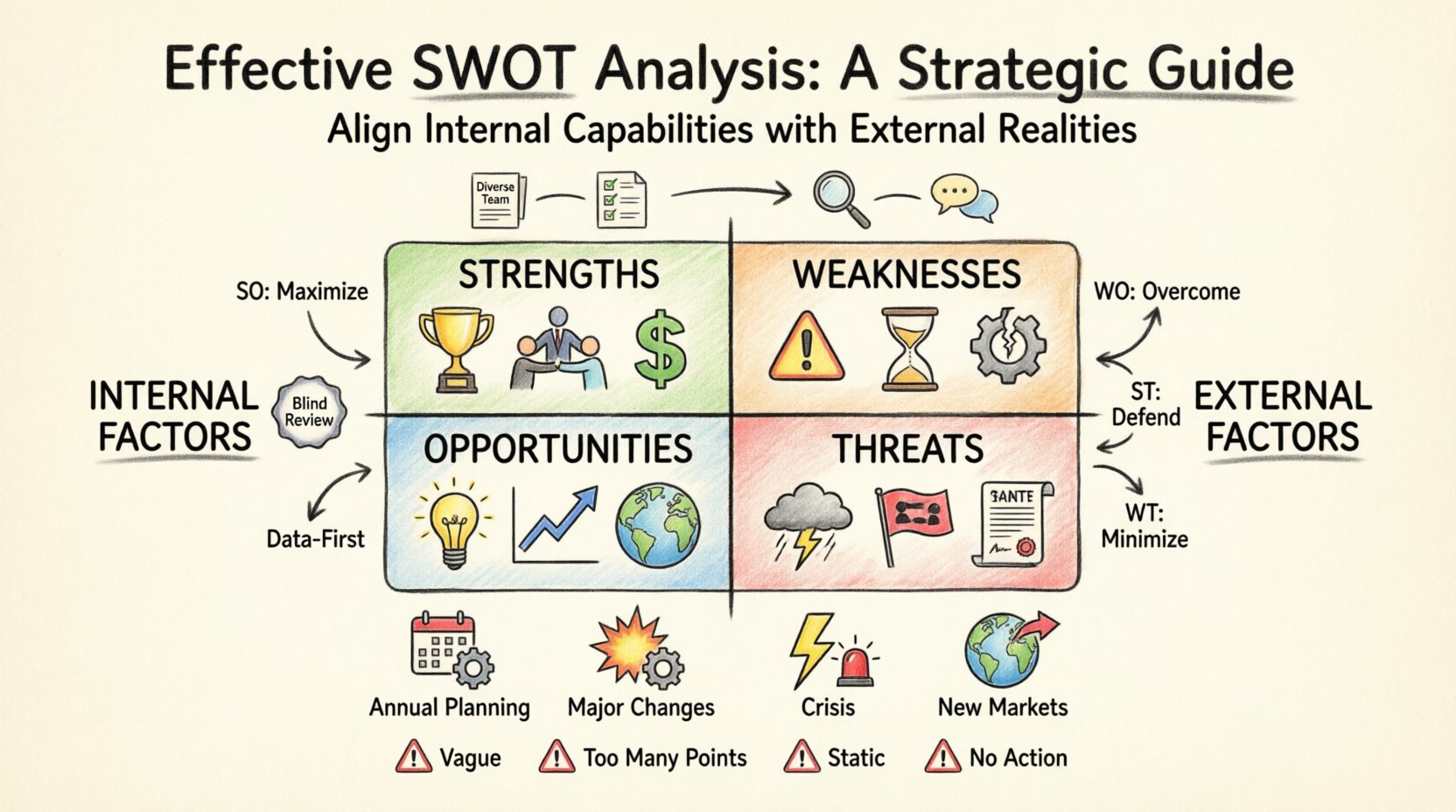
Strategic planning often feels like navigating a ship through fog. You know you need a direction, but the obstacles and opportunities are not always visible. The SWOT analysis remains one of the most enduring frameworks in business strategy. Yet, despite its longevity, confusion persists about how to execute it correctly. Many teams treat it as a box-checking exercise rather than a strategic tool. This guide addresses the critical inquiries regarding this methodology. We will explore the mechanics, the common pitfalls, and the practical application of the framework.
Understanding the nuances of this process is vital for organizational health. It is not merely about listing points; it is about understanding the relationship between internal capabilities and external market forces. The following questions address the most common hurdles faced by analysts and leaders. We will break down the theory and practice to provide clarity.
Many organizations view this framework as a simple list of positive and negative factors. This view limits its utility significantly. The true purpose is to align internal resources with external realities. It serves as a diagnostic tool to identify the current state of the organization. By mapping strengths and weaknesses against opportunities and threats, leaders can see where the gaps exist.
It is not a prediction mechanism. It is a snapshot of the present moment. Here are the core objectives:
Without a clear purpose, the exercise becomes a brainstorming session without output. The goal is to inform decision-making, not just to document thoughts.
This is the most frequent point of confusion. The framework divides factors into two categories: controllable and uncontrollable. Confusing these categories leads to flawed strategies. You cannot control the market, but you can control your product quality.
These reside within the organization. They are attributes you can change or manage. Consider the following:
These exist outside the organization. You cannot change them, only adapt to them. Consider the following:
A common mistake is listing a competitor’s action as a strength. If a competitor lowers prices, that is an external threat to your margins, not a strength of your own. Correct classification is the foundation of valid analysis.
Garbage in, garbage out. A SWOT analysis is only as good as the data supporting it. Relying on assumptions leads to strategies that fail in the real world. You need concrete evidence to back up every point listed.
Here are reliable sources for information:
Do not rely on hearsay. If a point cannot be substantiated with data or a specific example, it should be questioned. Quantitative data provides the weight, while qualitative data provides the context. Both are necessary for a balanced view.
Human nature tends to favor optimism or pessimism. Teams often list strengths they wish were true, or threats they fear might happen. This subjectivity undermines the credibility of the entire exercise. Bias can creep in during the facilitation phase.
Strategies to mitigate bias include:
It is also important to address the “Halo Effect.” Just because a company is successful in one area does not mean it is strong in all areas. Conversely, a temporary setback does not mean a weakness is permanent. Nuance is key.
Completing the matrix is not the end of the work. It is the beginning. A list of factors is useless unless it drives decisions. The analysis must lead to a strategy that connects the four quadrants.
Consider these four strategic approaches:
This cross-mapping forces the team to think about the interplay of factors. It moves the conversation from “what is” to “what can be.”
Timing matters. Conducting this analysis at the wrong time can yield irrelevant data. It should be part of a regular strategic rhythm.
Key triggers include:
Frequency is also a consideration. Annual reviews are standard. However, in fast-moving industries, quarterly reviews may be necessary. The market does not stand still, so your analysis should reflect current conditions.
Excluding key stakeholders leads to blind spots. The scope of the analysis should match the scope of the strategy. If the strategy affects the whole organization, the analysis should too.
Recommended participants:
Facilitation is crucial. The meeting leader must ensure everyone has a voice. Dominant personalities can skew the results. A structured approach ensures that introverts and experts alike contribute equally.
Even experienced teams make mistakes. Knowing these common errors helps you steer clear of them.
| Pitfall | Consequence | Solution |
|---|---|---|
| Too Vague | Actions become generic and unmeasurable. | Define specific metrics for each point. |
| Too Many Points | Focus is lost; nothing gets prioritized. | Limit to the top 3-5 items per quadrant. |
| Static Document | Strategy becomes outdated quickly. | Review and update regularly. |
| No Action Plan | Analysis leads to no change. | Assign owners and deadlines immediately. |
| Internal Focus Only | Blindsided by external market shifts. | Include external data sources. |
One of the most damaging errors is treating this as a one-time event. It is a living document. Markets change, resources shift, and capabilities evolve. A static list will become obsolete.
Success is not the completion of the document. It is the implementation of the resulting strategy. You need to track whether the insights led to tangible outcomes.
Metrics for success include:
If the analysis does not change behavior, it was not effective. The value lies in the application of the insights, not the generation of the list.
Yes. The framework is versatile. It applies to individuals just as well as organizations. Professionals can use it to assess their career trajectory.
Strengths: Skills, certifications, network, work ethic.
Weaknesses: Gaps in knowledge, lack of experience, time management.
Opportunities: Job openings, industry growth, mentorship availability.
Threats: Automation, economic downturn, competition for roles.
Applying this to personal development creates a clear roadmap for growth. It helps individuals make informed decisions about training, networking, and job searching.
It is common to find a high number of threats. This can be overwhelming. It does not mean failure; it means risk awareness. The goal is not to have a perfect scorecard, but an accurate one.
When threats outnumber opportunities:
Visibility of risk is better than ignorance. It allows the organization to prepare contingency plans.
Disagreement is healthy. It prevents groupthink. However, it can stall progress if not managed.
Management techniques include:
Conflict often arises because different departments have different priorities. Sales might see an opportunity that Operations sees as a risk. Both are valid. The synthesis of these views creates a robust strategy.
Absolutely. While the profit motive differs, the need for resource allocation remains. Non-profits must understand their strengths to secure funding. Public sectors must understand threats to serve citizens effectively.
The adaptation involves changing the metrics. Instead of “market share,” consider “community impact.” Instead of “revenue,” consider “funding sustainability.” The structure remains the same, but the context shifts.
SWOT is rarely used in isolation. It pairs well with other strategic tools.
Integration creates a comprehensive strategic picture. SWOT provides the diagnostic, while other tools provide the specific mechanics for execution.
Leadership sets the tone. If leaders treat the process as trivial, the team will too. Leaders must champion the findings.
Leadership buy-in is the single biggest predictor of success. Without it, the analysis sits in a drawer.
The SWOT analysis is a tool for clarity, not a magic wand. It requires effort, honesty, and discipline. When done correctly, it provides a solid foundation for decision-making. It forces organizations to look at themselves and the world honestly. This honesty is the bedrock of sustainable growth.
By addressing these questions, teams can move past the surface level. They can build strategies that are resilient and responsive. The process is iterative. It evolves as the organization evolves. The goal is continuous improvement and strategic alignment.
Remember, the value is in the action. The document is secondary. Focus on the insights that drive change. Utilize the framework to navigate uncertainty with confidence.