
Strategic planning is the backbone of any enduring organization. Yet, a common stumbling block remains the SWOT analysis. Many teams complete this exercise with a sense of accomplishment, only to find the output lacks actionable value. The document sits on a shelf, gathering dust, because it contains vague generalities rather than specific directives. This guide addresses the specific friction points in SWOT frameworks. We will explore how to diagnose weak points and transform them into tangible business objectives.
When a SWOT analysis fails, it usually stems from a lack of specificity. Phrases like “improve customer service” or “increase market share” are too broad. They do not provide a clear path for execution. This document serves as a manual for refining that process. We will move from abstract concepts to concrete data-driven goals.
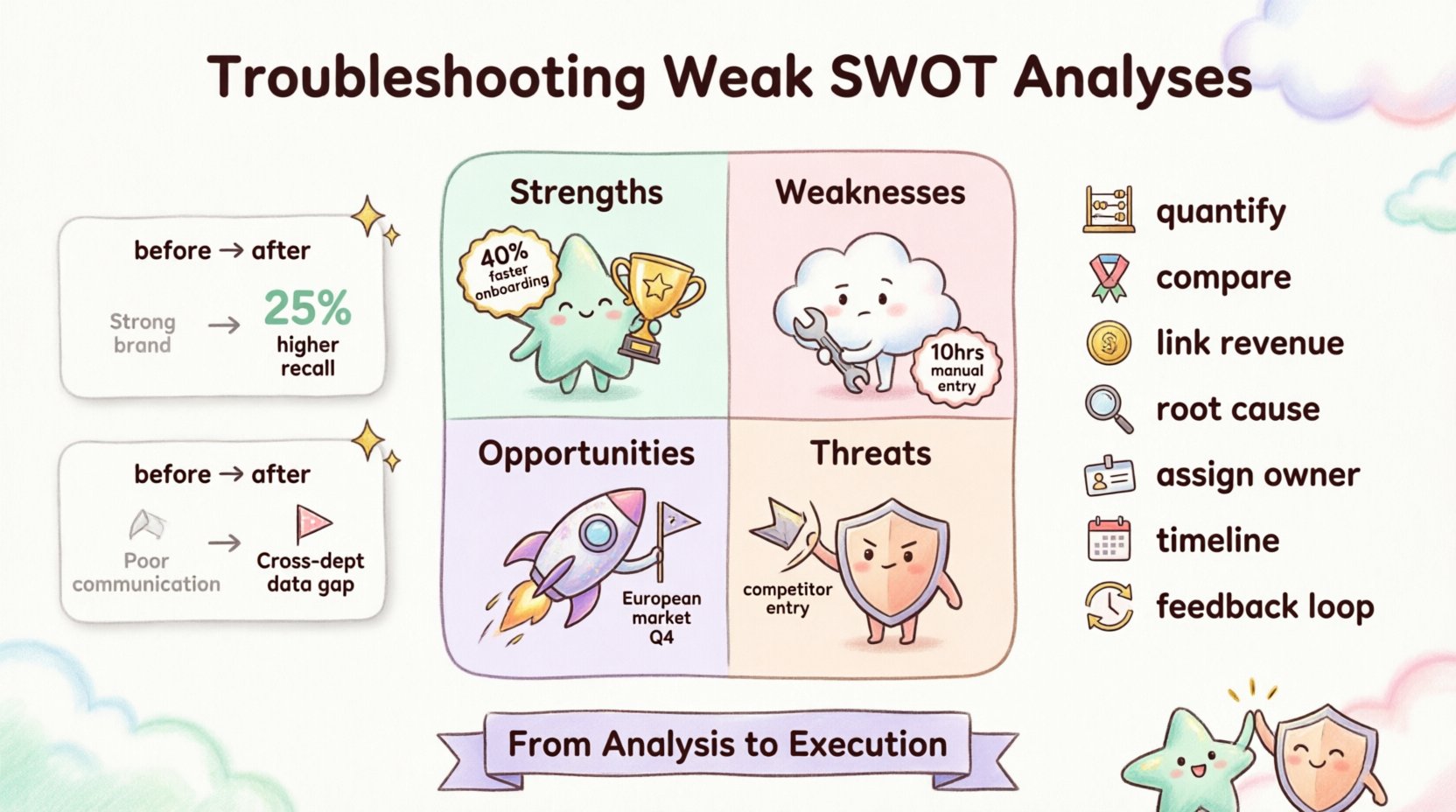
1. Understanding the Vagueness Trap 🎯
The primary reason SWOT analyses lose their power is the tendency to list attributes without context. A strength is not just “good technology.” It is “proprietary software that reduces client onboarding time by 40%.” The difference lies in the quantification and the specific outcome.
- Weak Entry: “We have a strong brand.”
- Strong Entry: “Brand recall is 25% higher than the industry average in the North American region.”
- Weak Entry: “Weakness in marketing.”
- Strong Entry: “Social media engagement rate is 1.2% below the competitor benchmark.”
To troubleshoot a weak analysis, one must first identify the symptoms of vagueness. Look for adjectives without supporting data. Look for areas that are labeled as strengths or weaknesses but lack evidence. If you cannot explain why something is a strength or weakness with a specific metric, it is likely a placeholder, not an insight.
2. Diagnosing the Analysis Structure 🔍
Before fixing the content, check the structure. A robust SWOT matrix requires four distinct quadrants. Each quadrant serves a specific strategic purpose. Strengths and Weaknesses are internal factors. Opportunities and Threats are external factors. Confusing these categories leads to misaligned strategies.
Here is a diagnostic table to help you identify common structural errors:
| Category | Common Error | Corrective Action |
|---|---|---|
| Strengths | Listing assets instead of capabilities | Focus on what the organization does well with those assets. |
| Weaknesses | Listing external problems as internal | Ensure the factor is within your control to change. |
| Opportunities | Confusing trends with actions | Identify specific market gaps you can fill. |
| Threats | Listing competitors as threats without strategy | Define the specific risk and the impact on revenue. |
3. Transforming Strengths into Actionable Assets 💪
Strengths are often the easiest to list but the hardest to utilize. A common mistake is treating a strength as a static fact. Instead, treat it as a lever. How can this specific advantage drive growth? Do not simply state you have experienced staff. State that your experienced staff reduces training costs by 15%.
Follow these steps to refine your Strengths section:
- Quantify the Advantage: Attach a number or percentage to every claim. Revenue growth, efficiency gains, or customer retention rates.
- Compare to Peers: Contextualize the strength. Is it better than the market average? Is it unique?
- Link to Revenue: Explain how this strength directly contributes to the bottom line.
- Document the Source: Note where the data comes from. Internal audits, customer surveys, or sales reports.
By grounding strengths in data, you create a foundation for competitive positioning. This allows the organization to double down on what works rather than guessing.
4. Converting Weaknesses into Improvement Targets 🛠️
Weaknesses are often overlooked or glossed over. Teams prefer to focus on positives. However, a strategic plan cannot succeed without addressing internal deficiencies. A vague weakness like “poor communication” is unfixable. A specific weakness like “lack of cross-departmental data sharing” is actionable.
To troubleshoot this section, apply the following logic:
- Identify the Root Cause: Why does this weakness exist? Is it a skill gap, a process gap, or a resource gap?
- Measure the Impact: What is the cost of this weakness? Lost sales, increased churn, or slower time-to-market?
- Assign Ownership: Who is responsible for fixing this? A vague weakness often means no one owns the problem.
- Set a Timeline: When should this improvement be visible?
Consider this transformation:
Original: “Weakness: Outdated technology.”
Refined: “Weakness: Legacy CRM system causes 10 hours of manual data entry per week per sales rep.”
Goal: “Migrate to integrated CRM by Q3 to recover 500 man-hours annually.”
5. Turning Opportunities into Concrete Goals 🚀
Opportunities represent external chances for growth. The trap here is wishing rather than planning. “Enter new markets” is a wish. “Launch product line B in the European region by December” is a plan. To convert opportunities, you must validate them against your current capabilities.
Use this checklist to validate opportunities:
- Market Validation: Is there proven demand? Do not assume demand exists.
- Resource Alignment: Do we have the budget and talent to pursue this?
- Timing: Is this the right moment? Are there regulatory or seasonal factors?
- Competitive Response: Will competitors react? How?
Once validated, convert the opportunity into a SMART goal. This ensures the opportunity moves from a concept to a target.
6. Mitigating Threats with Defense Plans 🛡️
Threats are external risks that could harm the organization. Weak analyses list threats but offer no defense. A threat like “rising costs” needs a specific mitigation strategy. Does this mean renegotiating supplier contracts? Does it mean increasing prices? Does it mean improving efficiency?
For every threat listed, require a corresponding mitigation strategy. This creates a risk management matrix. The table below illustrates how to pair threats with actions.
| Threat | Impact Level | Mitigation Strategy | Owner |
|---|---|---|---|
| New Competitor Entry | High | Launch loyalty program to retain existing base | Marketing Director |
| Supply Chain Disruption | Medium | Diversify vendor list to include three suppliers | Operations Lead |
| Currency Fluctuation | Low | Hedge currency for contracts over $100k | Finance Officer |
Without these defense plans, the threat remains a worry rather than a managed risk.
7. The Feedback Loop for Strategic Alignment 🔄
A SWOT analysis is not a one-time event. It is a snapshot of a specific moment in time. To keep it relevant, you need a feedback loop. This involves regular reviews of the analysis against actual performance.
Implement a quarterly review process:
- Re-evaluate Strengths: Has the competitive landscape shifted? Is a former strength now a weakness?
- Update Weaknesses: Have the previous targets been met? Are there new bottlenecks?
- Scan for Opportunities: Has new technology emerged? Are consumer behaviors changing?
- Monitor Threats: Have new regulations passed? Is the economic environment shifting?
This continuous improvement cycle ensures the strategic plan remains aligned with reality. It prevents the organization from operating on outdated assumptions.
8. Common Pitfalls to Avoid ⚠️
Even with a structured approach, teams often fall into traps. Be vigilant against these common errors:
- Brainstorming without Filtering: Generate ideas, but then rigorously filter them. If an item is not specific, discard it.
- Groupthink: Ensure diverse perspectives are included. A marketing team may see a strength that operations sees as a cost.
- Ignoring Data: Relying on anecdotes instead of metrics. Data provides the evidence needed for decision-making.
- Static Documentation: Treat the document as living. Update it as the business evolves.
9. Checklist for a Robust SWOT Analysis ✅
Before finalizing your strategic document, run it through this checklist. This ensures the output is ready for executive review.
- Is every point quantifiable? Can you attach a number to it?
- Is every point specific? Does it avoid broad adjectives?
- Are all internal factors truly internal? Can the organization control the outcome?
- Are all external factors truly external? Is the factor outside the organization’s direct control?
- Is there a link to action? Does each point suggest a next step?
- Is there ownership? Is there a person responsible for acting on each point?
- Is there a timeline? Is there a deadline for achieving the goal?
10. Moving Forward: From Analysis to Execution 📈
The value of a SWOT analysis lies not in the creation of the document, but in the execution of the insights derived from it. Once the vague points are sharpened into concrete goals, the organization can allocate resources effectively.
Integrate these refined goals into your broader planning cycle. Ensure they appear in departmental KPIs. Make sure they are discussed in leadership meetings. When a goal is visible and tracked, it becomes a priority.
By troubleshooting the vagueness in your analysis, you unlock the true potential of strategic planning. You move from guessing to knowing. You move from hoping to achieving. This rigorous approach builds a culture of accountability and clarity.
Remember, a strategy is only as good as its specificity. Take the time to refine every point. Ask the hard questions. Demand the data. The result will be a plan that drives measurable business growth.