
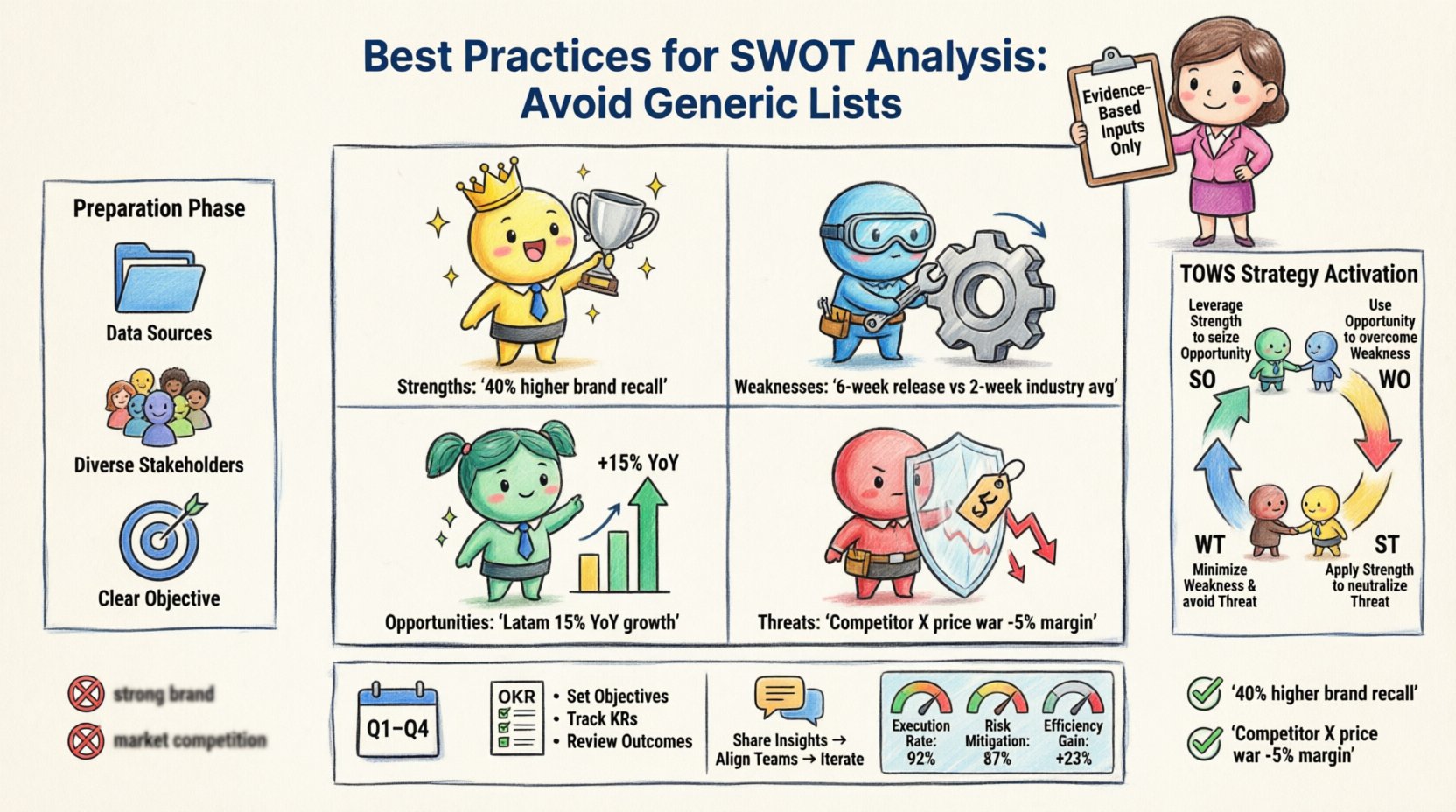
Strategic planning often begins with a familiar framework. Teams gather around a whiteboard, ready to define Strengths, Weaknesses, Opportunities, and Threats. Yet, too often, these sessions result in a wall of generic statements that offer no real direction. Phrases like “strong brand” or “market competition” fill the columns, leaving leaders wondering where to allocate resources next. This disconnect between analysis and action undermines the entire planning cycle.
To truly leverage this tool, organizations must move beyond surface-level brainstorming. Effective strategic work requires deep data, rigorous facilitation, and a commitment to specificity. This guide outlines how to conduct a SWOT analysis that drives decision-making rather than gathering dust. By focusing on evidence-based insights and actionable outcomes, teams can transform a standard exercise into a cornerstone of corporate strategy.
The primary failure point in most corporate workshops is vagueness. When a team identifies a “strength” as “good management,” the statement lacks utility. It does not explain why the management is good, what specific metrics support this claim, or how it differentiates the organization from competitors. Generic lists create an illusion of progress without providing the necessary granularity for execution.
Several psychological and structural factors contribute to this issue:
When a strategy document is filled with platitudes, it becomes impossible to measure success. A strategy needs to be testable. If you cannot measure the impact of a weakness being addressed, the analysis is incomplete.
The work begins before the meeting starts. High-quality output requires high-quality input. Preparation ensures that participants arrive with context, reducing the time spent debating basic facts and allowing more time for strategic synthesis.
Before convening the team, compile a dossier of relevant information. This preparation anchors the discussion in reality. Consider gathering the following:
Ensure the right people are in the room. A strategy session cannot be limited to the executive team. Include representatives from operations, sales, engineering, and customer success. Diverse perspectives prevent blind spots. For example, engineering might identify a technical debt weakness that leadership overlooks, while sales might spot a market opportunity hidden in customer requests.
Define the scope of the analysis. Are you evaluating the entire company, a specific product line, or a new market entry? A broad scope often leads to shallow insights. Narrowing the focus allows for deeper digging into specific areas.
Facilitation is the engine of a successful session. A skilled facilitator ensures that the conversation remains productive and focused. The goal is to extract insights, not just opinions.
Early statements in a meeting often set the tone for the rest. If a senior leader suggests a weakness first, the group may struggle to look beyond it. Use techniques like silent brainstorming where participants write down their thoughts independently before sharing. This prevents dominant voices from influencing the initial list.
Adopt a “prove it” mindset. When a participant states, “Our customer service is a strength,” ask for the data. Is response time faster than the industry average? Is retention higher? If they cannot provide evidence, mark the item as a hypothesis rather than a fact. This discipline forces the team to ground their statements in reality.
It is common for teams to confuse internal factors with external ones. A “new competitor” is a Threat (External). “Our inability to respond quickly to that competitor” is a Weakness (Internal). Keeping these quadrants distinct clarifies what the organization can control versus what it must react to.
The true value of a SWOT analysis lies in the TOWS matrix approach, which cross-references the four quadrants to generate strategic options. This step moves the conversation from “what is” to “what could be.”
Consider the following combinations:
This cross-analysis forces the team to think creatively about resource allocation. For instance, a strong cash position (Strength) should be used to acquire a startup offering a new technology (Opportunity), rather than simply sitting on the capital. Conversely, a reliance on a single supplier (Weakness) combined with supply chain instability (Threat) requires an immediate diversification plan.
Even with good preparation, teams can fall back into generic language. To ensure utility, every item in the SWOT matrix must pass the “So What?” test. If you read the statement, can you immediately derive an action item? If not, rewrite it.
Use the table below to compare generic entries against strategic, actionable ones.
| Quadrant | Generic Entry ❌ | Strategic Entry ✅ |
|---|---|---|
| Strength | Good brand reputation | 40% higher brand recall than top competitor in Q3 survey |
| Weakness | Slow software updates | Release cycle takes 6 weeks, industry average is 2 weeks |
| Opportunity | Expand into new markets | Latam market shows 15% YoY growth in our sector; local regulations favorable |
| Threat | Competitors are aggressive | Competitor X launched a direct price war reducing our margin by 5% |
Notice the difference in the strategic entries. They include metrics, timelines, or specific context. This specificity allows managers to assign ownership and deadlines immediately.
A strategy session is not a one-time event. The business environment changes rapidly. A SWOT analysis that is static becomes obsolete quickly. Organizations should treat the framework as a living document.
Revisit the SWOT matrix every quarter. Check if the identified threats have materialized or if the opportunities have closed. Update the Strengths and Weaknesses based on new performance data. This keeps the strategy aligned with current realities.
Ensure the output of the SWOT analysis feeds directly into Objectives and Key Results (OKRs). If a Weakness is identified as “high churn in enterprise accounts,” an OKR should be established to reduce churn by a specific percentage. This creates a direct line of sight from analysis to daily work.
Share the refined strategy with the wider organization. When employees understand the context behind strategic decisions, they make better independent choices. Transparency reduces friction and builds alignment.
Even with the best intentions, several traps can undermine the process. Awareness of these pitfalls helps teams navigate them.
How do you know if the SWOT analysis was successful? Look for changes in decision-making velocity and resource allocation. Did the team stop debating obvious issues? Did they make bolder moves based on identified opportunities? Did they mitigate risks that previously caused surprise?
Track the following metrics over time:
When the analysis drives measurable change, it validates the effort invested. This feedback loop encourages teams to continue engaging with the framework deeply rather than superficially.
The difference between a standard workshop and a strategic catalyst is the level of detail and the commitment to evidence. By preparing thoroughly, facilitating rigorously, and acting decisively, organizations can avoid the trap of generic lists. The goal is not to produce a document that looks good on a shelf, but to create a roadmap that guides the business forward. When every strength, weakness, opportunity, and threat is backed by data and linked to action, the SWOT analysis becomes a powerful engine for growth.
Strategic planning is a discipline, not a decoration. Treat it with the seriousness it deserves. Invest the time in the preparation and the facilitation. The return on investment will be seen in clearer decision-making, aligned teams, and sustainable competitive advantage.