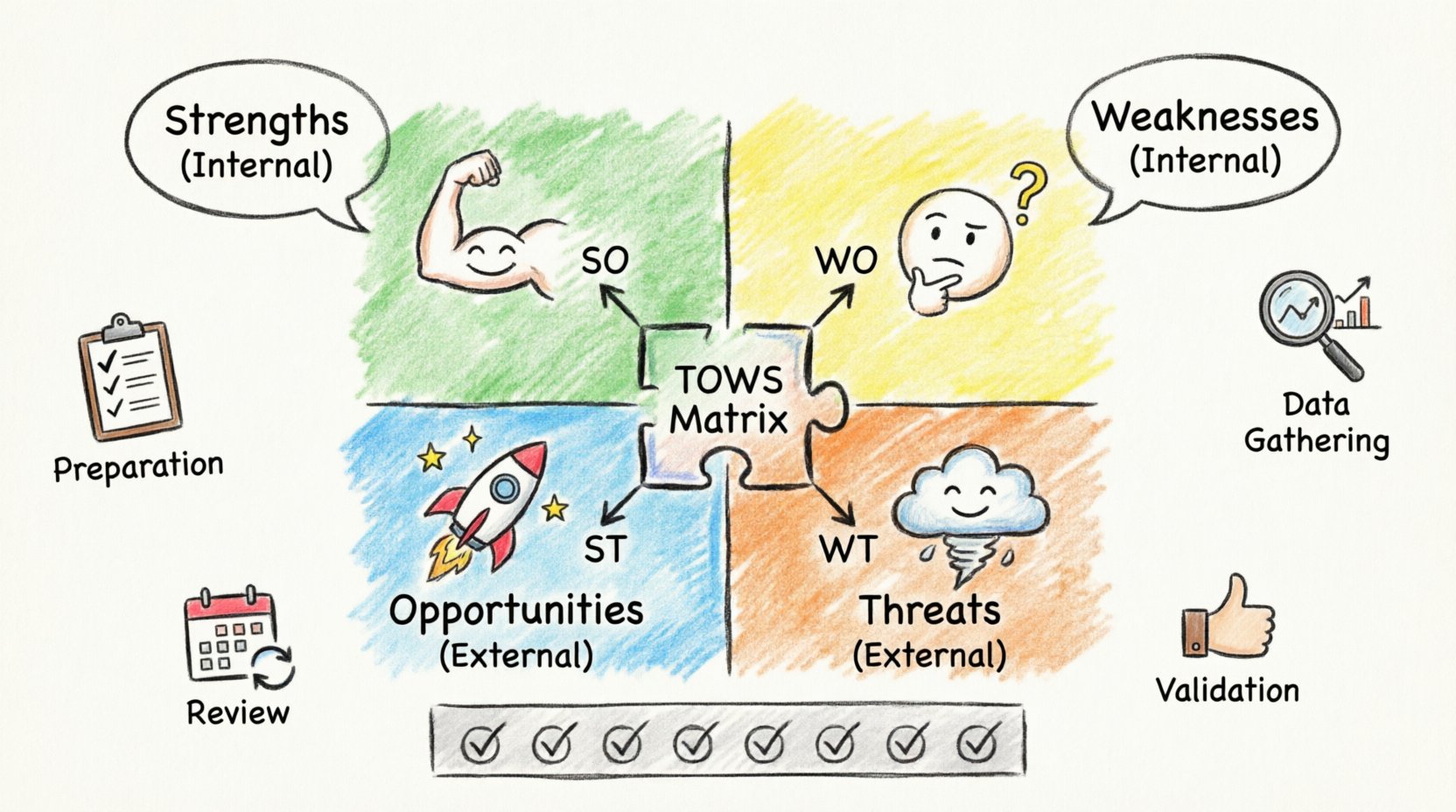
Strategic planning is rarely a one-time event. It is an ongoing discipline that requires rigorous scrutiny of your current position and a clear vision of where you intend to go. At the heart of this discipline lies the SWOT analysis. While many organizations treat this framework as a simple box-ticking exercise, its true power emerges when executed with precision and depth. This guide provides a comprehensive checklist to help you conduct a SWOT analysis that reveals actionable insights rather than generic observations.
We will move beyond the surface level to examine internal capabilities and external pressures. By following this structured approach, you can identify strategic blind spots that often derail long-term growth. This is not about finding the perfect answer immediately. It is about asking the right questions to build a resilient foundation for your business strategy.
Understanding the Core Framework 🧠
Before diving into the checklist, it is essential to clarify the components. SWOT stands for Strengths, Weaknesses, Opportunities, and Threats. The distinction lies in the locus of control.
- Internal Factors: These are within your organization’s control. They include your Strengths and Weaknesses.
- External Factors: These exist outside your organization. They include Opportunities and Threats.
Mixing these categories is the most common error in strategic planning. If you list a competitor’s weakness as your own strength, you have confused internal capability with external circumstance. The following sections break down each quadrant with specific criteria to ensure accuracy.
Phase 1: Preparation and Data Gathering 📊
A robust analysis begins before you write a single word on a whiteboard. Data quality determines the quality of the strategy. Relying on intuition alone often leads to bias. Instead, gather evidence from multiple sources.
Required Inputs
- Financial Reports: Review the last three years of balance sheets and income statements.
- Customer Feedback: Aggregate survey results, support tickets, and review data.
- Market Research: Industry reports, trend analysis, and competitor benchmarking.
- Employee Insights: Conduct interviews with staff across all departments to gauge morale and operational friction.
- Historical Performance: Analyze past projects to see what succeeded and what failed.
Tip: Assign a facilitator to the session. This person ensures the discussion stays focused and prevents dominant voices from steering the narrative.
Phase 2: Identifying Strengths (Internal) 💪
Strengths are the attributes that give you an advantage over others. They are the resources you possess that allow you to capitalize on opportunities. When listing strengths, focus on sustainable competitive advantages rather than temporary gains.
Questions to Ask
- What do we do better than anyone else in the industry?
- What unique resources do we own (patents, proprietary technology, exclusive partnerships)?
- What is our brand reputation?
- Do we have a loyal customer base?
- What operational efficiencies have we built?
- Is our talent pool superior to competitors?
Examples of Valid Strengths
- Proprietary algorithm that reduces processing time by 40%.
- Established distribution network in a specific geographic region.
- High employee retention rate compared to industry average.
- Strong cash flow allowing for rapid investment.
- Recognized industry thought leadership.
Caution: Do not confuse strengths with mere activities. “We hire well” is an activity. “We have a talent pipeline that reduces time-to-hire by 20%” is a strength. Quantify where possible.
Phase 3: Identifying Weaknesses (Internal) ⚠️
Weaknesses are internal attributes that place you at a disadvantage relative to others. Identifying these is often the hardest part of the process because it requires admitting failure or lack of capability. Honesty here is critical for risk mitigation.
Questions to Ask
- What resources or capabilities are missing?
- Where do we consistently lose market share?
- What processes are inefficient or prone to error?
- Do we lack critical skills within our team?
- Are there technological gaps we need to bridge?
- Is our brand perception outdated?
Common Weaknesses to Investigate
- Technology Debt: Legacy systems that hinder integration or speed.
- Skills Gap: Lack of expertise in emerging technologies like AI or data science.
- Operational Bottlenecks: Manual processes that slow down delivery.
- Financial Constraints: Limited budget for marketing or R&D.
- Dependency: Over-reliance on a single supplier or client.
Note: Addressing weaknesses does not always mean fixing them immediately. It means understanding where you are vulnerable so you can plan accordingly.
Phase 4: Identifying Opportunities (External) 🚀
Opportunities are external chances to improve performance or gain an advantage. They are trends or market conditions that your organization can exploit. Unlike strengths, you cannot create these out of thin air, but you can position yourself to take advantage of them.
Questions to Ask
- What emerging trends could benefit our business?
- Are there new markets or demographics we have not reached?
- Have there been changes in regulations that favor us?
- Are there gaps in the competitor landscape we can fill?
- Is there a shift in consumer behavior we can leverage?
- Can we form new partnerships to expand reach?
Categories of Opportunities
| Category |
Description |
Example |
| Market Expansion |
Entering new geographies or segments |
Targeting a younger demographic with a new product line |
| Technological Shift |
Adopting new tools or platforms |
Integrating automation to reduce labor costs |
| Regulatory Change |
Laws that open doors |
New safety standards requiring upgrades we can provide |
| Competitor Failure |
Competitors exiting the market |
Acquiring their customer base after a merger |
Phase 5: Identifying Threats (External) 🌪️
Threats are external elements that could cause trouble for the business. These are risks that are outside your direct control. Recognizing them early allows you to build contingency plans.
Questions to Ask
- What obstacles are we facing from competitors?
- Are there negative changes in the economy affecting demand?
- Could new regulations increase our compliance costs?
- Are there shifts in consumer preferences that hurt our model?
- Is there a risk of supply chain disruption?
- Are there emerging technologies that could make our offering obsolete?
Common External Threats
- Price Wars: Competitors undercutting pricing to gain volume.
- Talent Drain: Competitors poaching your key staff.
- Supply Chain Volatility: Raw material shortages or shipping delays.
- Cybersecurity Risks: Increased likelihood of data breaches.
- Economic Downturn: Reduced discretionary spending by customers.
Phase 6: The TOWS Matrix Strategy 🔗
Creating the four lists is only half the work. The real value comes from connecting them. This is where the TOWS Matrix (or TOWS analysis) comes in. It forces you to cross-reference internal factors with external factors to generate strategies.
Strategy Types
- SO Strategies (Maxi-Maxi): Use strengths to maximize opportunities. (Example: Use our strong R&D team to launch a product that meets a new market trend.)
- WO Strategies (Mini-Maxi): Overcome weaknesses by taking advantage of opportunities. (Example: Partner with a tech firm to fill a skills gap while entering a new digital market.)
- ST Strategies (Maxi-Mini): Use strengths to minimize threats. (Example: Use our brand loyalty to retain customers even if a cheaper competitor enters the market.)
- WT Strategies (Mini-Mini): Minimize weaknesses and avoid threats. (Example: Cut costs in underperforming areas to survive an economic recession.)
This step transforms a static list into a dynamic action plan. It ensures that every identified strength or weakness has a corresponding strategic response.
Phase 7: Validation and Prioritization ✅
Once you have generated the matrix, you must validate the findings. Not every item on the list is equally important. Prioritization ensures you focus resources on the critical path.
Validation Steps
- Fact Check: Verify every claim with data. Is the “high customer loyalty” actually true based on churn rates?
- Stakeholder Review: Present the findings to department heads. Do they agree with the assessment?
- Impact Assessment: Rate each item by potential impact on the business (High, Medium, Low).
- Feasibility Check: Can we actually execute the strategy associated with this item?
Prioritization Matrix
| Priority Level |
Criteria |
| High |
High Impact + High Feasibility |
| Medium |
High Impact + Low Feasibility OR Medium Impact + High Feasibility |
| Low |
Low Impact + Low Feasibility |
Phase 8: Common Pitfalls to Avoid 🚫
Even with a checklist, errors occur. Being aware of these common traps helps maintain the integrity of the analysis.
- Vagueness: Avoid phrases like “good service” or “high quality.” Define what that means numerically.
- Internal Bias: Do not let optimism inflate strengths or pessimism inflate weaknesses.
- Confusing Goals with Factors: “Increasing revenue” is a goal, not a strength. “High cash reserves” is a strength.
- Ignoring the Customer: The analysis must reflect how the market perceives you, not just how the internal team perceives itself.
- Static Analysis: Treating the SWOT as a one-time document. Markets change, and so must the analysis.
Phase 9: Integration into Strategic Planning 🗺️
The final step is embedding the insights into your actual planning cycle. A SWOT analysis that sits in a drawer provides no value.
- Align with OKRs: Ensure Objectives and Key Results are derived from the SO and ST strategies.
- Resource Allocation: Direct budget and personnel to address the High Priority items from the matrix.
- Risk Management: Feed the Threats and Weaknesses into your risk register.
- Communication: Share the relevant parts of the analysis with the wider team to ensure alignment.
Phase 10: Review and Iteration 🔄
The business environment is dynamic. What was a strength yesterday might be a weakness tomorrow. Schedule regular reviews of your SWOT analysis.
Review Cadence
- Quarterly: Review Opportunities and Threats to catch market shifts early.
- Annually: Conduct a full refresh of the entire analysis.
- Trigger-Based: Revisit immediately after major events (e.g., new competitor launch, leadership change, economic shock).
By treating the SWOT analysis as a living document, you maintain agility. You stop reacting to changes and start anticipating them.
Final Checklist Summary 📝
Before finalizing your strategic document, run through this summary list to ensure completeness.
- ☐ Preparation: Data gathered from financial, customer, and market sources?
- ☐ Internal: Are Strengths and Weaknesses truly internal?
- ☐ External: Are Opportunities and Threats truly external?
- ☐ Specificity: Are items specific and measurable?
- ☐ Connection: Have SO, WO, ST, and WT strategies been developed?
- ☐ Prioritization: Are the items ranked by impact and feasibility?
- ☐ Action: Are there specific owners assigned to each strategic initiative?
- ☐ Review Date: Is a future review date scheduled?
Executing a SWOT analysis with this level of rigor transforms a standard planning session into a strategic asset. It illuminates the blind spots that often lead to strategic drift. By adhering to this checklist, you ensure that your organization is building on a foundation of reality rather than assumption. The result is a clearer path forward, defined by actionable insights and a robust understanding of your competitive landscape.
Remember, the goal is not perfection. The goal is clarity. Clarity allows for decisive action. Decisive action drives results.