
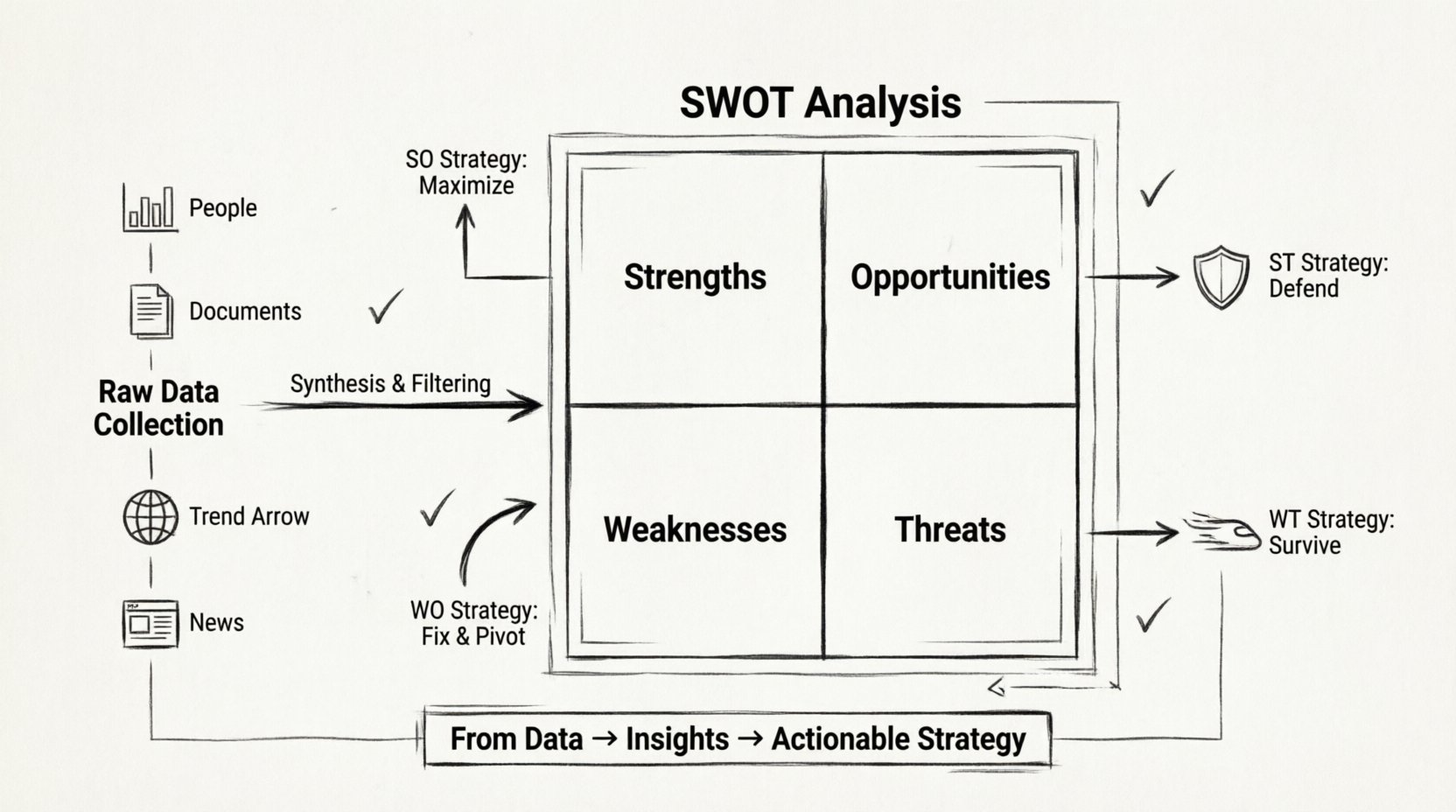
Strategic planning often begins with a mountain of information. Organizations collect metrics, feedback, market reports, and internal performance reviews daily. The challenge lies not in gathering this data, but in transforming it into a coherent plan that drives results. A SWOT analysis provides the framework for this transformation. It structures chaos into clarity, allowing teams to evaluate their current standing against future possibilities.
This guide details the process of moving from unstructured information to a concrete strategy. We will explore how to identify internal capabilities and external pressures, how to filter out noise, and how to formulate actions that address real risks and opportunities. By following a disciplined approach, you can ensure that your strategic decisions are grounded in evidence rather than intuition.
Before diving into the specifics of the analysis, it is essential to understand what this framework actually achieves. It is not merely a list of pros and cons. It is a diagnostic tool designed to map the current environment against potential futures. The goal is alignment: ensuring that internal resources match external demands.
When executed correctly, this process reduces the risk of strategic drift. It prevents the organization from pursuing opportunities it cannot support or ignoring threats that could destabilize operations.
The core of this methodology relies on categorizing information into four distinct quadrants. Each quadrant represents a specific type of variable affecting the organization. Confusion often arises when these categories are mixed. Keeping them distinct is vital for accurate analysis.
| Category | Focus | Nature | Examples |
|---|---|---|---|
| Strengths | Internal | Positive | Proprietary technology, skilled workforce, strong cash flow |
| Weaknesses | Internal | Negative | High turnover, outdated infrastructure, limited brand recognition |
| Opportunities | External | Positive | Emerging markets, competitor failure, regulatory changes favoring you |
| Threats | External | Negative | New regulations, supply chain disruptions, rising material costs |
Notice the distinction between internal and external. Strengths and Weaknesses exist within the organization’s control. Opportunities and Threats exist outside of it. This distinction dictates how you respond to them.
The first phase of data collection focuses inward. You must gather information about the organization’s current state. This requires honesty and a willingness to confront uncomfortable truths. If the data is biased toward positivity, the resulting strategy will be flawed.
Numbers provide an objective baseline. Look for historical data that highlights trends over time.
Numbers tell you what happened; people tell you why. Gather feedback from various levels of the organization.
Compile this information into a central repository. Ensure that every claim is backed by evidence. Avoid phrases like “we think” or “it feels like.” Use “data shows” or “records indicate.”
Once the internal picture is clear, shift focus outward. The organization exists in an ecosystem. Changes in this ecosystem can render internal strengths obsolete or create new avenues for growth.
Understand the direction of the industry. What are competitors doing? Where is the market moving?
Broader economic conditions impact all organizations. These factors are rarely controllable but must be accounted for.
When documenting external factors, verify the source. Rely on industry reports, government publications, and reputable news outlets rather than speculation.
Gathering data is only half the work. The next step is analysis. This involves sorting the raw information into the four quadrants and, more importantly, identifying the connections between them. A list of items is not an analysis. A list of relationships is.
Not every data point is relevant. During this phase, you must distinguish between signal and noise.
Look for correlations across the data. For instance, if customer complaints (Weakness) coincide with a new competitor entering the market (Threat), the combination is dangerous. If employee morale (Strength) aligns with a new market demand (Opportunity), the combination is powerful.
Ask critical questions during this synthesis:
This stage often requires multiple workshops. Diverse perspectives prevent blind spots. A sales team might see a market trend that finance teams miss. An engineering team might identify a technical limitation that marketing overlooks.
The final output of a SWOT analysis must be a set of actions. Strategy without execution is merely a wish list. This phase involves matching the quadrants to create specific strategic initiatives.
Use Strengths to take advantage of Opportunities. This is the ideal scenario for growth.
Use Opportunities to overcome Weaknesses. This requires investment and change.
Use Strengths to mitigate Threats. This is about risk management.
Minimize Weaknesses to avoid Threats. This is often the hardest quadrant but critical for stability.
Once strategies are defined, assign ownership. Every action item needs a specific owner and a deadline. Without accountability, strategic plans dissolve.
Even with a robust framework, errors occur. Awareness of common mistakes helps maintain the integrity of the process.
Strategic planning is a cycle, not a destination. To keep the analysis effective, it must be integrated into the operational rhythm of the organization.
Establish a schedule for revisiting the analysis. Quarterly reviews are common, but the frequency depends on the volatility of the industry. In fast-moving sectors, monthly updates might be required.
Share the findings with the wider organization. Transparency builds trust. When employees understand the strategic context, they make better daily decisions that align with the broader goals.
The duration depends on the size of the organization and the complexity of the data. A focused workshop might take a few hours, but gathering the data and refining the strategy can take several weeks. Do not rush the data collection phase; accuracy is more important than speed.
Yes. The framework applies to individuals as well as corporations. You can assess your skills (Strengths), areas for improvement (Weaknesses), job market trends (Opportunities), and competition (Threats) to guide your career trajectory.
Conflicting data is common. It indicates a need for deeper investigation. Do not discard data that contradicts your hypothesis. Instead, use it to refine your understanding of the situation. Disagreement in data often reveals the complexity of the market.
No. It is a complementary tool. Financial models provide numerical projections, while SWOT provides context and strategic direction. Use them together for a comprehensive view.
Moving from raw data to actionable strategy requires discipline. It demands that you look at the organization honestly and look at the market realistically. The SWOT framework is a proven method for structuring this thought process. By adhering to the steps outlined here, you can build a strategy that is resilient, focused, and capable of delivering tangible results.
Remember that the value lies not in the document itself, but in the conversations it sparks and the actions it triggers. Use this tool to navigate uncertainty and guide your organization toward sustainable growth.