
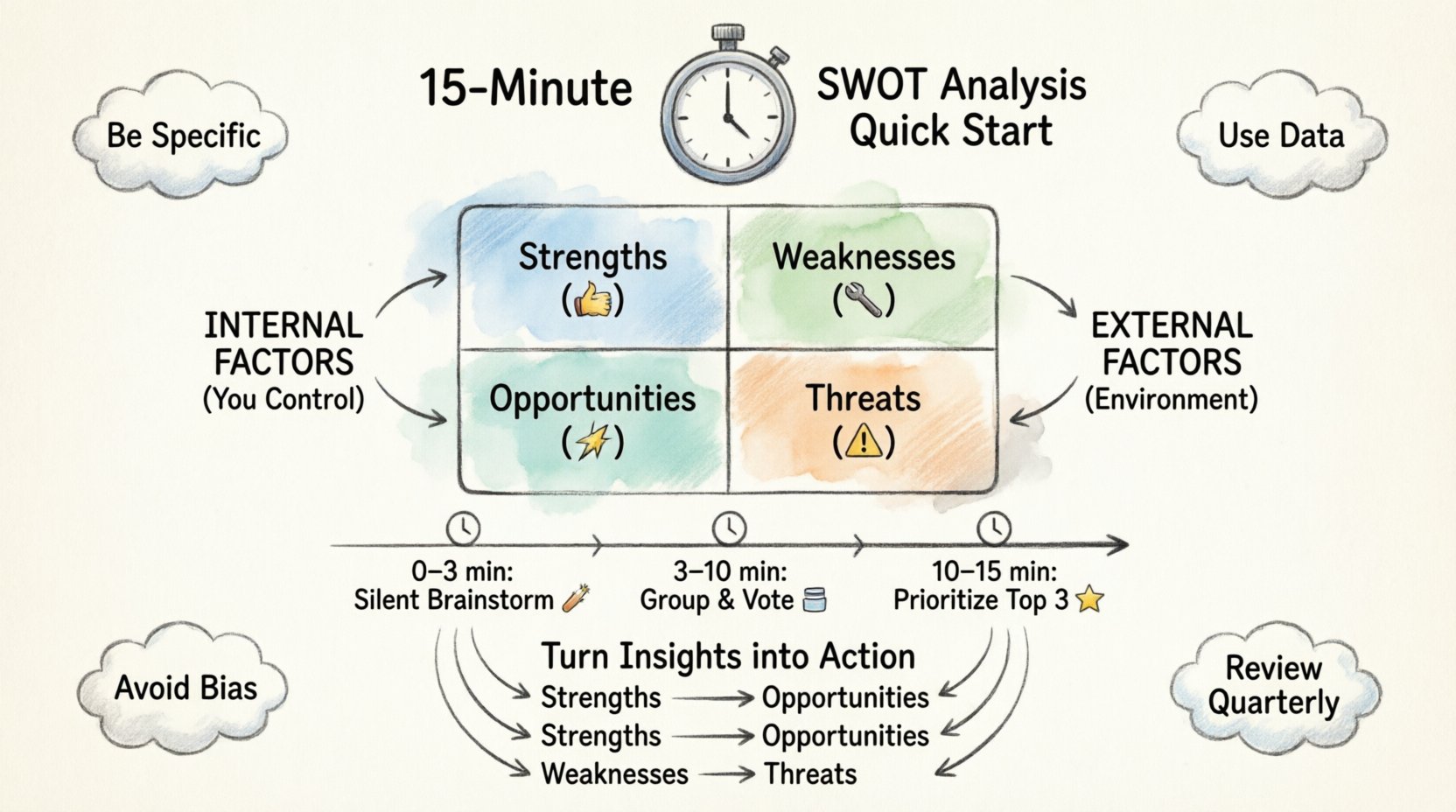
Strategic planning often feels overwhelming. You might worry about long meetings, complex spreadsheets, or vague outcomes. This guide changes that perspective. A SWOT analysis is a fundamental tool for understanding your current position. It does not require expensive consultants or hours of debate. With focus, you can complete a meaningful review in a short timeframe.
This document provides a structured approach to conducting a SWOT analysis. We will break down the four core components, identify common traps, and show you how to translate findings into actionable steps. The goal is clarity, not complexity.
The acronym stands for Strengths, Weaknesses, Opportunities, and Threats. It is a simple matrix that separates internal factors from external factors. This distinction is the key to accuracy.
Confusion often arises when teams mix these categories. For example, a new tax law is an external threat, not an internal weakness. Keeping this boundary clear ensures your analysis remains objective.
Each section of the matrix serves a specific purpose. Here is what to look for in each area.
What do you do better than anyone else? This is not about what you hope to do. It is about what you are doing well right now.
Where do you lack resources or face limitations? This section requires honesty. Identifying a weakness is not a failure; it is a prerequisite for improvement.
What trends can you leverage? These are chances to grow or improve that exist in the environment around you.
What obstacles stand in your way? These are risks that could damage performance or growth if ignored.
Use this reference to ensure you categorize items correctly during your session.
| Category | Control Level | Focus Area | Example |
|---|---|---|---|
| Strengths | Internal (High) | Capabilities | Experienced management team |
| Weaknesses | Internal (High) | Limitations | Limited marketing budget |
| Opportunities | External (Low) | Market Trends | Rising demand for remote work tools |
| Threats | External (Low) | Risks | New competitor entering the region |
Before starting the timer, gather the necessary elements. You do not need a conference room. You need focus.
Include individuals with different perspectives. A sales lead sees opportunities differently than a finance officer. However, keep the group small. Five to seven people is ideal for a 15-minute session. Too many voices dilute the focus.
Are you analyzing the entire organization? A specific department? A new product launch? A specific goal? Narrowing the scope prevents the analysis from becoming too broad to be useful.
Bring any relevant documents. Sales reports, customer feedback, market research, or past performance reviews. Do not rely solely on memory. Data grounds the discussion in reality.
Timeboxing is essential. When you have a deadline, you cut the fluff. Follow this schedule strictly.
Start with individual thought. Everyone writes down ideas for all four quadrants. Do not discuss yet. This prevents groupthink and allows introverted team members to contribute equally. Use a blank sheet or digital board.
Share ideas aloud. Place them in the correct quadrant. If an item does not fit, move it. If multiple people suggest the same point, group them. This creates a prioritized list without endless debate.
Not all points are equal. Select the top three items for each quadrant. These are your critical focal points. If you try to fix everything, you fix nothing.
Even with a structured approach, errors happen. Avoid these common mistakes to maintain the integrity of your analysis.
Creating the list is only half the work. The value lies in connecting the dots. This is where strategy happens.
How can you use what you are good at to capitalize on a market trend? If you have a strong tech team (Strength) and there is a demand for AI integration (Opportunity), prioritize that development path.
What internal advantages can help you survive a risk? If cash flow is strong (Strength), you can weather a supplier price hike (Threat) better than your competitors.
What limitations prevent you from growing? If you want to expand internationally (Opportunity) but lack multilingual staff (Weakness), hiring or training becomes a priority.
What internal flaws expose you to danger? If your security protocols are outdated (Weakness) and cyberattacks are rising (Threat), upgrading security is urgent.
Context matters. A local bakery requires a different analysis than a software startup. Here are two scenarios.
How do you know this was worth the time? Look for the following indicators after the 15 minutes are up.
Without documentation, the work is lost. Store the results in a shared location. Ensure the team knows where to find it when planning next quarter.
Human judgment is prone to bias. In a fast-paced session, confirmation bias is common. This happens when you only look for information that supports what you already believe.
This analysis is not an island. It feeds into your larger planning cycle. Use the results to inform your goals.
Markets change. A SWOT analysis from last year may be obsolete today. Set a schedule for review.
When you review, compare the new findings against the old ones. Did you improve the weaknesses you identified? Did the threats materialize? This tracking turns a static document into a living strategy.
Complexity often hides simple truths. The power of this tool lies in its simplicity. It forces you to look at your business honestly. It separates what you can control from what you cannot.
By dedicating 15 minutes to this process, you gain a snapshot of your position. You identify where to push and where to hold. You move from reactive problem-solving to proactive planning. This shift is the foundation of sustainable growth.
Start with the 15-minute timer. Keep the discussion focused. Prioritize the top three items in each section. Take action immediately on the highest priority. The result will be a clearer path forward without the noise of confusion.