
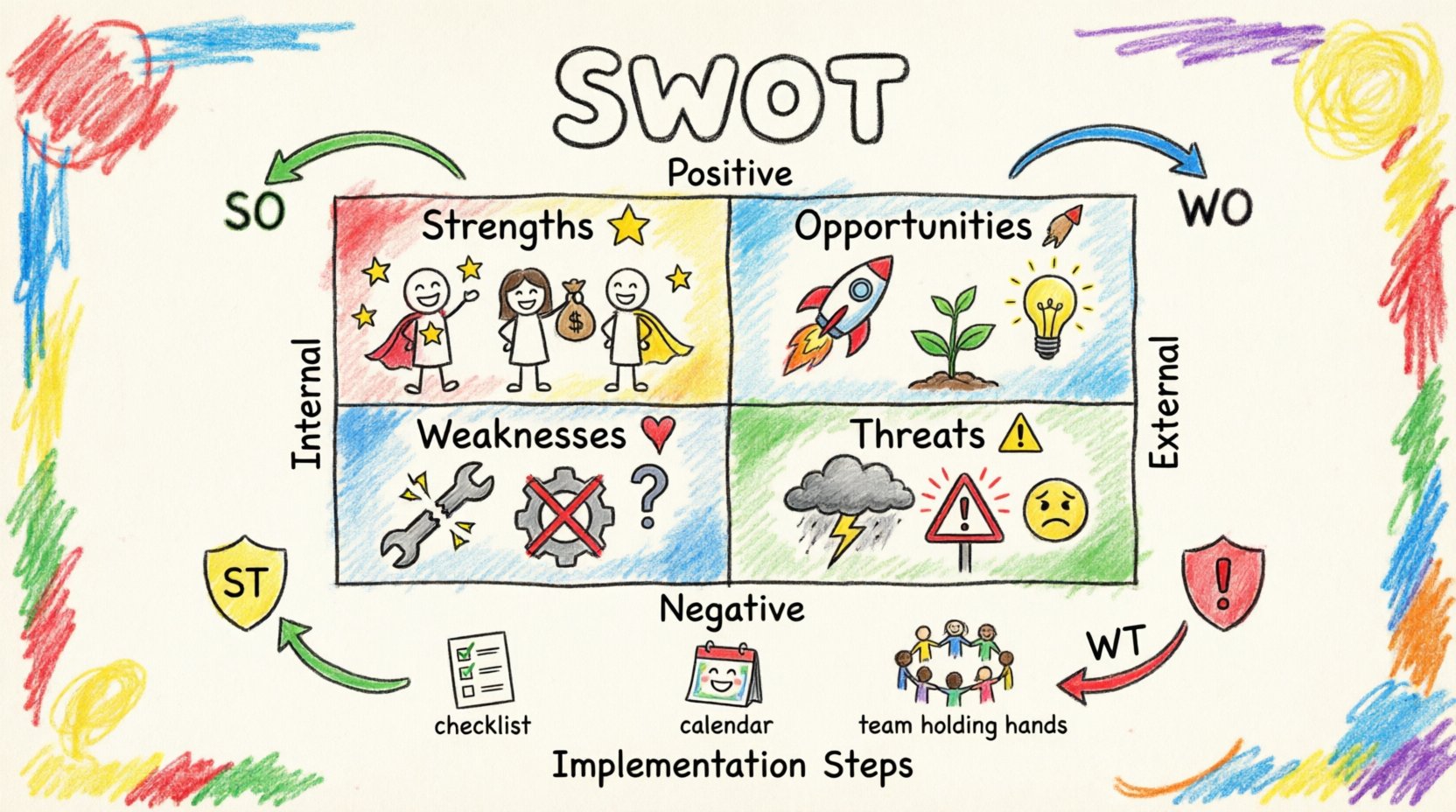
Strategic planning requires a clear view of where an organization stands today and where it intends to go tomorrow. The SWOT analysis remains one of the most enduring frameworks in business management. It provides a structured method to evaluate the internal and external factors influencing performance. This guide details the component breakdown of a robust SWOT analysis, ensuring every real business can utilize the tool effectively.
Without a solid framework, strategic initiatives often drift. Teams may focus on immediate fires rather than long-term stability. A well-executed analysis anchors the organization in reality. It balances optimism with caution. This document explores the four pillars: Strengths, Weaknesses, Opportunities, and Threats.
The framework divides factors into two categories: Internal and External. It also categorizes them by nature: Positive and Negative. This creates a 2×2 matrix that guides decision-making.
Combining these creates the four quadrants. Each quadrant requires specific attention and distinct data sources.
Strengths represent the internal positive attributes. These are the resources and capabilities that give the organization an advantage over others. Identifying these requires honest self-assessment. It is easy to overestimate capabilities. Objective data is necessary.
| Category | Example Description |
|---|---|
| Human Capital | Highly skilled workforce with specialized certifications. |
| Technology | Proprietary software or efficient manufacturing processes. |
| Brand Reputation | Strong loyalty and high customer retention rates. |
| Financial Health | Strong cash flow and low debt-to-equity ratio. |
Strengths should be leveraged to capitalize on opportunities. They are the foundation upon which growth is built.
Weaknesses are internal negative attributes. These are areas where the organization lags behind competitors or lacks necessary resources. Identifying weaknesses is often difficult due to internal bias. It requires a critical eye.
| Category | Example Description |
|---|---|
| Market Presence | Low brand awareness in key demographics. |
| Operations | Inefficient supply chain or slow delivery times. |
| Financial | High overhead costs or limited access to capital. |
| Product | Limited product range or poor quality control. |
Addressing weaknesses reduces risk. It prevents internal issues from becoming external threats. Prioritizing fixes is essential.
Opportunities are external positive conditions. These are trends or events in the market that the organization can exploit. They exist outside the organization but can be influenced.
| Category | Example Description |
|---|---|
| Demographics | Aging population creating demand for specific services. |
| Technology | Adoption of new platforms opening new sales channels. |
| Economic | Growth in disposable income in target markets. |
| Regulatory | New laws requiring compliance services we can offer. |
Opportunities must be matched with strengths. Without the internal capacity to act, external chances are lost.
Threats are external negative conditions. These are challenges that could cause trouble for the business. They are largely outside the organization’s control.
| Category | Example Description |
|---|---|
| Competition | New entrants with lower pricing models. |
| Economic | Inflation raising material costs significantly. |
| Technology | Rapid shifts rendering current infrastructure useless. |
| Supply Chain | Geopolitical instability disrupting logistics. |
Threats require mitigation strategies. The goal is not to eliminate them, as that is often impossible, but to reduce their impact.
A SWOT analysis is not just a list. It is a tool for strategy. The TOWS matrix connects the components to generate actionable strategies. It moves from analysis to execution.
Use Strengths to maximize Opportunities. This is the ideal scenario. It involves aggressive growth.
Overcome Weaknesses by taking advantage of Opportunities. This is about improvement and adaptation.
Use Strengths to minimize Threats. This is defensive but proactive.
Minimize Weaknesses and avoid Threats. This is a survival mode.
Subjective opinions often cloud the analysis. Data validation is crucial. Relying on gut feeling leads to inaccurate assessments.
Validation ensures the components are factual. It prevents bias from skewing the results.
Many organizations fail to execute SWOT analysis effectively. Understanding common mistakes helps avoid them.
Generic statements like “good service” lack utility. Specificity is key. Instead of “good service,” write “24/7 support response time under 1 hour.”
Placing a competitor’s action under Weaknesses is incorrect. Competitors are external. If you cannot compete, that is a weakness. If the competitor is stronger, that is a threat.
Not all factors are equal. A critical weakness that threatens survival is more important than a minor one. Rank items by impact and urgency.
The business environment changes. A one-time analysis becomes obsolete quickly. Regular updates are required to maintain relevance.
When everyone agrees too quickly, blind spots emerge. Encourage diverse perspectives. Include voices from different departments.
Analysis without action is merely academic. The output of the SWOT must drive decisions.
Each strategy derived from the TOWS matrix needs an owner. Someone must be accountable for execution. Ambiguity kills progress.
Strategies require deadlines. Long-term goals need milestones. Short-term goals need immediate targets.
What budget is needed? What personnel are required? Ensure resources are available before committing to the plan.
Regular reviews track performance. Did the strategy work? Did the threat materialize? Adjust the plan based on real-world feedback.
A SWOT analysis is a living document. It should be reviewed periodically. The frequency depends on the industry volatility.
For fast-moving industries, quarterly reviews are standard. They catch rapid shifts in the market.
For stable industries, an annual review may suffice. It aligns with fiscal planning cycles.
Major events trigger immediate updates. A merger, a new regulation, or a supply chain disruption requires an instant re-evaluation.
SWOT works best when combined with other strategic tools. It provides context for deeper analysis.
PESTLE expands on the Opportunities and Threats sections. It covers Political, Economic, Social, Technological, Legal, and Environmental factors.
This framework deepens the Threat analysis. It looks at industry competition, supplier power, buyer power, and substitute products.
The BCG Matrix helps categorize products based on market share and growth. It complements the Strengths and Weaknesses evaluation of specific business units.
Clarity is the primary benefit of this framework. It forces the organization to confront reality. It removes the illusion of invincibility. It highlights the path forward.
When these components are balanced, the organization moves with purpose. The risk of failure decreases. The potential for success increases.
This guide provides the structure. The execution depends on the team. Consistency is the key to long-term strategic success. Regular practice of these components builds organizational resilience.
Remember, the goal is not perfection. The goal is informed decision-making. Use this breakdown to guide your planning. Ensure every real aspect of the business is considered. This diligence pays dividends in stability and growth.
Strategic planning is a continuous journey. Tools like this are the compass. They do not walk the path, but they show the direction. Keep the analysis current. Keep the team engaged. Keep the focus on value creation.