
Process visualization is a critical component of effective business analysis. Among the various tools available, activity diagrams stand out as powerful instruments for mapping out workflows. However, technical representations often create barriers when communicating with stakeholders who do not possess formal training in system modeling. Understanding activity diagram interpretation is essential for bridging the gap between technical specifications and business requirements.
This guide provides a comprehensive approach to reading, analyzing, and explaining activity models. We will explore the core elements, common symbols, and strategies for translating technical logic into clear business value. By the end of this document, you will have a robust framework for facilitating discussions around process flows without relying on jargon.
An activity diagram functions similarly to a flowchart but carries specific semantic meaning within system modeling. It captures the dynamic behavior of a system. Unlike a static data model, this visual tool illustrates how actions move from one state to another. It is particularly useful for:
When stakeholders request a review of a process, they are often looking for validation of the logic. They want to know if the flow matches their mental model of how work should be done. Your role as the interpreter is to verify that the diagram accurately reflects the intended operations and to communicate any deviations clearly.
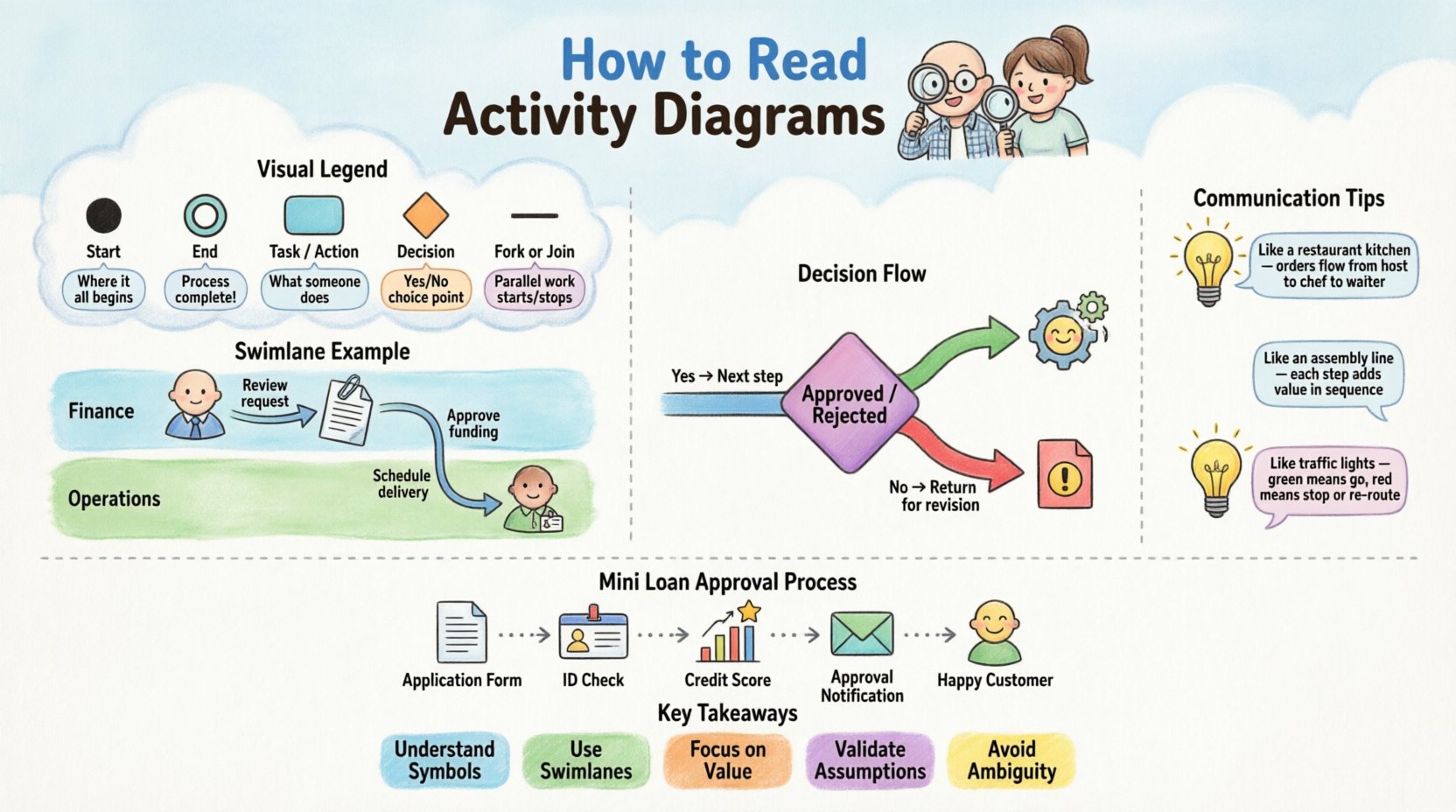
Before explaining the diagram to others, you must be fluent in its syntax. The diagram relies on specific shapes and lines to convey meaning. Below is a breakdown of the fundamental components you will encounter.
| Symbol Shape | Technical Name | Business Meaning |
|---|---|---|
| Black Circle | Initial Node | The starting point of the process |
| Double Ring | Final Node | The successful completion of the process |
| Rounded Rectangle | Activity / Action | A specific step or task being performed |
| Diamond | Decision Node | A point where a choice must be made (Yes/No) |
| Bar | Fork / Join | Parallel actions or synchronization points |
| Circle with ‘X’ | Acceptance / Guard | Conditions that must be met to proceed |
Notice that the visual elements are abstract. The rounded rectangle represents work, but it does not specify who does it or how long it takes. This abstraction allows the diagram to remain high-level. When interpreting these models, focus on the sequence and the logic rather than the implementation details.
Once you understand the symbols, the next step is tracing the path. A linear flow is easy to follow, but real-world processes often branch and merge. You need to track how data and control move through the diagram.
Swimlanes are horizontal or vertical partitions that divide the diagram by category. Typically, these categories represent roles, departments, or systems. When you look at a diagram with swimlanes, you can instantly see where accountability shifts.
When explaining this to a stakeholder, point to the boundary line. Ask, “Does this step belong to the Finance team or the Operations team?” If the diagram shows a step in the wrong lane, it indicates a breakdown in the defined responsibilities. This is a common area for improvement.
Decision nodes introduce branching paths. A line leaving a diamond shape represents a condition. It is crucial to label these lines clearly. Common labels include “Approved” and “Rejected” or “Yes” and “No”.
Without clear labels, the path becomes ambiguous. As an interpreter, you must verify that:
Guards are conditions placed on the lines themselves. They act as filters. If the guard is true, the flow continues. If false, the flow stops or diverts. This is vital for error handling and edge cases in business logic.
The most challenging part of activity diagram interpretation is translating technical notation into business language. Stakeholders often find the symbols intimidating. Your goal is to make the model feel familiar.
Analogies are powerful tools for simplification. Compare the activity diagram to a process they already know. For example:
By anchoring the diagram to a known concept, you reduce cognitive load. This allows stakeholders to focus on the logic rather than the symbols.
Stakeholders care about outcomes, not shapes. When presenting the diagram, shift the conversation from “This is a diamond” to “This is where we check for budget approval.”
Structure your explanation around the business value:
Do not get bogged down in the mechanics of the drawing. Ensure the narrative aligns with the strategic goals of the organization.
Advanced interpretation involves looking for inefficiencies within the flow. A well-structured diagram should guide you toward optimization opportunities.
Loops occur when the flow returns to a previous step. In business terms, this often represents a retry mechanism or an approval cycle. While necessary in some cases, excessive loops indicate friction.
When you see a loop, ask the stakeholders: “How many times does this typically happen?” If it happens frequently, the process might need redesigning to prevent the loop from occurring in the first place.
Fork and Join bars indicate parallel processing. This means multiple activities happen at the same time. This is often where performance gains are found.
However, concurrency can introduce complexity. Ensure that the Join bar waits for all incoming paths before proceeding. If one path is significantly slower than the others, the entire process is delayed. This is a critical insight to share with technical teams.
Not every diagram is clear. Some models are overly dense or lack necessary detail. As an interpreter, you must manage this complexity without overwhelming the audience.
If a diagram is too large to understand at a glance, use decomposition. Break a complex activity into a sub-diagram. This creates a high-level view and a detailed view.
This approach allows stakeholders to see the forest without getting lost in the trees. It keeps the conversation manageable.
Diagrams often omit implicit assumptions. You must surface these assumptions during interpretation. For example, a diagram might show a step “Send Email” but not specify what happens if the email fails.
Create a list of assumptions and validate them with the team:
Documenting these assumptions prevents future disputes when the system behaves unexpectedly.
Before finalizing your interpretation, you must validate the model. Verification ensures the diagram matches the requirements. Validation ensures it solves the business problem.
Conduct a walkthrough with the subject matter experts. Walk through the diagram step-by-step. Ask them to confirm if the flow matches their daily work.
This collaborative approach builds trust. It shows stakeholders that their input is valued and that the model is a shared artifact, not just a technical document.
Ensure that every activity in the diagram can be traced back to a requirement. If a step exists in the diagram but has no business justification, it should be questioned. Conversely, if a requirement has no corresponding activity, the process is incomplete.
Maintain a simple mapping table:
| Requirement ID | Diagram Activity | Stakeholder Confirmation |
|---|---|---|
| REQ-001 | Submit Form | Confirmed |
| REQ-002 | Validate Data | Confirmed |
This traceability ensures that the model remains aligned with the project goals throughout the lifecycle.
Even experienced analysts make mistakes when creating or interpreting activity diagrams. Being aware of common errors helps you maintain high standards.
Regular audits of the diagrams can catch these issues early. Schedule periodic reviews to ensure the models remain accurate as the business evolves.
Let us apply these concepts to a real-world scenario. Consider a loan approval process. The activity diagram would start with a customer application.
When explaining this to a bank manager, you would not say, “The decision node checks the boolean flag.” Instead, you would say, “We have a checkpoint to ensure the person applying is real. If they are, we check their credit history. If not, we ask for more ID.” This translation makes the model accessible and actionable.
Interpreting activity diagrams is a skill that combines technical knowledge with communication expertise. It requires a deep understanding of the symbols, but more importantly, it requires empathy for the audience.
By focusing on clarity, using analogies, and validating assumptions, you can turn complex models into clear roadmaps for business success. The goal is not just to draw a diagram, but to ensure everyone understands the process it represents.
With these strategies, you will be well-equipped to handle activity diagram interpretation in any professional setting. The models become tools for alignment rather than barriers to understanding.
 Activity Diagram Checklist: 15 Steps to Ensure Flawless Requirement Documentation
 Activity Diagram Best Practices for Business Analysts and Requirements Engineers
 Building Better Requirements: The Role of Activity Diagrams in Early Stages
 Activity Diagram Fundamentals: A Beginner’s Roadmap to Professional Modeling