
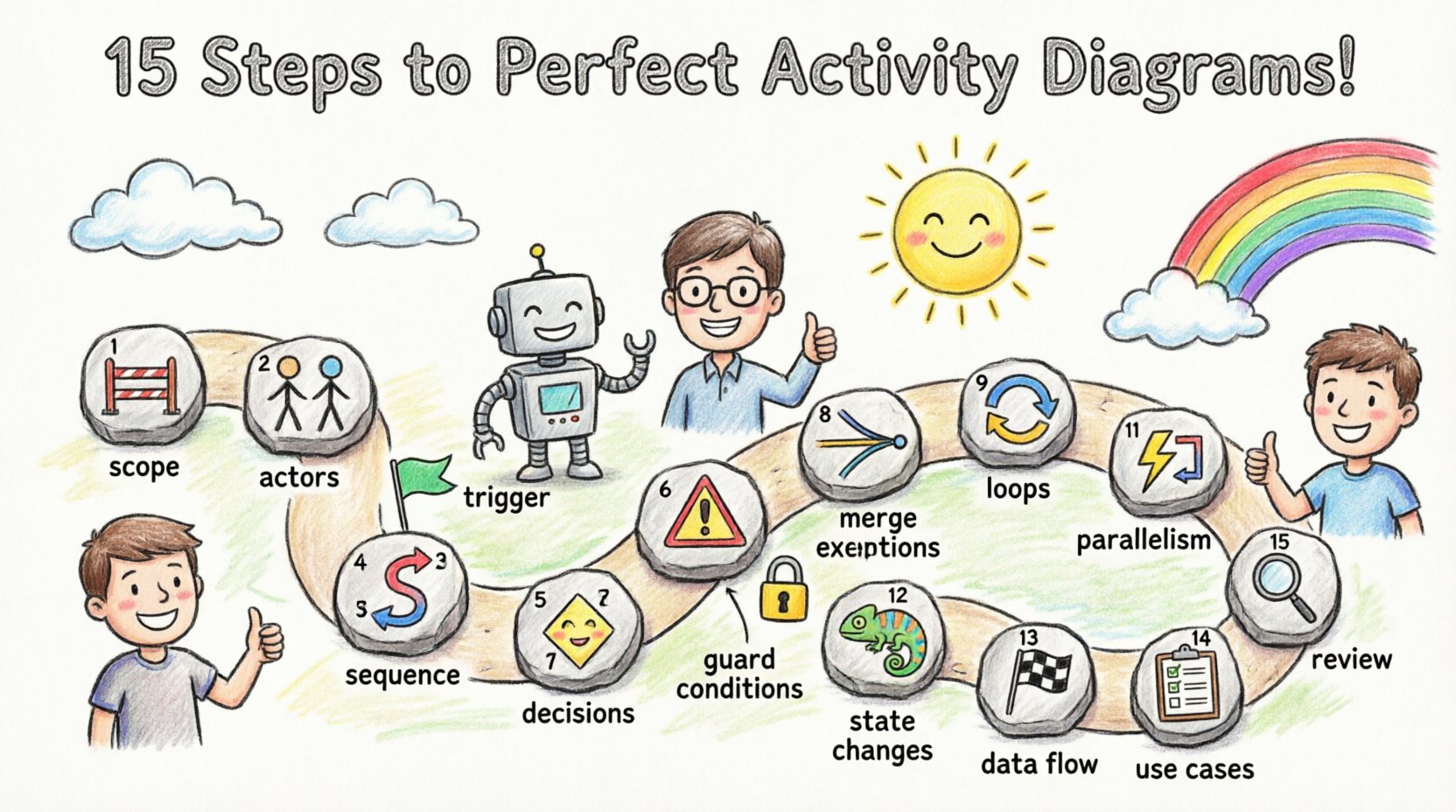
Creating a robust activity diagram is a foundational task in system analysis and design. These visual models bridge the gap between abstract business needs and concrete technical specifications. Without a rigorous validation process, diagrams can introduce ambiguity into the development lifecycle. This guide provides a 15-step checklist to verify the integrity of your requirement documentation. Each step focuses on a specific aspect of modeling, ensuring that logic flows are accurate, complete, and consistent.
Activity diagrams represent the dynamic behavior of a system. They illustrate the flow of control from start to finish. Stakeholders rely on these diagrams to understand processes. Developers use them to implement logic. If the diagram is flawed, the software may fail to meet user expectations. Therefore, a checklist is essential for quality assurance.
When requirements are documented visually, communication gaps between business analysts and engineering teams are reduced. A well-structured diagram clarifies complex workflows that text alone might obscure. It highlights decision points, parallel processes, and data dependencies. This clarity reduces the risk of rework during implementation. By adhering to a structured checklist, you ensure that the model serves as a reliable contract between stakeholders.
The following steps outline the critical checks required to validate an activity diagram. Proceed through these sequentially to identify gaps in logic or representation.
Before drawing a single node, clearly establish where the process begins and ends. The scope defines the limits of the system behavior being modeled.
Why it matters: Unclear boundaries lead to scope creep. Developers may implement features outside the intended workflow. Explicit boundaries prevent confusion about system responsibility.
Every activity involves an agent performing the action. Distinguish between human actors and system components.
Why it matters: Ambiguity in responsibility causes errors in authorization logic. If an action is not assigned, it may be overlooked during development.
A process does not start spontaneously. It requires a specific event or input.
Why it matters: Without a defined trigger, the system state is unknown. This is crucial for automated testing and event-driven architectures.
Ensure the main flow of events follows a logical chronological order.
Why it matters: Logical sequencing ensures the system behaves predictably. Random jumps break the user experience and data integrity.
Real-world processes involve choices. These must be represented explicitly.
Why it matters: Missing decision points result in rigid systems that cannot handle exceptions or variations in user input.
Guard conditions specify the boolean logic required to proceed along a path.
Why it matters: Vague conditions lead to unpredictable system behavior. Precise logic is required for unit testing.
Systems rarely run without errors. The diagram must account for failure paths.
Why it matters: Ignoring exceptions creates brittle software. Robust requirement documentation includes error handling strategies.
Parallel or alternative paths often converge back into a single flow.
Why it matters: Unmerged flows create orphaned processes. This confuses the state management of the application.
Repetitive actions require proper loop logic.
Why it matters: Infinite loops cause system hangs. Clear termination logic is a critical performance requirement.
Some processes happen simultaneously. These require fork and join nodes.
Why it matters: Incorrect parallelism modeling leads to race conditions. Data consistency depends on proper synchronization.
Actions transform data. These transformations must be visible.
Why it matters: Data integrity is the backbone of the system. Missing data flows result in null reference errors in code.
Entities change states during the process. These transitions must be tracked.
Why it matters: State management affects user experience and data storage. Incorrect transitions lead to data corruption.
The process must end cleanly.
Why it matters: Dead ends imply unfinished processes. This indicates a gap in the requirement logic.
The diagram should reflect the functional requirements.
Why it matters: Disconnection between use cases and diagrams leads to incomplete features. Traceability is key for compliance.
The final check ensures the diagram is understandable.
Why it matters: A confusing diagram defeats the purpose of documentation. Clarity ensures maintainability for future developers.
Even experienced modelers make mistakes. The table below highlights frequent errors and how to correct them.
| Error Type | Description | Correction |
|---|---|---|
| Unmatched Forks | Parallel branches do not join back together. | Verify that every fork has a corresponding join node. |
| Missing Guards | Decision nodes lack condition labels. | Add boolean expressions to all outgoing edges. |
| Orphaned Nodes | Activities with no incoming or outgoing flow. | Connect nodes to the main flow or remove them. |
| Ambiguous Triggers | Start node has no defined event. | Specify the external event or user action triggering the start. |
| Data Mismatch | Data objects change type between actions. | Ensure input and output data types are compatible. |
Completing the checklist is not the end of the process. Validation requires review cycles.
Iterative refinement ensures the model evolves with the requirements. Static documentation becomes obsolete quickly. Continuous validation keeps the diagram relevant.
Activity diagrams are powerful tools for clarifying complex systems. They translate text-based requirements into visual logic. By following a disciplined 15-step checklist, you minimize the risk of errors. The effort invested in validation pays off during the implementation phase.
Remember that the goal is clarity, not complexity. A simple, accurate diagram is better than a complex, ambiguous one. Adhere to the standards, respect the logic, and ensure every flow is accounted for. This approach builds trust with stakeholders and provides a solid foundation for engineering success.